11ty vs Astro: A CTO’s decision guide for content sites that won’t stay “just marketing”
11ty vs astro: how CTOs should choose between Eleventy and Astro
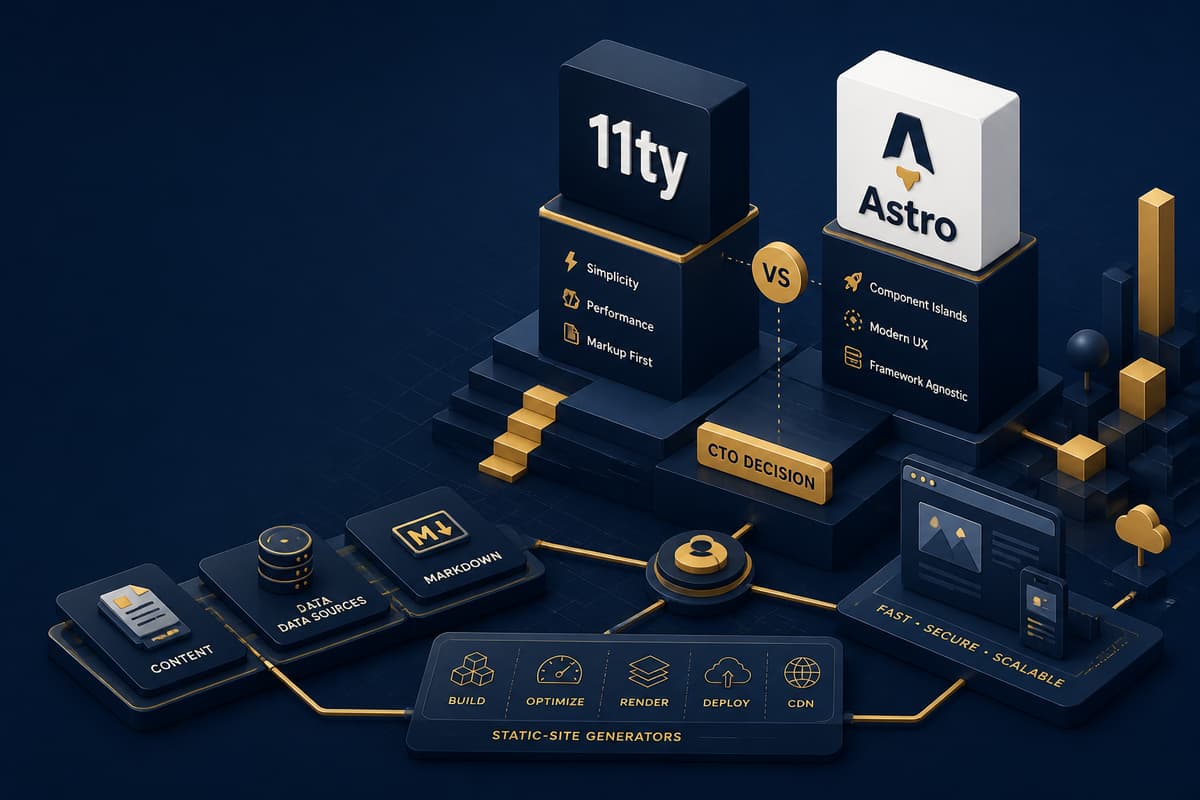
Table of Contents
11ty vs astro: how CTOs should choose between Eleventy and Astro
Astro went from roughly 500 GitHub stars in 2020 to 40,000+ by 2024, and it passed older SSGs in the Netlify State of Web Development 2023 survey (7,000+ respondents) according to a DEV Community analysis published on Apr 10, 2025. That kind of growth matters because content sites don’t stay “side projects” for long. Docs drive adoption. SEO pages drive pipeline. Status pages shape trust.
Here’s my thesis. Pick 11ty when you want the smallest surface area and the fastest builds. Pick Astro when you want a component system, a clean path to interactivity, and more guardrails as the team grows.
11ty vs Astro: what are you buying, and what are you owning
Eleventy (11ty) is a JavaScript static site generator. It turns templates and content into HTML and mostly stays out of your way.
Astro is a content-focused web framework. It also generates static HTML, but it comes with a component model, asset tooling, and a clear interactivity model.
Both tools can ship “zero JS by default” pages, and both can pull content from Markdown, APIs, or a headless CMS. Astro calls out that overlap in its own migration guide from Eleventy, which is a good sign for portability (Astro docs on migrating from Eleventy).
Here’s the cleanest way I’ve found to explain the difference to other execs.
Quotable definition: The Ownership Surface Area rule
A site tool’s ownership surface area is the sum of build tooling, runtime behavior, and team conventions you must maintain for three years.
11ty keeps that surface area small. Astro increases the surface area, and in return you get more built-in structure.
What 11ty gives you
- Template flexibility. 11ty supports multiple template languages.
- Build speed. 11ty markets “best in class build performance” and publishes benchmark tables.
- Low dependency weight. 11ty’s install footprint is smaller than Astro in published comparisons.
11ty’s performance page cites a July 2022 benchmark building 4,000 Markdown files. Eleventy clocks 1.93s and Astro clocks 22.90s in that dataset (Eleventy performance docs). The same page cites install comparisons from February 2023. Eleventy shows 34 MB node_modules and 5.81s npm install. Astro shows 169 MB and 12.52s.
What Astro gives you
- Component model. Astro components and layouts give teams a shared structure.
- Islands architecture. Astro loads interactive components only where needed.
- Bundling and assets out of the box. Astro handles CSS and JS bundling without custom glue.
- A path to SSR. Astro can do SSG and SSR, which matters when content starts behaving like an app.
A comparative study notes Astro’s “islands architecture” and describes the hybrid model as a way to keep initial display fast while still supporting dynamic features (SCIRP comparative study). CloudCannon also frames Astro as the better fit if you expect the project to evolve toward an app, and it calls out Astro’s built-in asset handling and SSR option (CloudCannon 11ty vs Astro).
The line I use with exec teams is blunt: a docs site is a product surface. Treat the stack like product infrastructure.
Which is faster and cheaper to run: build times, install times, and Core Web Vitals
CTOs ask “which is faster” and usually mean three different things: build time, dev loop time, and user-perceived performance.
Build time: 11ty wins more often than people admit
For sites in the hundreds to a few thousand pages, 11ty often wins on build time.
A real-world benchmark from Piper Haywood used 770 posts and about 2,550 built pages. The average of 10 builds showed Astro at 10.07 seconds and Eleventy at 4.29 seconds (Piper Haywood benchmark).
Eleventy’s docs also publish a “4,000 Markdown files” benchmark where Eleventy beats Astro by a wide margin (Eleventy performance docs). That dataset is older, but the direction matches what plenty of teams see.
Build time sounds like a developer convenience until you run CI on every PR. A 6 second delta across 80 PRs a day burns hours of engineer wait time each week.
Install time and dependency weight: 11ty keeps CI lean
Dependency weight shows up in cold CI runners and in supply chain risk.
Eleventy’s performance page cites 34 MB node_modules for Eleventy versus 169 MB for Astro, and 5.81s install versus 12.52s in that comparison (Eleventy performance docs).
A smaller tree also makes audits simpler. Security teams scan fewer packages. Platform teams get more reliable caching.
User performance: Astro’s defaults help teams hit CWV targets
Astro’s pitch lands when you care about Core Web Vitals and you have mixed skill levels on the team.
A DEV Community post cites Core Web Vitals stats where Astro “consistently demonstrates a high percentage of origins with good CWV scores” and often sits near the top tier with Next.js and Gatsby (DEV Community Astro rise). The same post points to Netlify’s 2023 survey where Astro passed older SSGs.
Astro’s islands model also blocks a common failure mode. Marketing asks for one interactive pricing calculator. A dev drops in a full client framework bundle. Lighthouse scores fall off a cliff, and SEO traffic follows.
A CTO can prevent that drift with architecture rules, but Astro makes the “interactive only where needed” behavior easier to teach and easier to review.
How to choose 11ty vs Astro for docs, marketing, and programmatic SEO
Most CTOs I talk to get stuck on the same problem: the site starts small, then it quietly turns into a platform.
The decision usually comes down to three questions.
Do you want a UI component system, or do you want templates
11ty works well when you want templates and content, and you don’t want a UI framework story.
Astro works well when you want components, and you want to share those components across teams.
A personal migration write-up from Random Geekery captures the trade. Astro has “more explicit paths” and a “golden path,” but stepping off that path can leave you searching forums and repos for clues (Random Geekery Astro impressions).
That matches what I see in orgs with 30 to 200 engineers. Opinionated structure speeds onboarding. The same structure creates sharp edges when you need custom behavior.
How much type safety do you want in content
Astro’s content collections plus Zod schemas give you build-time validation. That matters once content starts acting like data.
Index.dev notes Astro content collections with Zod schemas surface type errors at build time, while Eleventy is “JavaScript loose by default” (Index.dev comparison). Sandro Roth also calls out schema validation with Zod as a benefit after migrating from Eleventy to Astro (Sandro Roth migration).
Type safety pays off when:
- Product marketing ships 50 pages a week.
- Docs teams add new frontmatter fields for versioning.
- SEO teams generate 10,000 pages from a catalog feed.
A broken frontmatter field should fail the build, not ship a blank page.
How big will the site get, and how often will it change
Programmatic SEO changes the math. A site can jump from 200 pages to 25,000 pages in a quarter.
Gautam Khorana’s comparison page gives examples like HostList at 25k pages and Deluxe Astrology at 91k pages, and it frames Astro as a default for SEO-heavy sites (Gautam Khorana comparison). Treat those examples as directional, not as a guarantee.
The scaling pattern is real. Once you generate pages from data, you start caring about caching, partial rebuilds, and strict content contracts.
Piper Haywood notes Eleventy incremental builds exist since December 2022, but CI support remains a gap, and Astro’s incremental caching story can be hard to test apples to apples (Piper Haywood benchmark).
And here’s the question I ask teams: what happens when marketing wants daily rebuilds across 50 locales? The build system becomes production.
The CTO decision matrix: pick the tool that fits your org, not your taste
I use a simple matrix in exec reviews because it forces trade-offs into the open.
The SSG Fit Matrix (Ownership Surface Area edition)
| Criterion | 11ty (Eleventy) | Astro |
|---|---|---|
| Build speed on small to mid sites | Strong, often faster in practice | Good, but can be slower on pure Markdown builds |
| Install footprint and CI cold start | Smaller dependency tree in published comparisons (11ty perf) | Larger dependency tree in published comparisons (11ty perf) |
| Component model for design systems | Possible, but you build conventions | Built in component model |
| Interactivity model | You wire it yourself | Islands model, interactive only where needed (SCIRP study) |
| Content contracts and validation | You build it, or rely on tests | Content collections plus Zod schemas (Index.dev) |
| Hiring and ecosystem pull | Smaller job market | Larger job market and usage signals (Index.dev) |
| “Golden path” onboarding | Light, flexible | Stronger defaults, but sharper edges off path (Random Geekery) |
A CTO can score each row 1 to 5 for your org, then pick the tool with the higher total.
Most “Astro vs 11ty” posts miss the leadership cost. Tool choice changes who can ship safely. Tool choice changes how many rules you need.
Enterprise implications: why 11ty vs Astro shows up in risk, hiring, and continuity
-
Supply chain exposure changes with dependency weight. Astro’s larger dependency tree can increase audit work and patch churn. 11ty’s smaller footprint can reduce that load. Security teams care about this, even for “just a site.”
-
Hiring and staffing plans shift. Index.dev estimates 800 to 1,200 job postings mention Astro, versus 100 to 200 for Eleventy, and it lists about 3,500 Stack Overflow questions tagged Astro versus 1,500 to 2,000 for Eleventy (Index.dev comparison). Those numbers are noisy, but the direction is useful for workforce planning.
-
Shadow deployments become more likely with flexible stacks. 11ty’s flexibility invites “every team builds their own trail,” as Random Geekery put it (Random Geekery Astro impressions). That can lead to five different template patterns across one org. Astro’s structure can reduce that drift.
-
Business continuity depends on build pipelines. A content site often becomes the top funnel. A broken build blocks launches. A slow build blocks hotfixes. Treat the SSG pipeline like a tier one service.
If your org already uses The Art of CTO’s Command Center to track incidents and tech debt, add the marketing and docs build pipeline as a tracked system. Put it next to your APIs and queues. The pipeline breaks more often than you think.
CTO recommendations: what to do in the next 30 days
Immediate Actions
-
Inventory the site’s “product surface.” List pages, locales, build frequency, and owners. Put numbers on it. A site with 2,500 pages and daily rebuilds is not a toy.
-
Run a build benchmark on your real content. Use a representative export, like 500 to 1,000 posts plus tags and pagination. Piper Haywood’s 770 post test is a good template for methodology (Piper Haywood benchmark).
-
Set a Core Web Vitals budget. Pick targets for LCP, INP, and CLS. Then gate merges with Lighthouse CI. Astro’s CWV track record can help, but budgets keep teams honest.
-
Decide who owns the site as a system. Put an engineering manager on it, not a rotating volunteer. Use our guide to incident postmortems for customer facing outages to set expectations for blameless reviews when the pipeline breaks.
Policy Framework
-
Content contract policy. Define required frontmatter fields, allowed types, and validation rules. Astro can enforce this with content collections and Zod. 11ty can enforce it with tests and build scripts.
-
Interactivity policy. Define when client-side JS is allowed. Require a written reason for any global bundle. Astro’s islands model makes the policy easier to implement.
-
Dependency policy. Require lockfile updates on a schedule and track high-risk packages. Tie this to your broader supply chain program.
If you already use our Build vs Buy Matrix for vendor choices, reuse the same rubric for SSG plugins and integrations. A plugin is a vendor with no contract.
Architecture Principles
-
Build pipeline as a service. Treat build time, cache hit rate, and deploy time as SLOs. Track them in our Engineering Metrics Dashboard alongside DORA metrics.
-
Design system boundaries. If you pick Astro, define a component library and a review process. If you pick 11ty, define template partials and naming rules.
-
Content as data. Model content types in an architecture diagram. Use our ArchiMate Modeler to map content sources, build steps, and deploy targets. That map pays off during migrations.
-
Migration path policy. Keep content in portable formats. Astro’s own Eleventy migration guide highlights shared foundations like Markdown and headless CMS inputs (Astro migration docs). Use that portability as a guardrail.
Bigger picture: static sites are now part of your go to market system
Astro’s rise isn’t just hype. The ecosystem signals show momentum. Index.dev cites 4 to 5 million weekly npm downloads for Astro, and it lists companies like The Guardian, Porsche, and Trivago using Astro for marketing sites and docs (Index.dev comparison). CloudCannon also notes Astro outpacing Eleventy in download numbers despite being newer (CloudCannon 11ty vs Astro).
11ty keeps winning in a quieter way. Teams pick it when they want speed, control, and fewer moving parts. Teams also pick it after trying Astro and hitting content or integration friction, like the rkblog.dev migration story that preferred 11ty’s HTML handling and frontmatter consistency (rkblog.dev migration).
The strategic call isn’t “which tool is better.” The strategic call is whether your org wants a stronger framework with a clearer path to interactivity, or a smaller tool that demands more internal conventions.
So which system do you want to own for the next three years: a lean build tool, or a content framework with a bigger surface area?
Sources
- The Rise of Astrojs in 2025 (DEV Community)
- Comparative Study of React, Astro and Eleventy (SCIRP)
- Astro vs Next.js vs Eleventy: Framework Comparison 2026 (Index.dev)
- Starting 2025 With Astro (Random Geekery)
- Eleventy (11ty) vs. Astro (CloudCannon)
- Migrating blog to a static site generator: 11ty versus Astro (rkblog.dev)
- Migrating from Eleventy (Astro Docs)
- Inexactly benchmarking Eleventy vs Astro build times (Piper Haywood)
- Performance (Eleventy Docs)