Agentic Systems Are Becoming an Enterprise Runtime: Governance, Reliability, and Ops Are Catching Up
Agentic software is rapidly becoming an enterprise runtime: teams are standardizing governance, knowledge supply chains, and production infrastructure to make multi-agent, multi-model systems...
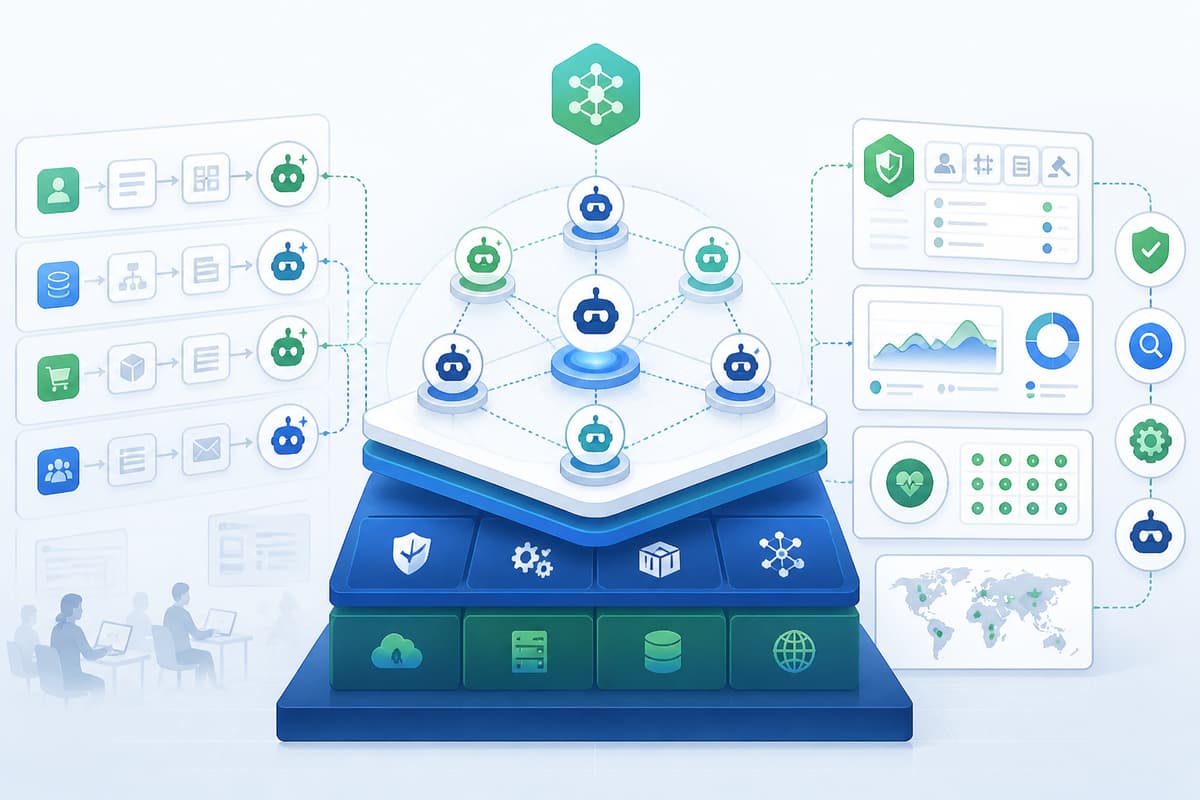
The last wave of AI adoption was about adding copilots to existing workflows. The next wave is about agents that take actions—executing code, operating browsers, moving data, and triggering production changes. In the last 48 hours, multiple sources signaled the same inflection point: agentic systems are graduating from demos to enterprise runtimes, and the bottleneck is no longer model capability—it’s governance, reliability, and operations.
On the platform side, Databricks is explicitly framing the “agentic era” as multi-model, multi-agent, and multi-vendor—and responding with governance building blocks rather than just model hosting. Their updates around Unity Catalog and Unity AI Gateway emphasize centralized controls for access, policy, and oversight across heterogeneous AI usage, while Agent Bricks positions agent development as something that should be standardized and repeatable inside the data platform rather than handcrafted per team (Databricks: “What’s new with Unity Catalog…”, “AI governance… Unity AI Gateway”, “Agent Bricks”). Snowflake’s parallel push—Dynamic Tables interoperability (including Iceberg) and “AIM” for migration/modernization—reinforces that the data plane is becoming the control plane for AI-enabled workflows, not a separate concern (Snowflake: “What’s New with Dynamic Tables…”, “Snowflake AIM…”).
Meanwhile, the operational reality is catching up. InfoQ’s talk on automating the web with MCP highlights that agentic workloads are bursty, stateful, and security-sensitive, especially when agents need real browser environments. That implies new patterns for multi-tenancy isolation, sandboxing, and capacity management that look more like running a fleet of short-lived, privileged robots than serving stateless APIs (InfoQ: “Automating the Web With MCP: Infra That Doesn’t Break”). And if agents are going to write code, they need a trustworthy knowledge supply chain: Stack Overflow for Agents is a strong signal that we’re entering an era where “docs” and “Q&A” are being repackaged as agent-consumable APIs with provenance and constraints (InfoQ: “AI Coding Agents Get a Stack Overflow of Their Own”).
The organizational consequences are already visible. LeadDev argues that AI is breaking familiar engineering metrics (e.g., throughput proxies) and changing how teams interpret performance, while also reshaping incident dynamics—when an AI agent “blames the network team,” the real challenge becomes accountability and shared mental models across humans and automation (LeadDev: “The 8 software engineering metrics AI broke”, “Your AI agent just blamed the network team. Now what?”). TechCrunch’s coverage of a startup focused on reducing hallucinations and pushing toward deterministic-grade accuracy underscores that reliability is becoming a first-class product category, not a footnote (TechCrunch: “Probably raises $9M to build a more reliable kind of AI”).
What CTOs should take from this: treat agentic AI as a platform shift, not a feature. The winning architectures will separate (1) governance and policy (identity, permissions, audit trails, data boundaries, model/tool allowlists), (2) execution runtimes (secure sandboxes, browser/OS automation, state management, quotas), and (3) knowledge supply chains (curated sources, versioned APIs, provenance). The winning org designs will also update operational norms: redefine “ownership” when actions are taken by automation, evolve incident review to include agent decision logs, and replace simplistic productivity metrics with measures that reflect quality, risk, and learning.
Actionable next steps: (1) Stand up an “agent control plane” roadmap—policy, auditability, and tool access—before agent rollouts scale. (2) Invest in an execution sandbox strategy (browser isolation, secrets handling, tenant boundaries) as seriously as you invest in Kubernetes. (3) Build an internal, versioned knowledge API (or adopt one) so agents don’t scrape tribal knowledge from chat logs. (4) Update engineering metrics and incident processes now—because the moment agents start taking real actions, your old measurement and accountability systems will fail first.
Sources
- https://www.databricks.com/blog/whats-new-unity-catalog-data-ai-summit-2026
- https://www.databricks.com/blog/ai-governance-data-ai-summit-2026-whats-new-unity-ai-gateway
- https://www.databricks.com/blog/agent-bricks-dais-2026
- https://www.infoq.com/presentations/parallel-agents-production/
- https://www.infoq.com/news/2026/06/stack-overflow-for-agents/
- https://leaddev.com/ai/the-8-software-engineering-metrics-ai-broke
- https://leaddev.com/ai/your-ai-agent-just-blamed-the-network-team-now-what
- https://techcrunch.com/2026/06/16/probably-raises-9m-to-build-a-more-reliable-kind-of-ai/
- https://www.snowflake.com/en/blog/whats-new-dynamic-tables-faster-flexible/
- https://www.snowflake.com/en/blog/snowflake-aim-enterprise-migration-modernization/
▶ Interactive tool
Put this into practice — free, no sign-up
Run your own numbers in these interactive tools built for exactly this decision.