AI code review gates: When to replace manual review
AI agents are pushing teams to replace human code review as the main quality gate with automated verification, sandboxing, and policy controls, because agents can ship large volumes of changes faster...
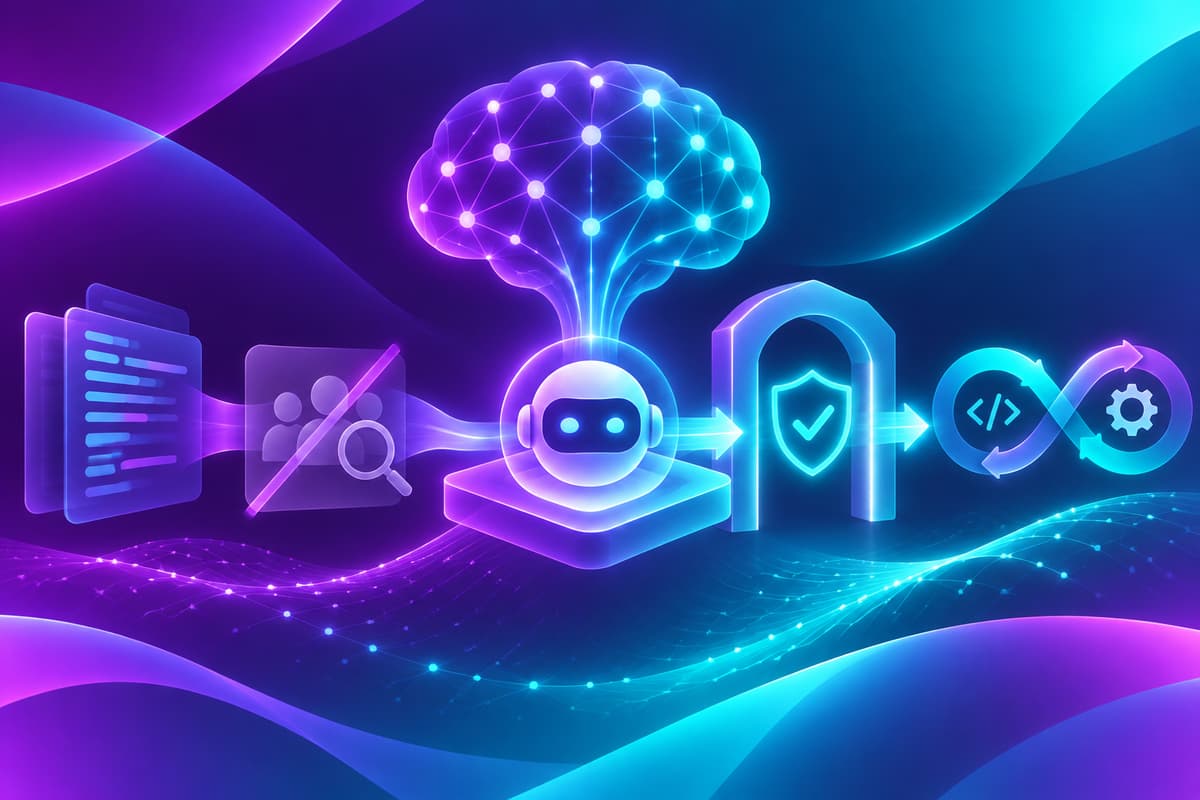
Table of Contents
Decide whether to keep human code review as your primary release gate, or to shift to verification-first gates (tests, sandboxing, policy checks) by the end of Q1 2027. Evidence is piling up that agent-generated change volume is outgrowing human review capacity, and teams are already compensating with batched PRs, layered automated testing, and containment patterns.
At QCon San Francisco 2026, OpenAI described building a $100M product in six weeks using Codex agents with no human-written code, then relying on sandboxes, layered testing, and batched pull requests to control risk (InfoQ on OpenAI’s agent-built ads product). In the same conference coverage, Google framed AI agents as an insider-risk problem at machine speed, pushing identity, credential, and containment patterns into the SDLC (InfoQ on securing AI agents in production). LeadDev, Snowflake, and Stripe all point at the same operational pressure from different angles: context scarcity, review scalability, and a business model that rewards shipping more bespoke software.
"Manual code review" vs "verification gates": what is actually changing?
Manual code review is the practice of requiring a human reviewer to read and approve most changes before merge. Verification gates are automated checks that determine merge and deploy eligibility, typically including unit and integration tests, static analysis, policy checks, sandbox execution, and staged rollouts.
LeadDev’s question, “The end of manual code review?”, cites JetBrains’ CEO predicting a two-year horizon for large parts of review to be automated (LeadDev on the end of manual code review). Treat the prediction as a forcing function, not a timeline guarantee. The near-term reality is simpler: agent-driven throughput makes “read every diff” a bottleneck.
OpenAI’s QCon talk is the clearest signal that teams are already adapting. Agent-generated code was not merged by hoping for the best. OpenAI described sandboxes, layered testing, and batched pull requests as the safety rails that made speed possible (InfoQ on OpenAI’s agent-built ads product). Batched PRs matter because they invert the review problem: reviewers stop validating every line and start validating outcomes, invariants, and test evidence.
The security framing is also shifting. Google’s QCon talk treats agents like privileged insiders that can act quickly and repeatedly, which pushes orgs toward explicit identity, scoped credentials, and containment boundaries for agent actions (InfoQ on securing AI agents in production). A human reviewer cannot compensate for an agent that can run a destructive action loop at 3 a.m.
Why AI coding agents keep failing without context (and what to do about it)
Context is the set of constraints and facts that make a change correct in your system: architecture decisions, domain rules, prior incidents, release constraints, and “how we do things here.” LeadDev argues the hours go into context, not into typing code (LeadDev on AI coding agents lacking context). That claim connects directly to why verification gates are rising.
A CTO problem emerges: context does not scale by adding more humans to review more diffs. Context scales when it is externalized into artifacts the pipeline can enforce.
Three practical moves show up across the sources:
-
Externalize constraints into tests and policies. OpenAI’s layered testing and sandboxing are a context encoding mechanism. A test suite is institutional memory you can execute.
-
Change the unit of review from diffs to intent. Batched PRs push teams to review “what should be true” rather than “what changed.” That only works if the verification evidence is strong.
-
Treat agent actions as governed operations, not just code generation. Snowflake’s framing is explicit: trustworthy agents require a governed data foundation and an agentic control plane (Snowflake on trusting AI agents with a data foundation). The same concept applies to engineering systems: agents need a controlled environment with auditable inputs and outputs.
A short, concrete point. Tests are the new context.
How Stripe’s “software for one merchant” changes your release math
Stripe’s SaaS Platform Summit recap argues AI makes it practical to build custom software and specialized workflows for a single merchant (Stripe on custom software and specialized workflows). That business direction increases change volume and variance. More bespoke workflows mean more branches in behavior, more integration points, and more “small” changes that still carry production risk.
A verification-first SDLC becomes a revenue enabler in that world, because manual review does not scale linearly with customer-specific customization.
The connection to agentic SDLC is direct:
- Per-customer customization encourages smaller, more frequent changes.
- Agents make producing those changes cheap.
- The bottleneck shifts to validation, rollout, and incident containment.
SRE Weekly’s continued focus on incident response and on-call reinforces the operational cost of getting this wrong (SRE Weekly Issue #544). Agentic throughput without stronger gates is a recipe for more pages.
What should replace “LGTM” as the primary control?
“LGTM” is a human assertion. Verification-first pipelines rely on evidence.
Based on the patterns described by OpenAI and Google at QCon, plus Snowflake’s governance framing, a workable control stack looks like this:
-
Agent identity and scoped credentials. Agents should authenticate like services, not like humans. Google’s “insider-risk at machine speed” framing implies strict token scope, short-lived credentials, and explicit authorization boundaries for what an agent can do (InfoQ on securing AI agents in production).
-
Sandboxed execution for risky operations. OpenAI’s use of sandboxes is a reminder that “run it safely” beats “read it carefully” when change volume spikes (InfoQ on OpenAI’s agent-built ads product).
-
Layered tests with escalation rules. A unit test pass should not be enough for a migration or auth change. Gates should be risk-tiered.
-
Review shifts to: (a) spec, (b) risk classification, (c) evidence. Humans stay in the loop, but at a higher leverage point. LeadDev’s warning about misleading metrics applies here too: measuring “review throughput” will not tell you whether the gates are catching the right failures (LeadDev on engineering metrics lies).
-
Auditable traces for agent actions. Snowflake’s emphasis on governed foundations is a proxy for auditability. If an agent proposed a change, you need to reproduce the prompt, context bundle, tool calls, and test evidence.
A short, punchy line. Evidence beats opinions.
What to decide this quarter
-
VP Engineering: set a policy for when human review is mandatory, by January 31, 2027. Trigger: more than 20% of merged PRs in a sprint are agent-authored or agent-edited. Outcome: a written rule set (for example, “auth, billing, data retention, and migrations require human approval plus staged rollout”).
-
Head of Developer Experience: ship a “context bundle” standard for coding agents by February 15, 2027. Trigger: two or more incidents in a month where an agent change violated an unwritten convention. Outcome: a required repo artifact (architecture notes, invariants, runbooks, key ADRs) that tools must attach to agent runs.
-
Security Engineering: implement scoped, short-lived credentials for agent tools by March 1, 2027. Trigger: any agent is allowed to run with a human’s long-lived token, or any tool can reach production without explicit allowlisting. Outcome: service identities, least-privilege permissions, and an audit log for tool calls.
-
SRE Lead: add a sandbox and canary requirement for “high-blast-radius” agent changes by March 15, 2027. Trigger: agent-generated changes touch deployment config, IAM, networking, or data pipelines. Outcome: a pipeline stage that runs the change in isolation and enforces canary analysis before full rollout.
-
CTO: run a 30-day baseline on review capacity vs change volume, starting next sprint. Trigger: median PR review time exceeds 24 hours or reviewers are skipping diffs. Outcome: a decision memo choosing either (a) invest in verification gates, or (b) cap agent-generated change volume until gates exist.
Use the CI/CD Maturity Grader as the tool to quantify which pipeline capabilities you are missing (test depth, deployment controls, and pipeline security), then tie each missing capability to a specific gate you will add before expanding agent throughput.
Sources
- https://www.infoq.com/news/2026/11/qcon-sf-openai-lessons/
- https://www.infoq.com/news/2026/11/qcon-ai-agent-security/
- https://leaddev.com/ai/your-ai-coding-agent-lacks-context
- https://leaddev.com/software-quality/the-end-of-manual-code-review
- https://www.snowflake.com/content/snowflake-site/global/en/blog/trust-ai-agents-data-foundation
- https://stripe.com/blog/custom-software-specialized-workflows-and-other-new-growth-paths-from-saas-platform-summit
- https://leaddev.com/reporting/lies-our-engineering-metrics-tell-us
- https://sreweekly.com/sre-weekly-issue-544/
▶ Interactive tool
Put this into practice — free, no sign-up
Run your own numbers in this interactive tool built for exactly this decision.