AI Coding Agents Are Becoming an Internal Platform (and Policy Is Forcing the Guardrails)
Engineering orgs are shifting from individual AI copilots to internal agent platforms integrated into workflows, while external policy pressure increases the need for governance, testing, and...
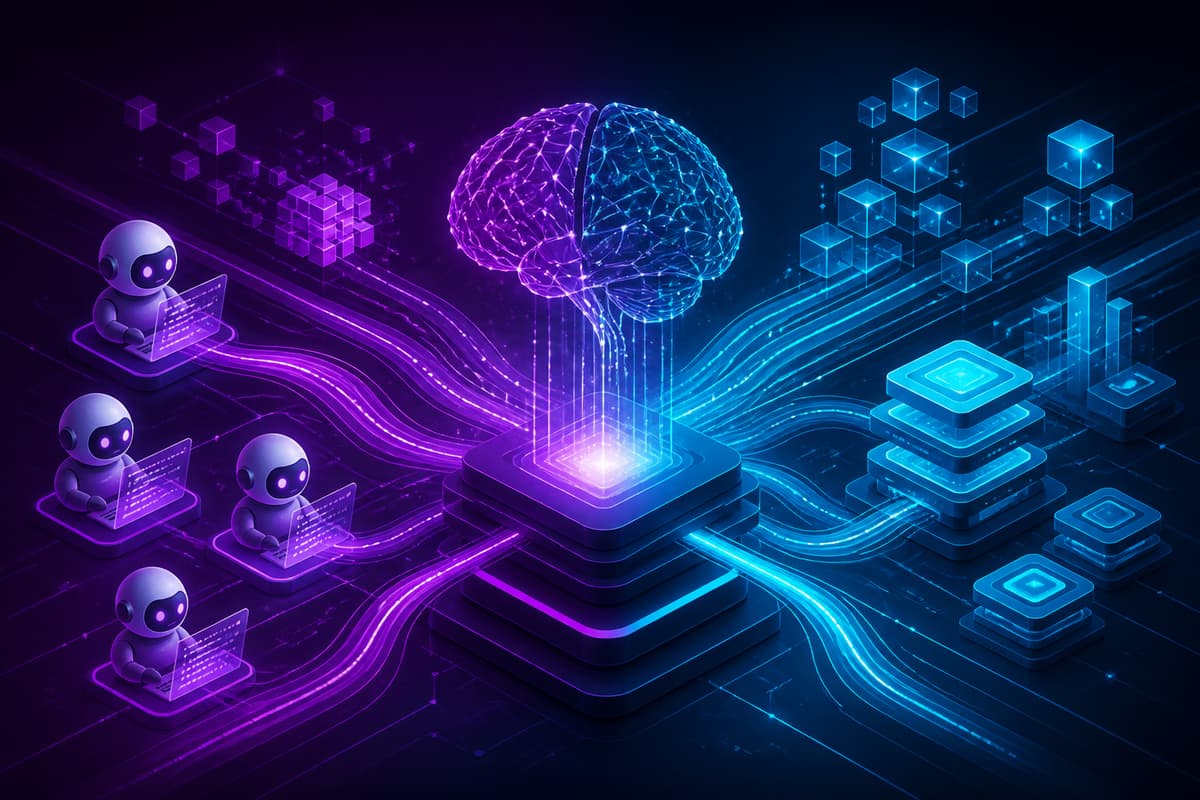
AI coding help is rapidly shifting from “a tool developers use” to “a platform the company operates.” That matters now because the moment agents can run multiple sessions in parallel, trigger automated workflows, and touch production-adjacent systems, they stop being productivity experiments and start looking like a new tier of engineering infrastructure—with the same expectations: reliability, cost control, security, and audit trails.
On the engineering side, Dropbox’s Nova is a concrete signal of this shift: it’s an internal platform designed to run multiple coding sessions in parallel and to let internal systems use agents as part of automated workflows (Dropbox Tech, “Introducing Nova, our internal platform for coding agents”). That’s a different posture than “give everyone a copilot license.” It implies shared primitives (session orchestration, identity/permissions, tool access, logging), plus a product mindset around agent UX and repeatability.
In parallel, the industry conversation is increasingly about productionizing AI rather than demoing it. InfoQ’s coverage of QCon AI Boston highlights sessions explicitly focused on the gap between AI that works in a demo and AI that works in production (InfoQ, “Six Sessions at QCon AI Boston 2026 That Take Productionizing AI Seriously”). The subtext: teams are standardizing on MLOps/LLMOps disciplines—evaluation, rollout controls, incident response, and ongoing measurement—because agent behavior changes over time (model updates, prompt/tool changes, data drift). Even ByteByteGo’s focus on async API patterns is relevant here: agent platforms tend to be event-driven and long-running, and they need robust async patterns (queues, callbacks, sagas) to be dependable under partial failure (ByteByteGo, “A Guide to Async Patterns in API Design”).
What’s new is that policy pressure is starting to align with this engineering reality. The Hill reports California’s executive order aimed at AI job displacement (The Hill, “Newsom signs order aimed at tackling AI job displacement”) and uncertainty around a voluntary AI model testing process at the federal level (The Hill, “Trump postpones long-awaited artificial intelligence order signing”). Regardless of where these land, CTOs should read them as a directional signal: organizations will be asked—by regulators, auditors, customers, and boards—to explain where AI is used, what it’s allowed to do, and what safeguards exist when it fails or causes harm. That pushes internal agent platforms toward stronger governance-by-design.
For CTOs, the strategic implication is to treat agents like you treated cloud a decade ago: centralize the hard parts, decentralize safe usage. Concretely: (1) create an “agent runtime” with opinionated defaults—authn/authz, sandboxing, secrets handling, egress controls, and immutable logs; (2) define evaluation gates (task success metrics, regression suites, red-team prompts) before agents can touch sensitive repos or production workflows; (3) design agent actions as async, observable workflows with idempotency and human-in-the-loop checkpoints for high-risk operations; and (4) plan the FinOps angle early—parallel sessions and tool calls can turn into a new variable cost center fast.
The takeaway: the competitive advantage won’t come from having agents—it’ll come from operating them well. If you don’t build a governed internal platform, you’ll get a shadow ecosystem of prompts, plugins, and scripts with inconsistent permissions and no auditability. If you do build it, you can capture the upside (throughput, faster incident response, better internal tooling) while being ready for the inevitable questions from security, compliance, and regulators about how your AI systems behave in the real world.
Sources
- https://dropbox.tech/machine-learning/introducing-nova-our-internal-platform-for-coding-agents
- https://www.infoq.com/news/2026/05/qconai-boston-2026-talks/
- https://blog.bytebytego.com/p/a-guide-to-async-patterns-in-api
- https://thehill.com/policy/technology/5889582-california-ai-job-losses/
- https://thehill.com/policy/technology/5889379-trump-postpones-ai-testing/
▶ Interactive tool
Put this into practice — free, no sign-up
Run your own numbers in this interactive tool built for exactly this decision.