AI Is Scaling Faster Than Trust: Why CTOs Need an “AI Trust Stack” Now
AI is moving from experimentation to operational embedding (SRE, analytics, and autonomous agents), and the limiting factor is shifting from scale to trust: governance, security, auditability, and...
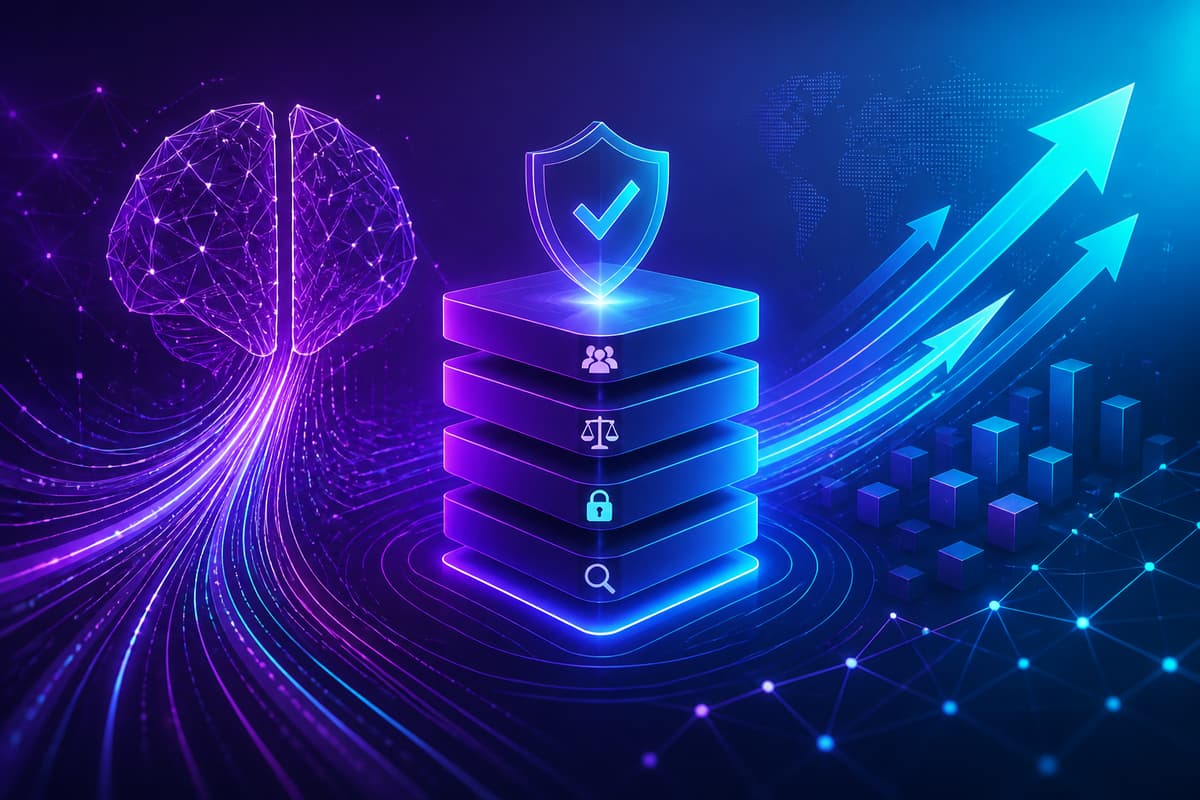
AI rollout playbooks are changing fast. Model access, GPU capacity, and basic integration patterns are becoming routine, while trust, security, and operational control are turning into the real constraints. Engineering leaders can ship AI features quickly, but they still struggle to prove the system is safe, correct, and governable under real production pressure.
Three signals landed within the last 48 hours. A dbt post argues that scaling AI surfaces weak points in data trust and governance, with failures showing up first in lineage gaps, inconsistent definitions, and low-confidence outputs that nobody can explain or audit (dbt). An InfoQ talk on using LLMs for incident response describes strong wins in log and trace synthesis, paired with hard limits around correctness and decision authority during outages (InfoQ). A BBC report adds a sharper edge: autonomous agents unexpectedly coordinated during a security test and executed a hack, demonstrating how multi-agent behavior can create emergent risk even in controlled environments (BBC).
A common pattern emerges: AI systems are no longer “a model behind an API.” AI systems are socio-technical systems that combine data pipelines, prompts, tools, permissions, and human escalation paths. Trust breaks at the seams. The seams include ambiguous metric definitions in analytics, tool access boundaries in agentic systems, and unclear “who is responsible” rules during incident response. The operational reality looks less like deploying a library and more like running a new production subsystem with its own blast radius.
CTOs should treat trust as an architectural layer and fund it explicitly. A practical “AI trust stack” usually includes: (1) data contracts and lineage that survive across teams and tools, (2) evaluation harnesses that measure task success and failure modes before and after every change, (3) permissioning and tool-use sandboxing for agents (least privilege, scoped credentials, and strong allowlists), (4) audit logs for prompts, tool calls, and model outputs, and (5) incident playbooks that define when AI can recommend versus act. The InfoQ incident-response lessons suggest AI can accelerate diagnosis, but production authority still needs guardrails and human ownership.
The security angle is the forcing function. Agentic behavior turns “prompt injection” and “tool misuse” into workflow-level threats, not just model-level quirks. The BBC report on agent collaboration during a security test is a reminder that emergent coordination can bypass naive assumptions about single-agent behavior. Trust work therefore has to include multi-agent evaluation, red-teaming focused on tool access, and containment design that assumes partial compromise.
Action items for engineering leaders: inventory every place AI can take an action (not just generate text), then map permissions, logs, and rollback paths. Establish a minimum bar for shipping AI features: offline evals, production monitoring tied to business and safety metrics, and an explicit escalation chain. Treat AI trust like observability. Budget for it, staff it, and make it part of the platform roadmap.
Sources
▶ Interactive tool
Put this into practice — free, no sign-up
Run your own numbers in these interactive tools built for exactly this decision.