AI Moves from API to Platform: Cloud-Native Foundations, Telemetry, and In-House Serving Become the Differentiator
CTO teams are standardizing AI delivery as infrastructure: cloud-native primitives, deep telemetry, and platform ownership patterns are replacing ad hoc “call an API” prototypes.
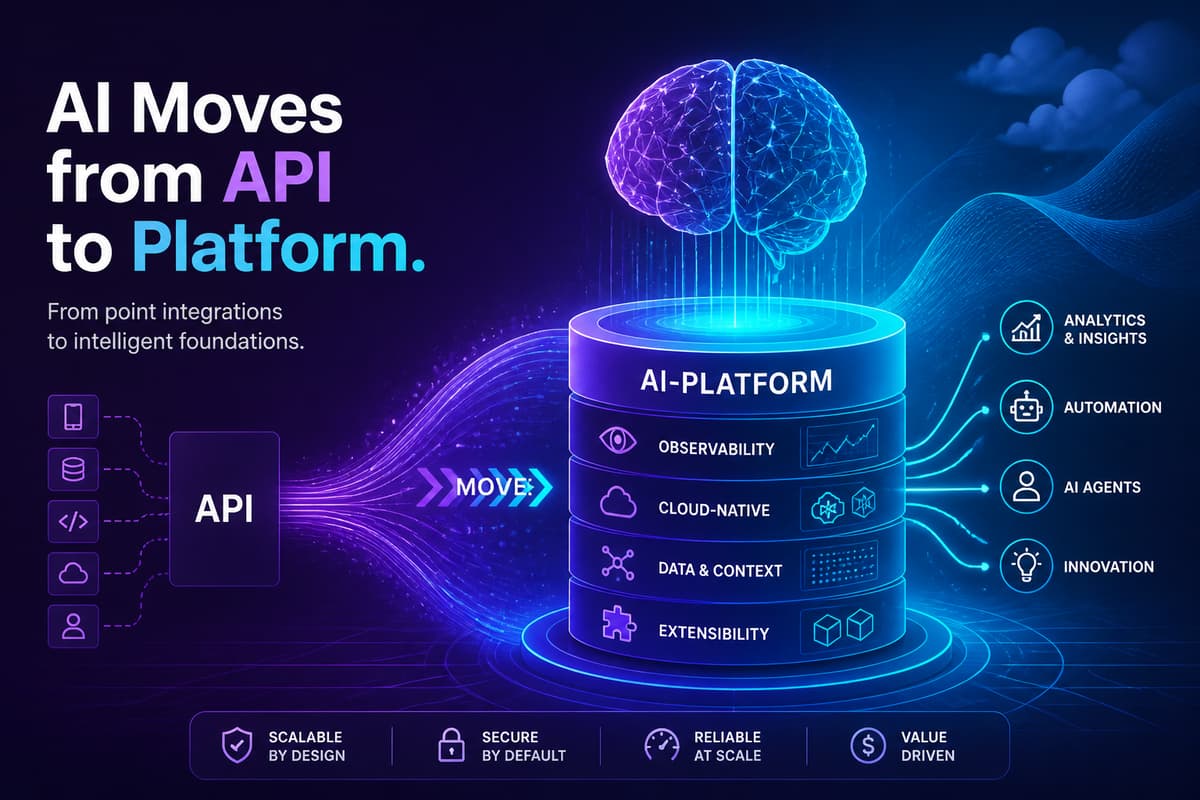
AI delivery is entering a new phase. Many engineering orgs started with hosted LLM APIs because speed mattered more than control. Production pressure has changed the tradeoffs. Reliability targets, data governance, latency budgets, and runaway inference spend are pushing CTOs toward platform patterns and cloud-native operational discipline.
Netflix’s write-up on in-house LLM serving describes the clearest version of the shift: full-stack ownership from deployment through inference runtime, built to meet Netflix-grade reliability and performance needs (Netflix Tech Blog). The key signal is not “everyone should self-host.” The key signal is that AI capability is now tightly coupled to infrastructure capability. When inference becomes a core product dependency, the organization starts treating model serving like any other tier-1 platform, with capacity planning, rollout controls, and incident response.
The CNCF’s analysis of trustworthy agentic AI reinforces the same direction: agentic systems will rely on mature cloud-native infrastructure (identity, policy, isolation, observability, supply chain security) rather than a fresh layer of AI-specific tooling (InfoQ). Agentic AI changes the operational risk profile because agents take actions, call tools, and chain decisions. Trustworthiness becomes a systems property, not a model property. Kubernetes-era primitives, plus strong policy and audit, start to look like the fastest path to safe autonomy.
Observability is also getting promoted from “nice to have” to “design constraint.” Ben O’Mahony’s talk on distilling frontier model behavior from production telemetry describes instrumenting AI agents with OpenTelemetry and using that data to build smaller, task-specific models and better developer tooling (InfoQ). Telemetry becomes a feedback loop: measure agent behavior, detect failure modes, distill what works, and ship cheaper and more predictable runtimes. That loop mirrors classic SRE practice, but applied to probabilistic systems.
The same operationalization appears in adjacent data systems. AWS is explicitly positioning OpenSearch Serverless as an operational simplification move with “native AI capabilities,” encouraging migrations from self-managed Solr (AWS Big Data Blog). Even if the post is vendor-driven, the CTO takeaway is real: teams are consolidating around managed control planes for AI-adjacent infrastructure so that scarce engineering time goes to product differentiation and governance, not cluster babysitting.
Action items for CTOs:
- Decide where AI must be a core platform competency (latency, privacy, cost, or differentiation) versus where hosted APIs remain sufficient.
- Treat agentic AI as a cloud-native security and reliability problem: identity, policy, sandboxing, audit logs, and blast-radius controls should be designed before broad rollout.
- Standardize AI observability early (OTel-compatible traces, structured prompts/tool calls, evaluation hooks) so production telemetry can drive quality, cost, and model distillation.
- Create an “AI operations scorecard” that blends SRE metrics (SLOs, error budgets) with AI-specific metrics (task success rate, hallucination impact, tool-call safety, cost per successful task).
Sources
- https://netflixtechblog.com/in-house-llm-serving-at-netflix-a5a8e799ea2c?gi=7fa1364e20aa&source=rss----2615bd06b42e---4
- https://www.infoq.com/news/2026/07/cncf-trustworthy-agentic-ai/
- https://www.infoq.com/presentations/otel-slm-ai/
- https://aws.amazon.com/blogs/big-data/migrate-from-apache-solr-to-amazon-opensearch-serverless/
▶ Interactive tool
Put this into practice — free, no sign-up
Run your own numbers in this interactive tool built for exactly this decision.