Compliance and Resilience Are Becoming the Same Platform Problem
Cloud architecture and platform engineering are converging around a single mandate: bake compliance, security, and multi-region resilience into paved roads so developers can ship without negotiating...
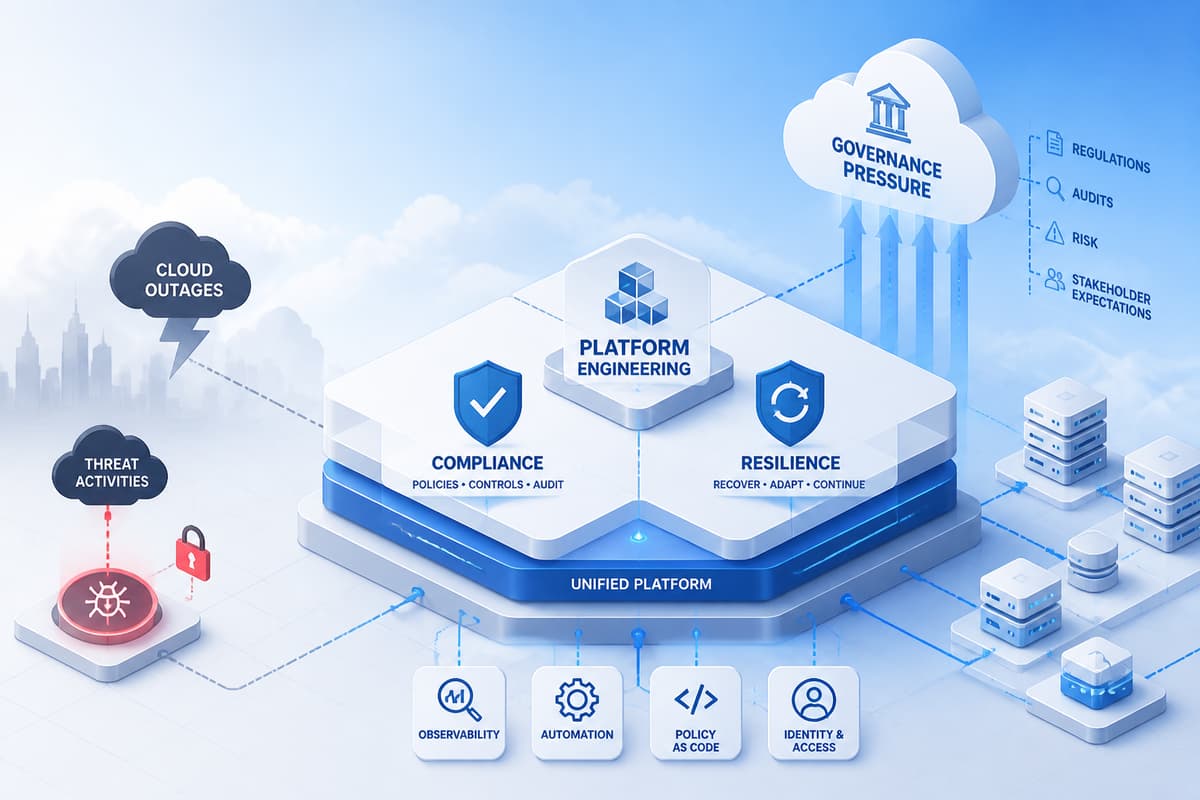
Governance pressure is rising at the exact moment cloud outages and threat activity are forcing more aggressive resilience planning. CTOs are getting squeezed from both sides: regulators and security teams want tighter controls, while product teams want faster delivery. The practical response showing up across recent writing looks less like “more process” and more like “better platforms.”
InfoQ’s talk on rolling out cloud compliance without alienating internal users frames the core organizational tension: platform teams can either become a ticket queue or a product team with adoption, usability, and trust as first-class goals ("Road to Compliance: Will Your Internal Users Hate Your Platform Team?"). Compliance work that lands as friction will be routed around, quietly. Compliance work that lands as defaults will be adopted.
The architectural side of the same trend shows up in InfoQ’s multi-region AWS API story. A supposedly resilient design failed global failover because a hidden pre-flight discovery call created an unexpected regional dependency. The lesson for CTOs is not “audit your code” in the abstract. The lesson is that resilience properties often hinge on small, implicit control-plane calls, SDK behaviors, and signing flows that do not appear in high-level diagrams ("Removing a Hidden Round Trip from a Multi-Region AWS API"). Platform teams increasingly own the guardrails, libraries, and golden paths that prevent those footguns from propagating.
AWS Architecture’s recent case studies reinforce why the platform layer becomes the control point. March Networks describes large-scale video data storage on AWS, and MAPFRE USA describes modernizing fraud claims with Amazon EMR Serverless. Both patterns push teams toward managed primitives, serverless analytics, and standardized pipelines because the operational surface area becomes unmanageable otherwise. The tradeoff is that governance and reliability move “left” into templates, reference architectures, and policy-as-code owned by a platform organization, not ad hoc decisions in every product repo.
Security guidance adds urgency. The UK NCSC advisory notes Russian state actors exploiting poorly configured routers, a reminder that misconfiguration remains a primary attack path and that “secure-by-default” configurations matter as much as detection. A CTO response that scales is to treat configuration baselines, network controls, and identity boundaries as part of the paved road, with continuous validation, rather than relying on developer discretion or periodic audits.
Action for CTOs: (1) merge resilience and compliance roadmaps into a single platform product strategy with explicit adoption metrics, (2) invest in “dependency visibility” (control-plane calls, SDK defaults, signing, DNS and discovery paths) as a resilience requirement, not an SRE nice-to-have, and (3) ship guardrails as defaults in templates and shared libraries, with escape hatches that are reviewed and time-bounded. The key question for the next quarter is simple: does the platform make the safe path the easiest path, or does the organization still depend on heroics and exceptions?
Sources
- https://www.infoq.com/presentations/platform-engineering-team-compliance/
- https://www.infoq.com/articles/aws-multi-region-signing/
- https://aws.amazon.com/blogs/architecture/unlocking-the-future-of-video-data-march-networks-cloud-storage-on-aws/
- https://aws.amazon.com/blogs/architecture/how-mapfre-usa-modernized-fraud-claims-with-amazon-emr-serverless/
- https://www.ncsc.gov.uk/news/uk-and-allies-urge-critical-sectors-to-improve-defences-against-russian-intelligence-targeting
▶ Interactive tool
Put this into practice — free, no sign-up
Run your own numbers in these interactive tools built for exactly this decision.