From AI Assistants to Agent Operations: Governance, Observability, and Team Design Become the Real Work
Engineering organizations are moving from experimenting with AI assistants to operating agentic systems in production, which forces new governance layers: identity, context management, observability,...
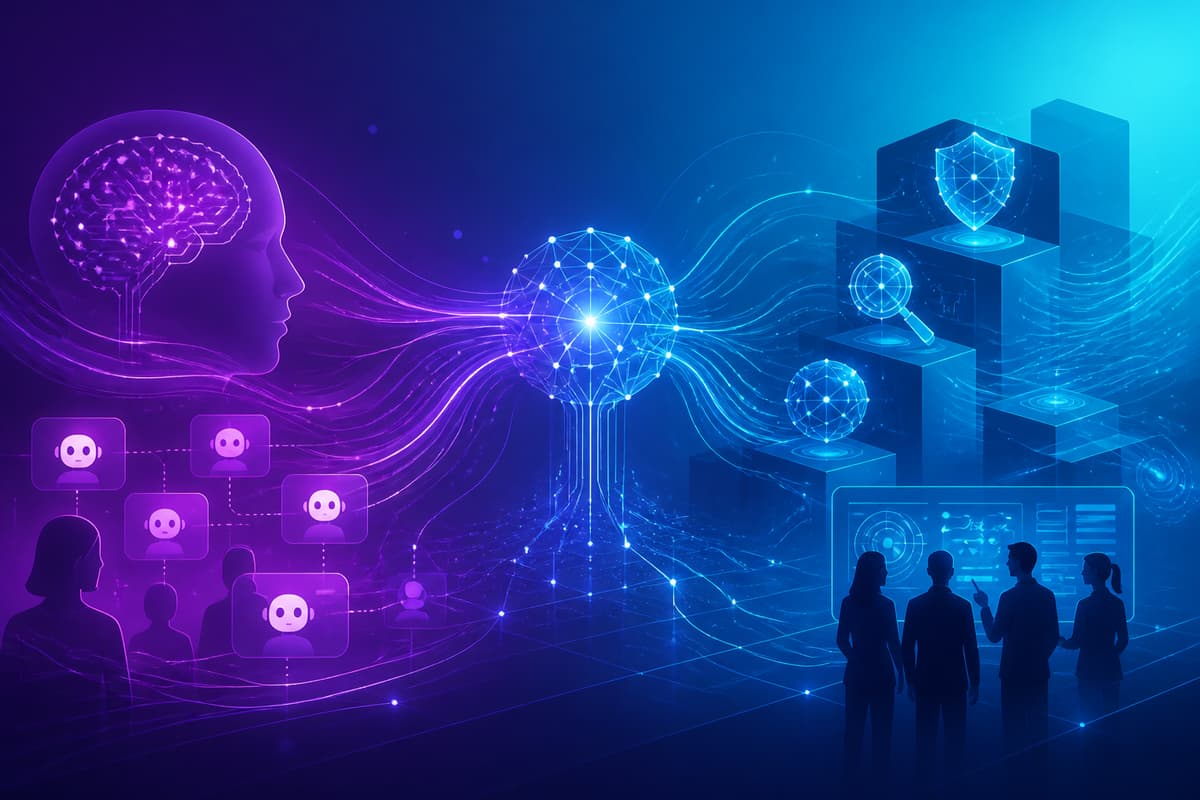
AI adoption inside engineering teams has crossed a line in the last year, and the last 48 hours of writing makes the shift obvious. The conversation is no longer “should developers use an assistant?” The conversation is “how does a company run agentic systems safely, predictably, and collaboratively?” The gap between experimentation and operations is where CTOs are getting squeezed.
Architecture discussions are starting to name a new tax. Martin Fowler’s piece on the orchestrator’s tax argues that multi-agent setups fail in a subtle way: every token in the orchestrator’s context competes for attention, so adding subagents can degrade outcomes even when parallelism looks efficient on paper (MartinFowler.com, “The Orchestrator’s Tax”). That framing matters because it turns agentic design into a resource allocation problem, not a vibes problem. Context becomes a scarce production resource, similar to CPU, memory, and on-call bandwidth.
Security and governance vendors are responding as if agents are about to be everywhere. Snowflake’s Black Hat announcement leans into “agentic controls” and “MCP governance”, including agent identity controls and data exfiltration prevention (Snowflake Blog, “Enterprise AI Security: Agentic Controls and MCP Governance”). The BBC report about publicly accessible Claude conversations adds a concrete failure mode: conversational and prompt data can leak through product settings, indexing, or operational mistakes, and the blast radius includes proprietary code, credentials, customer data, and internal decisions (BBC, “Some people's chats with Claude AI found to be publicly available online”). Agent governance is becoming part of the security program, not an add-on.
Observability is also being pulled into the agent era. Grafana’s expansion of Grafana Assistant to query and correlate across 30+ data sources shows where the market is going: natural-language interfaces that span logs, metrics, traces, and business data (InfoQ, “Grafana Assistant Expands to More Than 30 Data Sources”). Snowflake’s Whatnot case study similarly emphasizes observability and AI analytics to keep up with hyper-growth (Snowflake Blog, “Observability at Scale: Whatnot at Snowflake Summit”). The immediate CTO implication is that “agent reliability” will be judged using the same muscle as SRE, including traceability, auditability, and measurable outcomes. If an agent changes a dashboard query, triggers an action, or proposes a remediation, engineering leaders will need to answer who authorized it, what it saw, and what it touched.
Team design is the overlooked constraint, and LeadDev is surfacing the friction early. The argument that “AI-coding agents kill team collaboration” captures a real failure mode: agents optimize for isolated throughput while teams optimize for shared understanding, review, and coordinated change (LeadDev, “AI-coding agents kill team collaboration”). LeadDev’s companion pieces on engineering managers’ changing job descriptions and the reality of senior engineering reinforce the same direction: leadership roles tilt further toward system orchestration, alignment, and decision hygiene rather than raw code output (LeadDev, “Engineering managers have a new job description”; “The reality of being a senior engineer”). Collaboration becomes a designed process, not an emergent property.
Actionable takeaways for CTOs:
- Treat agents as identities, not features. Require agent authentication, scoped permissions, and auditable actions, and align that work with security leadership (Snowflake’s “agent identity controls” is a useful mental model).
- Budget for context, explicitly. Put architectural guardrails around orchestration depth, context windows, retrieval policies, and handoffs, and measure failure rates as orchestration complexity grows (Fowler’s “orchestrator’s tax”).
- Make agent work observable. Instrument prompts, tool calls, data access, and outcomes, and connect the traces to existing incident response and postmortems.
- Redesign collaboration loops. Define how agent-generated code gets reviewed, how decisions get recorded, and how shared context is maintained so the team does not fragment into “agent operators” working in parallel silos.
The next competitive advantage will not come from having agents. The advantage will come from operating agents with the same rigor applied to production services.
Sources
- https://martinfowler.com/articles/orchestrator-tax.html
- https://www.snowflake.com/en/blog/enterprise-ai-security-agentic-mcp-governance/
- https://www.infoq.com/news/2026/07/grafana-assistant-data-source/
- https://leaddev.com/ai/ai-coding-agents-kill-team-collaboration
- https://www.bbc.co.uk/news/articles/cly5qgjk5ywo
- https://www.snowflake.com/en/blog/observability-at-scale-whatnot-snowflake-summit/
- https://leaddev.com/management/engineering-managers-have-a-new-job-description
- https://leaddev.com/career-development/the-reality-of-being-a-senior-engineer
▶ Interactive tool
Put this into practice — free, no sign-up
Run your own numbers in these interactive tools built for exactly this decision.