Agent-ready architecture: persistent AI workers force identity, governed context, and token economics into the critical path
AI agents are moving from demos to production workflows, pushing teams to build “agent-ready” foundations: persistent runtimes, strong identity, governed context, and token-cost-aware data modeling.
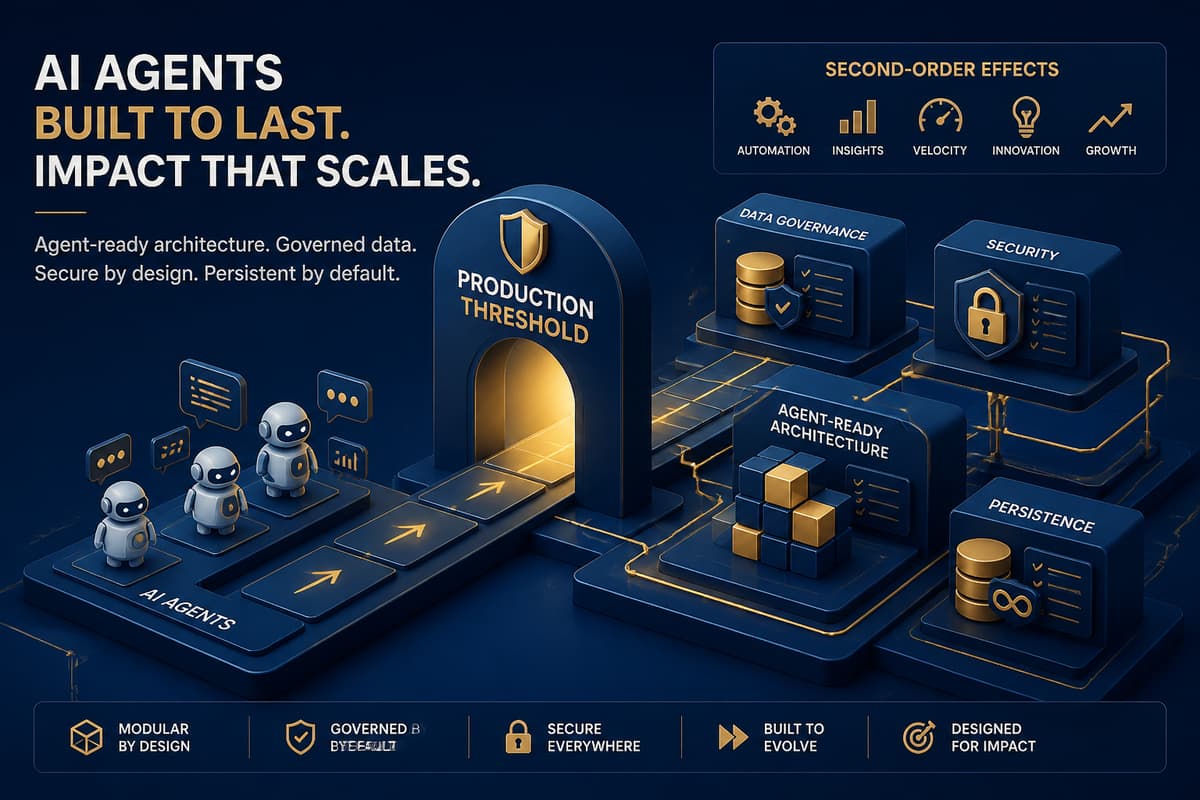
AI agents have crossed a threshold over the past year, and the last 48 hours of coverage shows a clear second-order effect: production agents are no longer “just another model call.” Production agents behave like long-lived workers that need durable compute, authenticated access to tools, and a governed stream of context. CTOs now have to design for agent operations, not only model quality.
InfoQ’s coverage of SpaceXAI’s Grok Bot describes persistent agents running on dedicated cloud computers that can interact with websites, inboxes, and applications (a concrete runtime pattern, not a prototype) InfoQ. InfoQ also reports Grab’s use of analytics agents to reduce mechanical analyst work from 44% to 30% in four months, attributing progress to a blend of agent autonomy plus “certified data” and context management InfoQ. The common thread is operational: agents need trusted context and controlled capabilities or they create new failure modes at scale.
The data layer is becoming the cost and control lever. dbt’s “Model for the token, not the table” argues that naive ingestion of raw transcripts into AI workflows can explode token spend, and that warehouse-first modeling cut token costs by 20x in one case dbt. In a separate post, dbt draws a sharper boundary between compute platforms (for processing) and transformation semantics (for meaning), warning that executives often approve both as one decision dbt. The emerging implication: agent programs need a “semantic contract” for context (what fields mean, what is certified, what is safe to use) and a unit-economics plan for tokens.
Identity is turning into the gating function for agent adoption. Two AWS posts focus on OAuth 2.0, LDAP, HTTP auth, and IAM-based authentication for Amazon MQ for RabbitMQ, replacing static local credentials with existing identity infrastructure AWS AWS. Message brokers sit on many automation paths, and the move toward federated identity is a strong signal: organizations are preparing for more non-human actors (agents) that must be authenticated, scoped, rotated, and audited like any other principal.
CTO takeaways land in three architectural moves. First, treat agents as services: give agents a runtime boundary (dedicated workers, queues, idempotency, retries) and observability (tool-call traces, decision logs, and cost telemetry). Second, build “certified context” pipelines: define which datasets are agent-eligible, version the semantic layer, and enforce data quality and redaction before context reaches a model. Third, adopt token-aware modeling and budgeting: measure cost per workflow, cache or precompute expensive context, and push summarization and feature extraction into governed transformations rather than ad hoc prompts.
Agent adoption will accelerate, but the differentiator will be boring systems work. Durable runtimes, federated identity, and a semantic layer that turns raw data into safe, compact context will decide whether agents become reliable teammates or expensive chaos.
Sources
- https://www.infoq.com/news/2026/08/grok-bot-agent/
- https://www.infoq.com/news/2026/08/grab-ai-analytics-agents/
- https://www.getdbt.com/blog/model-for-the-token-not-the-table
- https://www.getdbt.com/blog/databricks-processes-your-data-dbt-defines-what-it-means
- https://aws.amazon.com/blogs/big-data/iam-authentication-with-oauth-2-0-for-amazon-mq-for-rabbitmq/
- https://aws.amazon.com/blogs/big-data/oauth-2-0-ldap-and-http-auth-for-amazon-mq-for-rabbitmq/
▶ Interactive tool
Put this into practice — free, no sign-up
Run your own numbers in this interactive tool built for exactly this decision.