Zero-Growth Engineering: Architecture and Automation Patterns for Shipping More Without Scaling Spend
Engineering leaders are shifting from “scale by adding” to “scale by constraining,” using deliberate architecture patterns, automation, and data-platform upgrades to deliver more capability without...
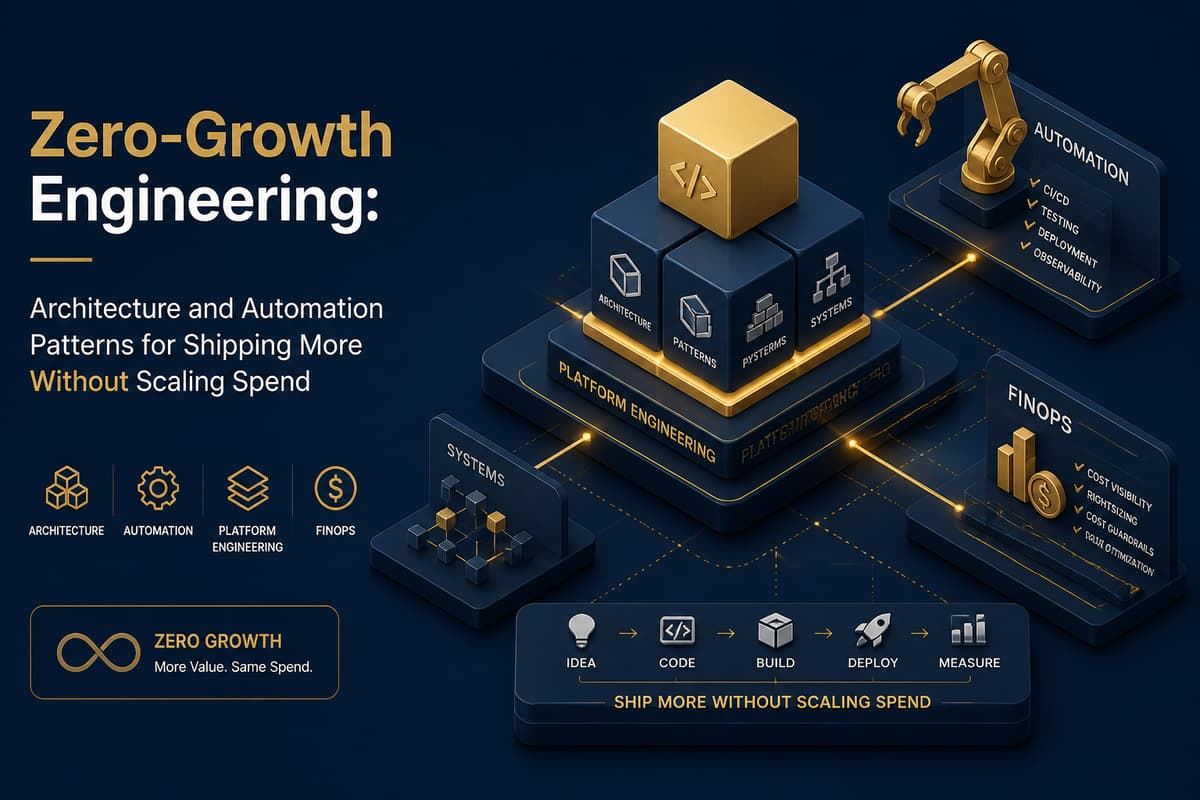
Cost pressure has moved from a quarterly budgeting exercise into a core architectural constraint. Engineering organizations are increasingly expected to ship features, support more users, and adopt AI, while keeping infrastructure growth and operational headcount close to flat. The most interesting shift in the last two days of coverage is not a single tool release, but a set of patterns that treat “no proportional growth” as a first-class design goal.
Uber’s “Zero Growth Stack” frames the problem explicitly: decouple capacity growth from business demand and squeeze waste out of the system before buying more hardware (InfoQ). The tactics described, like aggressive efficiency work and cost-aware scaling, echo a broader reorientation toward engineering economics. The same constraint shows up in a very different context in the “Hard-Stop Rule” migration story, where a payroll and HR team moved from three monoliths to 120+ domain services over five years without a dedicated migration budget by making every new feature a service and letting the legacy core slowly shrink (InfoQ). The common thread is governance: strong rules that prevent cost and complexity from creeping back in.
Data platforms are also being redesigned to avoid the classic tradeoff of “low latency requires a separate system.” Spotify’s work on indexing the data lake for online point queries aims to serve low-latency access patterns directly from lake-oriented storage, narrowing the gap between analytical and operational data access (Spotify Engineering). Snowflake’s Whatnot story adds the operational layer: observability at hyper-growth scale increasingly uses AI analytics and real-time monitoring so teams can detect issues and make decisions faster, without multiplying on-call burden (Snowflake). The “zero growth” idea is extending into data: fewer duplicate pipelines, fewer bespoke stores, more shared primitives.
Security and privacy are getting pulled into the same constraint system. AWS’s GuardDuty investigation agent automates threat triage by correlating findings, activity logs, and resource topology into structured reports with confidence scoring (InfoQ). Automation matters because manual triage does not scale when environments sprawl. The BBC report about publicly accessible chats with Anthropic’s Claude highlights the other side of the coin: productivity gains from AI-assisted work can create new classes of accidental data exposure if access controls, sharing defaults, and retention policies are not engineered deliberately (BBC). Risk becomes another “growth vector” that must be constrained.
Practical takeaways for CTOs:
- Treat cost and operational load as product requirements. Uber’s framing suggests setting explicit targets (infra growth, GPU spend, on-call load) and designing against them, not reviewing them after the fact.
- Use “hard-stop” governance to prevent architectural backsliding. The pull-based migration approach works when teams have crisp rules for where new work goes and what legacy code is allowed to change.
- Collapse redundant data paths. Spotify’s indexing direction and Snowflake’s observability story both point to shared platform primitives that reduce duplicated systems and duplicated toil.
- Automate triage and add AI guardrails. Security automation like GuardDuty’s agent reduces the marginal cost of operating safely, but only if paired with clear policies for LLM data handling and sharing defaults.
The next competitive advantage may be the ability to say “yes” to growth and new capabilities while saying “no” to proportional spend, toil, and exposure. Which constraint is explicit in the roadmap today: cost, operational load, or risk?
Sources
- https://www.infoq.com/news/2026/07/efficient-ai-infrastructure/
- https://www.infoq.com/articles/pull-based-migration/
- https://engineering.atspotify.com/2026/7/indexing-the-data-lake-for-online-point-queries
- https://www.snowflake.com/en/blog/observability-at-scale-whatnot-snowflake-summit/
- https://www.infoq.com/news/2026/07/guardduty-investigation-agent/
- https://www.bbc.co.uk/news/articles/cly5qgjk5ywo
▶ Interactive tool
Put this into practice — free, no sign-up
Run your own numbers in this interactive tool built for exactly this decision.