Agentic Ops Is Here, and Governance Is the New Platform Boundary
Engineering organizations are moving from “LLM features” to “agentic operations”, where AI agents participate in the software and data lifecycle (PRDs, pipelines, troubleshooting, feature serving)...
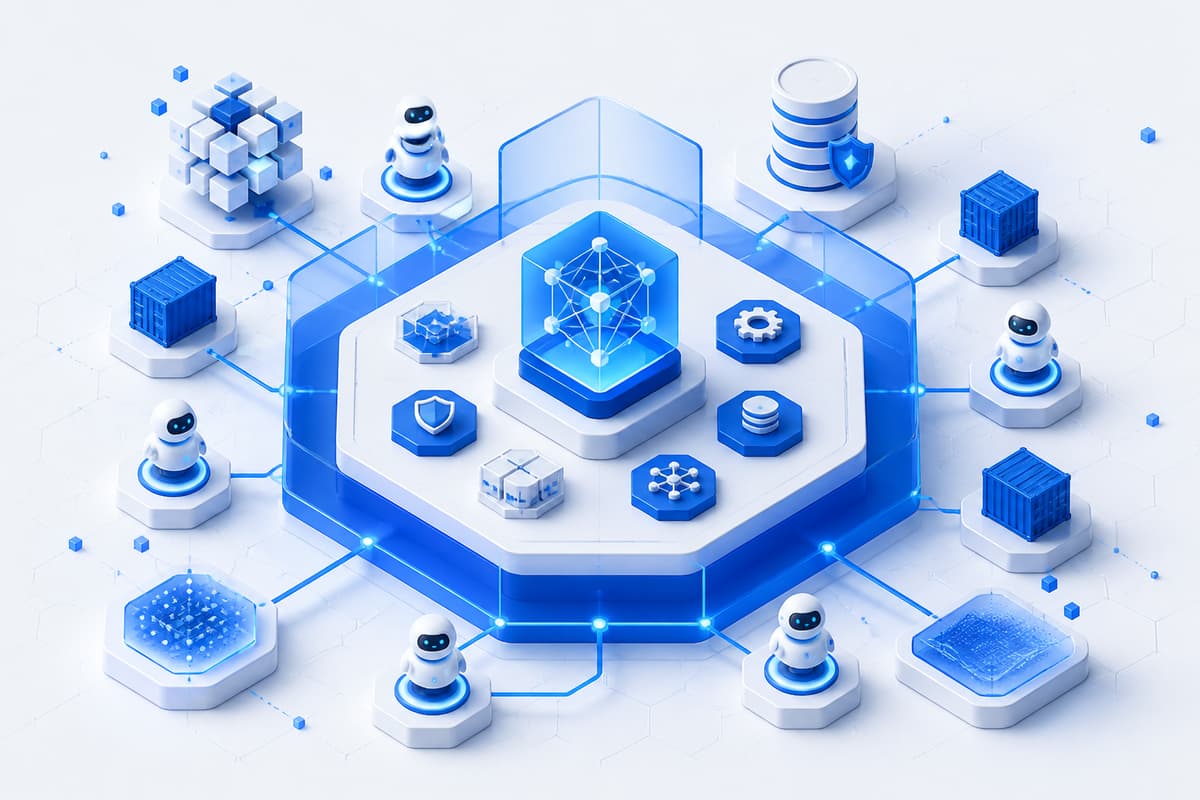
AI adoption inside engineering orgs is crossing a line from “assistive tooling” into “operational participation.” Agents are starting to touch PRDs, code review, data pipelines, and incident response. The hard part is no longer prompting. The hard part is making agent behavior safe, auditable, and cost-bounded in production.
Several sources point to the same architecture pressure: agentic workflows need a governed substrate. InfoQ reports AI moving earlier in the lifecycle into PRD validation and governance, alongside code review and design inputs, citing examples from large tech companies that are treating AI as a process control layer rather than a coding shortcut (https://www.infoq.com/news/2026/06/ai-prd-code-review-governance/). In parallel, Databricks positions “agentic data engineering” as a new pipeline-building model, emphasizing consistency and scale rather than one-off copilots (https://www.databricks.com/blog/how-daikin-applied-americas-builds-consistent-data-pipelines-scale-genie-code). AWS goes even further into operations, showing autonomous troubleshooting for Medallion Architecture pipelines by wiring AWS DevOps Agent and an Apache Spark Troubleshooting Agent through MCP, effectively turning pipeline support into an agent-driven workflow (https://aws.amazon.com/blogs/big-data/autonomous-troubleshooting-for-medallion-architecture-with-aws-devops-agent-and-apache-spark-troubleshooting-agent/).
Platform vendors are also packaging the “agent meets governed data” story. Snowflake and NVIDIA frame agentic AI in life sciences as governed workflows with secure data access (https://www.snowflake.com/en/blog/snowflake-nvidia-bionemo-agentic-ai-life-sciences/). Snowflake’s separate push on low-latency feature serving via Postgres highlights a second-order effect: agents and ML systems increase demand for fast, online access paths, not only offline lakehouse queries (https://www.snowflake.com/en/blog/snowflake-postgres-ml-online-feature-store/). AWS’s multi-region identity-based access patterns for Redshift and S3 tables underline the same requirement from a different angle: identity and authorization must work across regions and services when more automated actors are querying and moving data (https://aws.amazon.com/blogs/big-data/multi-region-identity-based-access-to-amazon-redshift-and-s3-tables/).
Kubernetes is quietly becoming the execution plane for this new agentic layer. Netflix describes simplifying batch compute with Kueue as part of becoming more Kubernetes-native, which matters because agentic workloads tend to be bursty, queue-driven, and multi-tenant by default (https://netflixtechblog.com/how-netflix-simplified-batch-compute-with-kueue-87860682629c). Google’s OpenRL reinforces the direction: post-training and fine-tuning exposed as a self-hosted API on standard Kubernetes clusters, pulling model adaptation into the same operational domain as the rest of engineering (https://www.infoq.com/news/2026/06/google-open-rl-fine-tuning/). Multi-tenancy shows up explicitly in AWS’s OpenSearch Serverless “collection-per-tenant” design, which is the same isolation problem teams hit when multiple internal agents, teams, and products share search and retrieval infrastructure (https://aws.amazon.com/blogs/big-data/implement-multi-tenant-search-with-amazon-opensearch-serverless-next-generation/).
What should a CTO do with this? Treat “agentic” as a platform program, not a tool rollout. Start by defining agent identities (service accounts, scopes, region boundaries), audit requirements (what the agent read, wrote, and executed), and tenancy models (per team, per product, per customer) before scaling usage. Then align execution and cost controls: queueing, quotas, and scheduling (Kueue-style) for batchy agent workloads, plus low-latency online stores for real-time decisions. Finally, decide where agents are allowed to act: suggestion-only in PRDs and reviews, or authorized to merge, deploy, and remediate.
Actionable next steps for the next 30 days: (1) create an “agent control plane” checklist covering identity, policy, audit logs, and kill switches, (2) pick one operational workflow (pipeline troubleshooting or PRD validation) and run a gated pilot with measurable blast radius, (3) standardize the execution substrate (often Kubernetes) and the data access layer (grants, row-level controls, multi-region rules) so agents do not become the fastest path to accidental data exfiltration. Agentic ops will expand anyway. The only real choice is whether governance arrives before the incident report.
Sources
- https://www.infoq.com/news/2026/06/ai-prd-code-review-governance/
- https://www.databricks.com/blog/how-daikin-applied-americas-builds-consistent-data-pipelines-scale-genie-code
- https://aws.amazon.com/blogs/big-data/autonomous-troubleshooting-for-medallion-architecture-with-aws-devops-agent-and-apache-spark-troubleshooting-agent/
- https://www.snowflake.com/en/blog/snowflake-nvidia-bionemo-agentic-ai-life-sciences/
- https://www.snowflake.com/en/blog/snowflake-postgres-ml-online-feature-store/
- https://aws.amazon.com/blogs/big-data/multi-region-identity-based-access-to-amazon-redshift-and-s3-tables/
- https://netflixtechblog.com/how-netflix-simplified-batch-compute-with-kueue-87860682629c
- https://www.infoq.com/news/2026/06/google-open-rl-fine-tuning/
- https://aws.amazon.com/blogs/big-data/implement-multi-tenant-search-with-amazon-opensearch-serverless-next-generation/
▶ Interactive tool
Put this into practice — free, no sign-up
Run your own numbers in these interactive tools built for exactly this decision.