AI-native organization vs AI bolt-on: the architecture and operating model difference CTOs can’t ignore
AI-native organization vs AI bolt-on: what it is, and how to build it
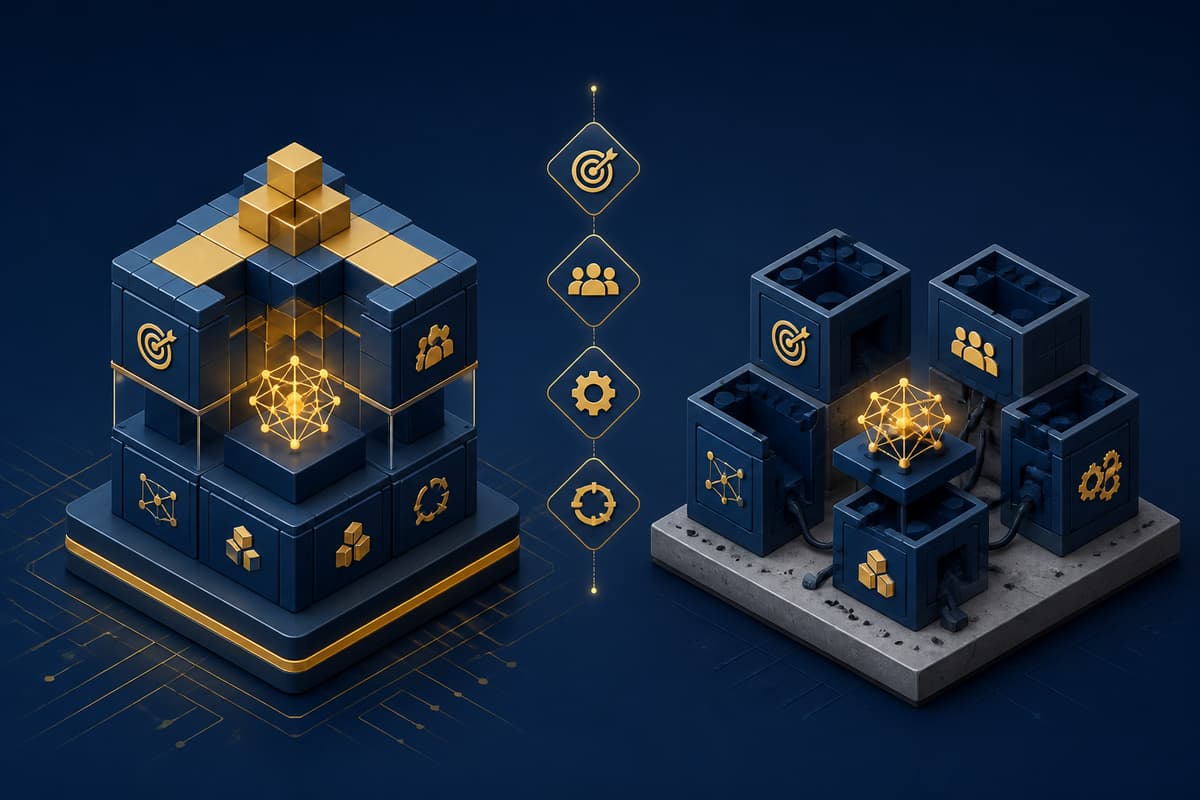
Table of Contents
AI-native organization vs AI bolt-on: what it is, and how to build it
In 2025, the DORA research team warned that AI doesn’t fix teams. It amplifies what’s already there. You see it fast in real orgs. Roll out Copilot to 400 engineers and PR counts jump. Release cadence stays flat. Incident load creeps up.
That gap is the difference between an AI bolt-on and an AI-native organization. If you treat AI like a feature, you buy tools and get local speedups. If you treat AI like a new operating system, you rebuild workflows, data paths, and governance so speed compounds instead of stalling out in coordination.
What is an AI-native organization (primary query: “AI-native organization”)
Most CTOs I talk to use “AI-native” as a vibe. Vendors use it as a label. You need a definition you can actually test.
Here’s mine, and it’s the one I use in board conversations.
Quotable definition: An AI-native organization designs its core workflows so models can take actions, learn from outcomes, and stay governed in the flow of work.
An AI bolt-on organization adds AI to existing workflows, then keeps the same handoffs, approvals, and data friction.
Deloitte describes the shift as replacing point-in-time oversight with embedded governance. Policies become “living assets” that get monitored and updated in short cycles, with real-time signals surfacing risk early Deloitte on AI-native tech organizations.
First Line Software makes the same point in plainer terms. AI-native is not “AI features.” It is restructuring how systems run, how workflows work, and how decisions get made First Line Software on what AI-native means.
What “AI bolt-on” looks like in practice
Bolt-ons aren’t useless. They just hit a ceiling, and they hit it sooner than most teams expect.
Stackpoint gives common bolt-on examples: chatbots added to an existing system, auto-fill, and simple recommendation engines. The base architecture stays the same Stackpoint on AI-native vs bolt-on.
Functionize makes the vendor angle concrete. A bolt-on testing platform “reacts to failures.” An AI-native platform “adapts proactively,” like self-healing tests that adjust as the app changes Functionize on bolt-on vs AI-native.
You’ll recognize the same pattern across domains:
- Support: a chatbot answers FAQs, but escalations still bounce across three queues.
- Sales: AI drafts emails, but approvals and CRM hygiene still gate pipeline.
- Engineering: AI writes code, but review, test, and release still run on old rails.
The components AI-native orgs build on purpose
AI-native isn’t one system. It’s a set of choices, and you can spot them in the plumbing.
Core components:
- Context infrastructure: shared, permissioned access to product, customer, and system context.
- Action surfaces: places where AI can do work, not just suggest work.
- Feedback loops: outcome signals that improve prompts, retrieval, and models.
- Embedded governance: controls that run inside pipelines, not in a monthly committee.
- Metrics that measure value: throughput and quality, not prompt counts.
That’s the framing. Next you need a clean way to tell which side you’re on.
AI-native vs AI bolt-on: a CTO decision matrix you can use
Most teams blow this step. They ask “which model should we use?” The better question is “what are we rebuilding?”
Use this matrix in vendor reviews and internal design reviews.
| Dimension | AI bolt-on | AI-native |
|---|---|---|
| Workflow design | AI sits inside one step | AI spans steps and removes handoffs |
| Data access | Manual exports and brittle connectors | Shared context layer with permissions |
| Reliability | Breaks when inputs shift | Adapts with monitoring and fallbacks |
| Governance | Review boards after the fact | Controls in CI, runtime, and audit logs |
| Ownership | One team “does AI” | Every product team owns AI outcomes |
| Measurement | Usage and time saved | Cycle time, defect rate, ROI, rework |
Functionize calls out a hard truth. If your base system is script-heavy and your team spends half its time on maintenance, AI will amplify that burden. It won’t remove it Functionize on architecture as strategy.
So ask questions that force clarity:
- Can the system generate work from intent, or do engineers still write glue code first?
- Does it self-correct when the app changes, or does it just file failures?
- Can the vendor show verified ROI in your industry, not a demo?
Functionize cites the World Quality Report 2025 to 2026: 89% of organizations use GenAI in testing workflows, yet 50% still lack AI and ML expertise to evaluate ROI Functionize citing World Quality Report. That gap is why bolt-ons sell so well.
Why “we gave many people AI tools” doesn’t make the company faster
Individuals get faster. Orgs often don’t.
Yuzheng Sun summarizes the paradox with numbers: individuals see 15% to 40% speed gains, but companies show “zero measurable gain” in many cases. He points to org friction and incentives as the blockers LinkedIn on the AI-native organization paradox.
Raffaela Rein makes the same point from a metrics angle. Leaders track adoption and training. Those are activity metrics. They don’t show if coordination costs dropped The new metric for AI productivity.
So what breaks in the bolt-on path?
Coordination becomes the bottleneck
AI compresses “doing.” It does not compress “deciding.”
If your release train needs:
- a weekly architecture review
- a security sign-off ticket
- a QA gate that runs in two days
- a change advisory board
…then AI code generation just feeds a slower pipe.
This is why I push CTOs to pair AI adoption with our guide to engineering metrics that reflect flow, not output volume. Use an internal dashboard like the Engineering Metrics Dashboard (/tools/engineering-metrics-dashboard) to track cycle time, change failure rate, and rework.
Incentives reward time, not outcomes
If performance reviews reward:
- “responsiveness” in Slack
- meeting attendance
- ticket throughput
…then AI speed creates noise. People ship more artifacts, not more value.
Deloitte notes that trust in AI correlates with usage frequency and duration. People who use tools more learn the quirks and start giving them bigger problems Deloitte on trust and usage. Incentives decide who gets to build that trust, and who stays stuck doing “safe” work.
Data friction kills compounding gains
Bolt-ons pull data from five systems, then paste results back into one. That’s not a strategy, it’s a tax.
AI-native orgs build a context layer that makes data usable:
- consistent IDs for customers, accounts, and assets
- clear data contracts
- permissioning and audit trails
If you want a practical way to map this, model the context layer in ArchiMate Modeler (/tools/archimate). It forces you to name systems of record, data flows, and control points.
How to become an AI-native organization: operating model and architecture changes
You don’t get AI-native by decree. You get it by changing how work moves, and by being honest about where the friction lives.
Landing AI’s transformation playbook starts with pilots, then builds an in-house team, then broad training, then strategy Landing AI Transformation Playbook PDF. That sequence still works in 2026, but only if you add two missing pieces: context infrastructure and embedded governance.
Board of Innovation says “avoid retrofitting.” Rebuild workflows as if AI existed from day one BOI on becoming AI-first.
Here’s the model I use.
The CALM Stack framework (Context, Actions, Learning, Monitoring)
This is a simple test for AI-native design. If you can’t describe all four, you’re building a bolt-on.
- Context: what the system knows, and how it retrieves it.
- Actions: what the system can do, and where it can do it.
- Learning: how outcomes feed back into prompts, retrieval, and models.
- Monitoring: how you detect drift, abuse, and failures.
Use CALM in architecture reviews the same way you use threat modeling.
Immediate actions CTOs can take in 30 days
- Pick one workflow: Choose a workflow with clear inputs and outputs, like refund approvals or incident triage.
- Instrument the baseline: Measure cycle time, handoffs, and rework rate before AI.
- Build a context pack: Create a permissioned bundle of docs, tickets, and runbooks for that workflow.
- Add an action surface: Let AI open a PR, create a ticket, or execute a safe runbook step.
- Run a weekly review: Review failures like incidents. Use the Incident Postmortem template (/tools/incident-postmortem).
If you can’t measure baseline cycle time, stop and fix that first. AI will hide the problem for a month or two, then it’ll bite you.
Policy framework CTOs should set this quarter
- Data access rules: Define what can go into prompts, and what rarely can.
- Model risk tiers: Tier use cases by impact, like “draft,” “recommend,” and “act.”
- Audit logging: Log prompts, retrieved context IDs, actions taken, and approvals.
- Human override: Define who can stop the system, and how fast.
Deloitte’s “embedded governance” idea fits here. Put controls in pipelines and runtime, not in slide decks Deloitte on embedded governance.
Architecture principles that separate AI-native from AI bolt-on
- Context layer first: Build retrieval and permissions before fancy agents.
- Small action radius: Start with actions that are reversible, like drafts and PRs.
- Fallback paths: Design for model failure. Keep deterministic paths.
- Evaluation in CI: Treat prompt and retrieval changes like code changes.
If you need to decide between building and buying parts of this stack, use the Build vs Buy Matrix (/tools/build-vs-buy-matrix). AI-native work fails when teams buy five tools that don’t share context.
How to measure AI-native progress without getting fooled by activity
You need metrics that don’t get inflated by AI.
Larridin’s 2026 benchmarks argue that PRs per week and LOC are unreliable. AI inflates volume without raising value. They propose five dimensions: adoption, AI code share, complexity-adjusted velocity, code quality, and cost and ROI Developer productivity benchmarks 2026.
They also give concrete “elite team” ranges:
- 80%+ weekly active usage
- 60% to 75% AI-assisted code share
- Sub-8-hour PR cycle times
- Code turnover ratios below 1.3x compared to human-only baselines
Use those as directional targets, not as a scoreboard.
Here’s a simple checklist I use with VPs of Engineering.
AI-native measurement checklist:
- Flow: PR cycle time dropped by 20% or more, with stable incident rate.
- Quality: escaped defects per release stayed flat or fell.
- Rework: time spent fixing AI-generated code stayed under 10% of time saved.
- Cost: total AI cost per developer stayed in a known band, like $200 to $600 per month.
- Coordination: approval steps per change dropped, not just time per step.
If you want one place to track this, wire it into Command Center (/command-center) so AI work shows up next to incidents, tech debt, and migration load.
Enterprise implications: why this matters for CTOs
-
Vendor risk shifts from features to foundations: Bolt-on tools look good in demos. They fail at scale when data access, audit, and reliability matter. Functionize calls this “architecture is strategy” for a three to five year horizon Functionize on bolt-on vs AI-native.
-
Shadow AI becomes a supply chain problem: Teams will route data through browser plugins and personal accounts. That creates data leakage risk and compliance gaps. Embedded governance reduces the need for underground work.
-
Org design becomes a performance constraint: Deloitte expects new roles and new hiring patterns. They cite that nearly 70% of tech leaders plan to grow teams in response to gen AI, and AI architect roles are expected to rise from 30% to 58% in two years Deloitte on roles and hiring.
-
Your speed gap becomes visible in the market: AI-native competitors ship faster with smaller teams. They don’t just code faster. They decide faster.
CTO recommendations: how to move from bolt-on to AI-native
Immediate Actions
- Workflow selection: Pick one workflow with a hard metric, like “refund approval under 2 hours.”
- Context inventory: List the five sources of truth that workflow needs. Fix IDs and access.
- Evaluation harness: Add offline tests for prompts and retrieval before production.
- Safe actions: Start with drafts, PRs, and ticket creation. Avoid irreversible actions.
Policy Framework
- Data classification: Define what can be used for retrieval and what cannot.
- Model tiering: Set tiers by impact, and map tiers to review gates.
- Audit and retention: Store action logs and context references for a defined period.
- Vendor proof: Require verified ROI numbers and live demos, not videos.
Architecture Principles
- Shared context layer: One context system beats five copilots.
- Product ownership: Each product team owns AI outcomes and failure modes.
- Governance in pipelines: Put checks in CI and runtime, not in quarterly reviews.
- Cost visibility: Track per-workflow cost, not just per-seat licensing.
If you need to estimate the infra impact of retrieval, eval, and model routing, run it through the Cloud Cost Estimator (/tools/cloud-cost-estimator). AI-native work dies when costs surprise finance.
Bigger picture: AI-native is a change program, not a tooling program
The best mental model I’ve found is BOI’s line: treat AI as a general-purpose technology, not a tool BOI on AI-first. Tools come and go. Operating models stick.
And the hard part is people. Deloitte calls out resistance from senior engineers, and the hiring market rewarding developers who use AI in daily work Deloitte on leadership and adoption. You need to lead that shift without turning it into a culture war.
If you want to go deeper on the leadership side, pair this with our internal guides on running blameless incident postmortems (/tools/incident-postmortem), tracking engineering performance with DORA-style metrics (/tools/engineering-metrics-dashboard), making build vs buy decisions under uncertainty (/tools/build-vs-buy-matrix), and portfolio-level risk and tech debt management (/command-center).
So here’s the question I ask CTOs in planning season: if your best team shipped 2x faster next quarter, would your org let that speed reach customers, or would approvals and handoffs absorb it?
Sources
- Functionize: Bolt-On vs. AI-Native
- Stackpoint: AI-Native vs. AI Bolt-On Products
- Deloitte: The great rebuild, architecting an AI-native tech organization
- First Line Software: AI Native, what it really means
- Landing AI: AI Transformation Playbook (PDF)
- Board of Innovation: The Autonomous Enterprise, how to become AI-first
- Larridin: Developer Productivity Benchmarks 2026
- Raffaela Rein: The new metric for AI productivity
- Yuzheng Sun: The AI-Native Organization
▶ Interactive tool
Put this into practice — free, no sign-up
Run your own numbers in these interactive tools built for exactly this decision.