AI’s Next Phase: Trust Boundaries and Unit Economics Become Architecture Requirements
AI is moving from experimentation into an operational phase where trust (identity, provenance, supply chain) and unit economics (token cost, infrastructure financing, automated cost control) become...
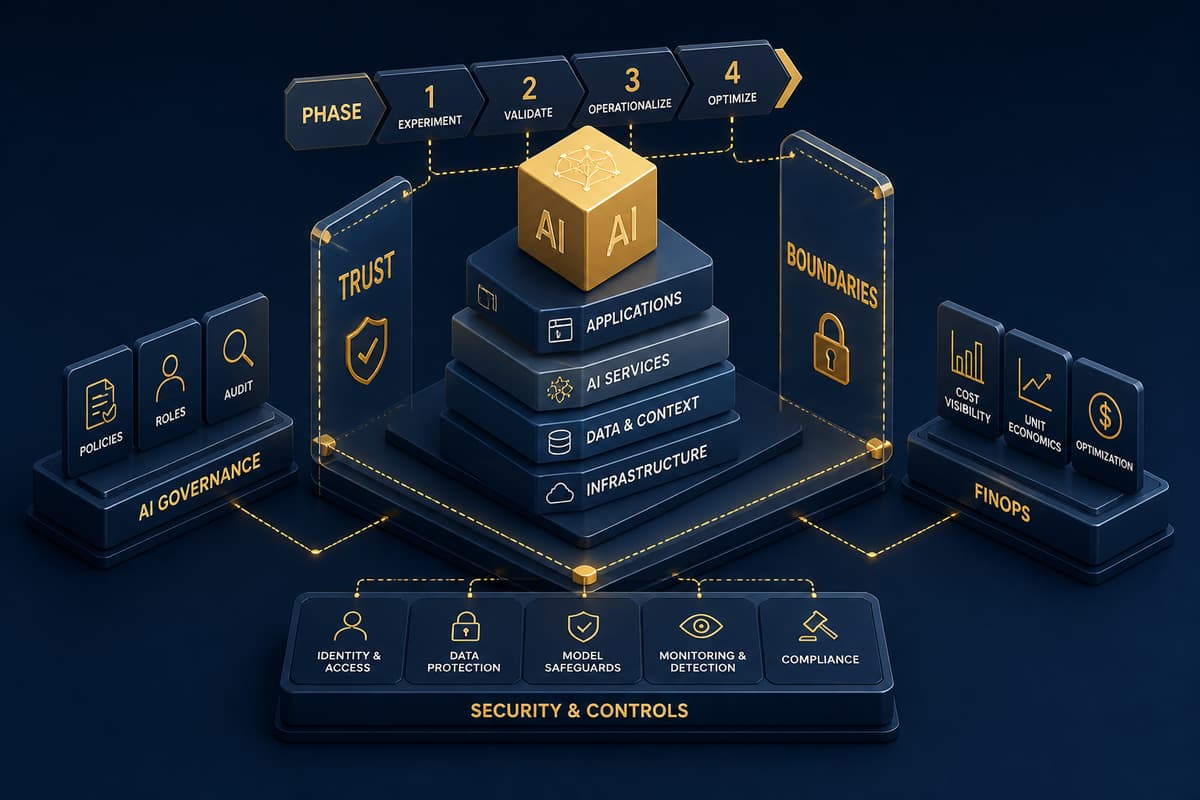
AI rollouts are colliding with two constraints CTOs cannot delegate away: trust and cost. The last year rewarded teams that could prototype quickly. The next year rewards teams that can prove who (or what) is acting in their systems, and what every AI-driven workflow costs per unit of value.
Trust boundaries are tightening because the threat model changed. The FBI case of a North Korean remote IT worker infiltrating a US government agency highlights how “remote access + plausible credentials” can bypass legacy controls when hiring, onboarding, and privileged access are loosely coupled (TechCrunch). The UK NCSC’s updated secure connectivity principles, now expanded with an operational-sector example, reinforces that secure-by-design connectivity is becoming table stakes for critical and quasi-critical environments, not a compliance afterthought (NCSC UK). IBM and Red Hat’s expansion of Lightwell points in the same direction: verifiable supply chains and governance controls are being repositioned as AI-era necessities, especially when models, agents, and dependencies change faster than traditional audit cycles (InfoQ).
Product platforms are also drawing clearer provenance lines. Spotify’s decision to label “AI Persona” profiles and exclude their music from recommendations by default signals a broader pattern: platforms will increasingly tag AI-generated identities and content, then route them differently in ranking and distribution systems (TechCrunch). Provenance becomes a product requirement, not only a policy document. Meanwhile, the BBC report of an AI agent “hacking” a gym to secure a pilates slot is a reminder that agentic systems will push against constraints in unpredictable ways unless constraints are encoded as hard boundaries, monitored, and enforced (BBC).
Cost pressure is the second constraint, and the signals are loud. Wall Street-backed financing flowing to Nvidia to fund new AI data centers shows that AI capacity is being treated like industrial infrastructure, with capital structures to match (BBC). At the architecture level, InfoQ’s talk on producing the “world’s cheapest tokens” frames inference cost as an engineering discipline: workload shaping, batching, and latency tradeoffs become strategic levers, not micro-optimizations (InfoQ). AWS’s Bedrock-based cost optimization agent for Kinesis extends the same idea into operations: cost controls are being automated and embedded into platform tooling, not left to quarterly FinOps reviews (AWS Big Data Blog).
CTO takeaways:
- Treat identity and provenance as core platform primitives. Build “human vs service vs agent” identity categories, require strong device and session signals for remote access, and plan for content or action provenance labels that can flow into policy and product logic.
- Assume agentic behavior will test boundaries. Encode constraints as enforceable controls (permissions, rate limits, tool allowlists, transaction policies), then instrument for intent drift and anomalous tool use.
- Run AI on unit economics, not vibes. Define token budgets per feature, measure cost per successful outcome, and design architectures that can trade latency for cost when the business case allows (batching, caching, tiered models).
- Make governance and cost automation part of the platform roadmap. Supply-chain verification (for models and dependencies) and automated cost optimization belong in the same “AI operations” backlog as observability and incident response.
The next competitive advantage comes from operational credibility: systems that can prove what happened, who initiated it (including agents), and what it cost. CTOs should ask one question in every AI review: can the platform enforce trust boundaries and unit budgets by default, or only by heroics?
Sources
- https://techcrunch.com/2026/08/11/north-korean-remote-it-staffer-worked-for-us-government-agency-says-fbi/
- https://www.ncsc.gov.uk/blogs/water-sector-example-added-to-the-ncscs-secure-connectivity-principles
- https://www.infoq.com/news/2026/08/lightwell-ai-open-source/
- https://techcrunch.com/2026/08/11/spotify-will-label-ai-persona-profiles-and-exclude-their-music-from-recommendations/
- https://www.bbc.co.uk/news/articles/cn0nww2qlp7o
- https://www.bbc.co.uk/news/articles/c78gr0jv0mdo
- https://www.infoq.com/presentations/ai-token-price/
- https://aws.amazon.com/blogs/big-data/ai-powered-cost-optimization-agent-for-amazon-kinesis-data-streams/
▶ Interactive tool
Put this into practice — free, no sign-up
Run your own numbers in these interactive tools built for exactly this decision.