API blast radius scoring: When to gate library changes
Engineering orgs are shifting from manual review and tribal knowledge to automated change-risk scoring (API blast radius, dependency impact, safety checks) so they can ship faster while bounding...
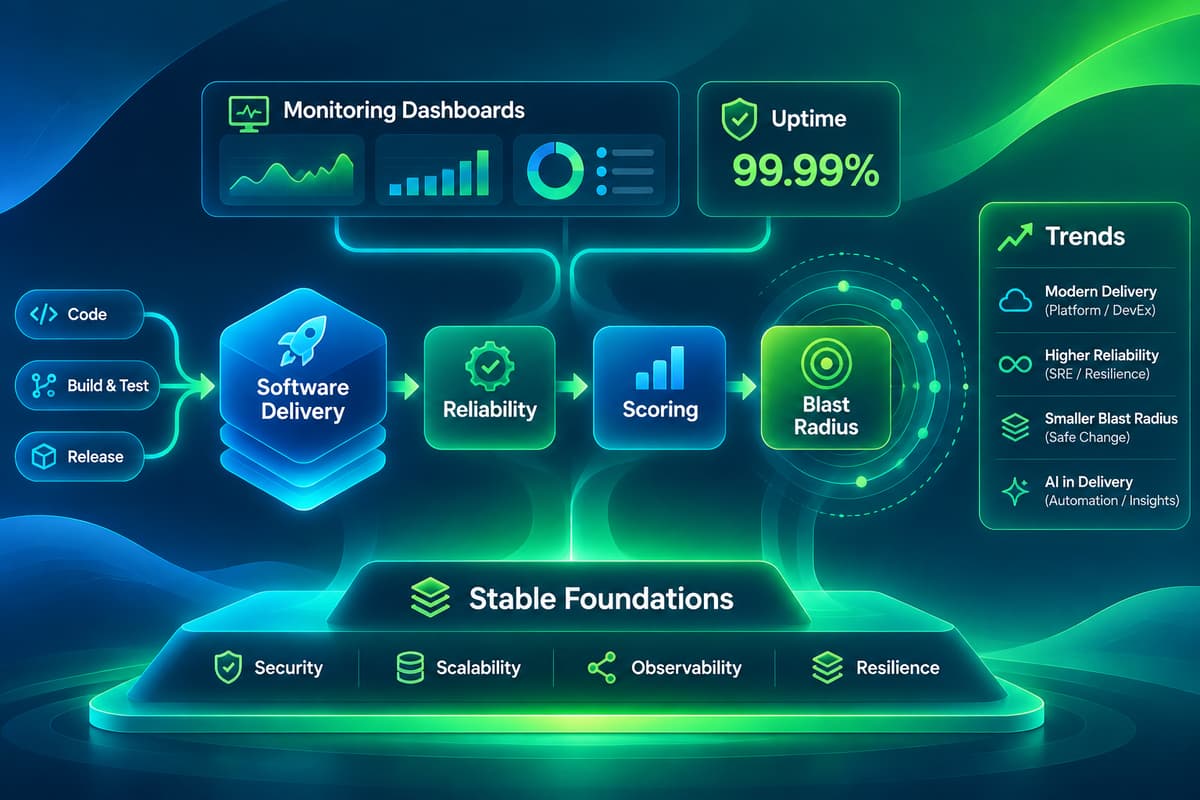
Table of Contents
Decide whether to fund automated change-risk scoring (API blast radius plus safety checks) before your next major dependency upgrade cycle. Netflix and Meta are both publishing evidence that the winning move is not “more review”, it is “better targeting of review”, and Spotify’s outage report shows the cost when change impact is not contained.
The common thread is operational: large codebases fail when engineers cannot predict who will break. The response is a new internal control plane for change, one that measures impact and routes work accordingly.
How do Netflix Quasar and SCIP make API blast radius measurable?
Netflix’s Quasar is an internal tool that combines semantic code indexing with API comparisons to find downstream consumers affected by library changes. In November 2026, InfoQ reported that Quasar uses the SCIP ecosystem for indexing, and stores/indexes data using Amazon S3 and queries via Athena to compute impact at scale (InfoQ on Netflix Quasar measuring downstream API impact).
The important CTO takeaway is not the particular stack. The takeaway is the artifact: a repeatable “who will break?” answer that does not rely on a principal engineer’s memory.
A blast radius system like Quasar changes three decisions:
- When you can merge a library change: if the blast radius is zero, merge is a routine operation. If the blast radius touches a Tier-1 service, merge becomes a coordinated change.
- Who must approve: approvals can be routed to owning teams for impacted call sites, rather than to a central architecture group.
- How you schedule upgrades: you can batch low-impact upgrades continuously and reserve change windows for high-impact ones.
Without a measured blast radius, teams compensate with process. Process scales poorly.
What does Meta/PyTorch GreenLight change about code review and release safety?
In November 2026, InfoQ covered PyTorch’s move to make code review auto-approval more mainstream with “GreenLight”, an open-source take on Meta’s internal RADAR approach. The reported pattern is that low-risk diffs can be auto-landed after passing safety checks and risk scoring, rather than waiting for a human reviewer to get to them (InfoQ on PyTorch GreenLight and Meta-style auto-landing).
Even if your organization never auto-approves, the design is still useful: define “low risk” as a computable category, then build a fast lane.
For CTOs, GreenLight points to a practical delivery architecture:
- Risk scoring sits upstream of review, not downstream of incidents.
- Safety checks become the product, meaning teams invest in test determinism, dependency policy, static analysis, rollout checks, and rollback hooks.
- Humans spend time on high-leverage review, not on formatting changes, comment edits, or mechanical refactors.
The business effect is predictable. Cycle time drops, and reviewer load becomes less spiky.
What does the Spotify outage report imply about change containment and incident cost?
Spotify’s engineering team published a detailed incident report for a September 29 outage, describing what happened, what they learned, and what they planned to change afterward (Spotify’s September 29 outage incident report).
A public incident write-up is not automatically evidence for any single root cause pattern across the industry. The useful signal is more general: outages routinely become the moment when engineering leaders discover that the organization lacked one of the following:
- A clear map of critical dependencies.
- A way to bound the impact of a change.
- A rollout method that limits customer impact when something is wrong.
A change-risk scoring program is a direct response to those gaps. Risk scoring is not “more governance”. Risk scoring is how you keep governance from becoming a bottleneck.
One short sentence matters. Incidents are expensive.
When should CTOs invest in change-risk scoring instead of more process?
Change-risk scoring is worth a dedicated investment when the organization hits any two of these conditions:
- Dependency upgrades are a quarterly fire drill. Netflix built Quasar because library changes had too many unknown consumers at scale (InfoQ on Netflix Quasar). If your upgrades require spreadsheet chasing, you are already paying the tax.
- Code review is the throughput limiter. Meta-style auto-landing exists because human review does not scale linearly with change volume (InfoQ on PyTorch GreenLight). If PR queues are growing, more “review discipline” will not fix the math.
- Outage learnings keep repeating. Spotify’s incident reporting is a reminder that reliability work often starts after a visible failure (Spotify incident report). If postmortems repeatedly call for better containment, the missing piece is usually tooling plus standards.
A CTO can treat this as an internal platform problem with a narrow scope:
- Start with libraries and internal packages.
- Add service-to-service API contracts later.
- Tie the output to CI and release workflows.
Avoid boiling the ocean. Pick the highest-churn dependency surface.
The synthesis: “blast radius” and “risk scoring” are the same control, applied at different layers
Netflix is measuring impact at the API consumption layer. Meta/PyTorch is using risk scoring at the PR landing layer. Spotify’s outage report represents the operational cost when neither layer reliably contains change.
A coherent strategy combines them:
- Blast radius answers “who is affected?”
- Risk scoring answers “how careful must we be?”
Together, those answers let you automate the low-risk path and slow down only where slowing down prevents real damage.
What to decide this quarter
-
(Owner: VP Engineering) Define a “change risk” rubric by December 31, 2026. Require three tiers (low, medium, high) with explicit triggers (public API change, config-only change, data migration, auth surface). Deadline matters because teams will otherwise keep arguing case by case.
-
(Owner: DevEx or Platform Lead) Pilot API blast radius detection on one internal library by January 31, 2027. Success metric: for that library, 90% of releases include an automatically generated list of affected repos or services, comparable to what Netflix Quasar produces (InfoQ on Netflix Quasar).
-
(Owner: SRE Lead) Add a “blast radius and rollback plan” section to SEV postmortems starting next incident. Use the next SEV2+ incident as the trigger, and require at least one action item that reduces future blast radius, aligned with the kind of learnings Spotify documents in its outage write-up (Spotify incident report).
-
(Owner: CI/CD Lead) Create a fast lane for low-risk diffs by February 15, 2027. Start with auto-merge for documentation, comment-only changes, and dependency bumps that pass tests, inspired by the GreenLight/RADAR pattern (InfoQ on PyTorch GreenLight). Measure median time-to-merge for low-risk PRs, target a 30% reduction.
-
(Owner: CTO) Decide by March 1, 2027 whether to productize this internally. Trigger: if the pilot library shows fewer rollbacks and faster merges without an incident increase, staff a 2-person effort for two quarters. If results are ambiguous, keep it as a local tool.