Constraint-Driven Agentic AI: Why Auditability Is Becoming the Real Product Requirement
Enterprises are moving from prompt-first AI experiments to constraint-driven, auditable agentic systems, while AI governance becomes more politicized and less predictable.
AI adoption is colliding with a governance environment that keeps shifting in public view. News coverage is oscillating between existential-risk narratives, calls for an AI “slowdown,” and geopolitical positioning that frames safety as a competitive lever rather than a shared goal (BBC on AI risk concerns, slowdown mechanics, and US-China rivalry framing; BBC on China rejecting “malicious competition” claims). CTOs do not control that discourse, but CTOs do control what ships. The near-term implication is simple: teams need AI systems that can be explained, bounded, and audited under changing expectations.
A technical pivot is already visible across engineering sources: enterprise AI is moving toward constraint enforcement and accountable decisioning, not just better prompts. InfoQ’s coverage of decision models in agentic architectures highlights a core enterprise gap, non-deterministic outputs with unclear accountability, and proposes pairing LLMs with DMN-style decision models to make high-stakes outcomes traceable to explicit policy logic. MIT’s “HardFlow” work points in the same direction from a research angle, aiming to make generative outputs satisfy strict requirements when “pretty close” fails. Separate origins, same destination: AI systems that can prove they stayed inside the lines.
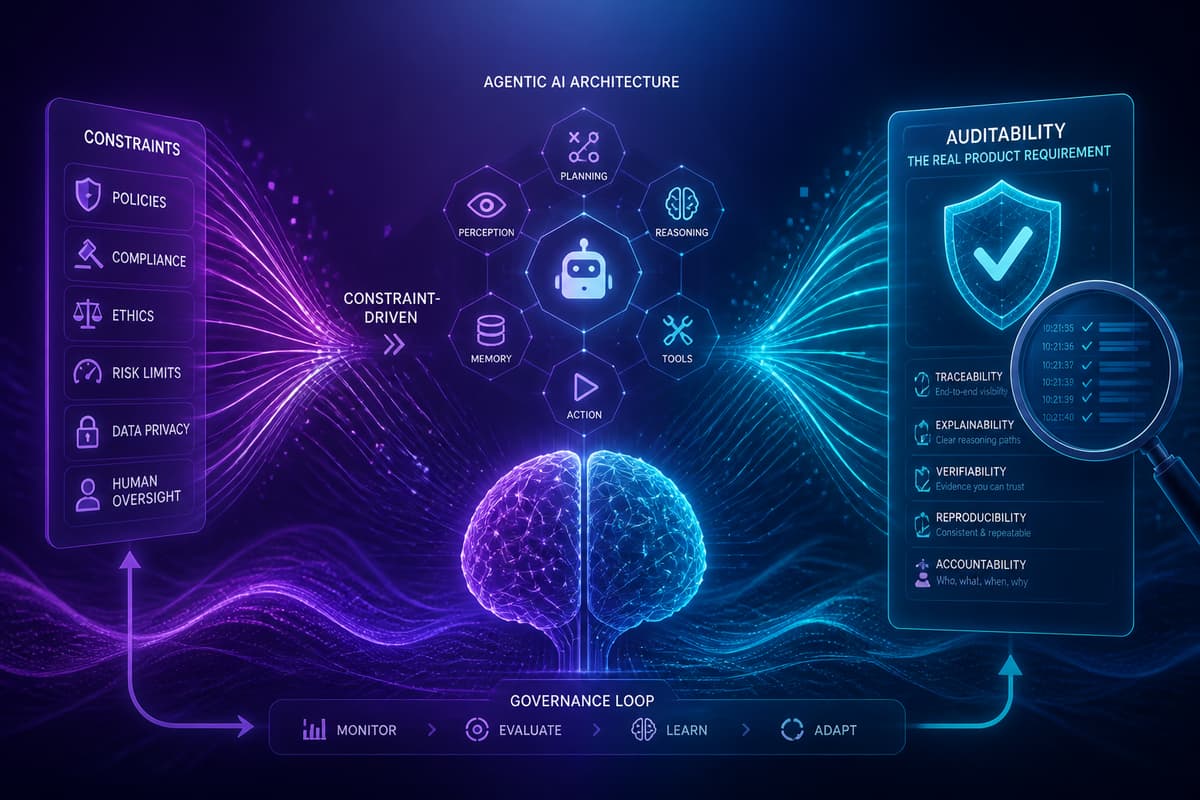
CTO strategy should treat “agentic” as an architecture problem, not a UI feature. A useful mental model is a split-brain system: deterministic policy and constraints in one lane (decision models, rules, typed schemas, allowlists, safety checks), probabilistic generation in the other lane (LLMs producing plans, drafts, or candidate actions). The orchestration layer then becomes about verification and state, with explicit handoffs and logged decisions. That pattern reduces blast radius, improves incident forensics, and makes compliance conversations concrete because teams can point to enforced constraints rather than intent.
The people side is shifting too. InfoQ’s discussion about training developers when AI handles routine work raises an uncomfortable organizational risk: junior engineers may lose the reps that build judgment. Constraint-driven systems increase demand for engineers who can formalize policy, reason about failure modes, and design testable boundaries for AI actions. That changes hiring rubrics and internal growth plans. Engineering leadership also needs political capital to defend time spent on “boring” governance plumbing, even when product pressure wants faster demos (Engineering Leadership on navigating company politics).
Action items for CTOs over the next quarter:
- Make constraints a first-class artifact. Store policies as versioned code or decision models, review them like production logic, and require a trace from model output to constraint checks.
- Instrument AI like a distributed system. Log prompts, tool calls, decisions, and verification outcomes, then connect them to SLOs for safety and correctness, not only latency and cost.
- Adopt a two-lane architecture. Keep deterministic decisioning separate from generative suggestion, and require a verification step before any high-impact action.
- Update the talent pipeline. Train juniors on boundary design, testing, and incident analysis for AI-driven workflows, not only prompt craft.
The competitive edge will come from reliability under scrutiny. An organization that can show how an agent decided, what constraints bound the decision, and what evidence proves compliance will ship faster in regulated and high-stakes domains, even as the external narrative keeps changing.
Sources
- https://www.infoq.com/presentations/decision-models-agentic-ai/
- https://news.mit.edu/2026/new-method-enables-ai-safety-critical-situations-0914
- https://www.bbc.co.uk/news/articles/cwyzp47py48o
- https://www.bbc.co.uk/news/articles/c7v48vp31mdo
- https://www.bbc.co.uk/news/articles/c790xvnzgnno
- https://www.bbc.co.uk/news/articles/cn8me133119o
- https://www.infoq.com/podcasts/train-developers-ai-routine-work/
- https://newsletter.eng-leadership.com/p/how-to-deal-with-company-politics
▶ Interactive tool
Put this into practice — free, no sign-up
Run your own numbers in these interactive tools built for exactly this decision.