AI’s New Bottleneck: Context, Cost, and the Data-Perimeter Architecture
Enterprises are shifting from “pick the best model” to “ship the best context,” focusing on prompt/context compression, agent I/O efficiency, and governed data-perimeter execution to control cost,...
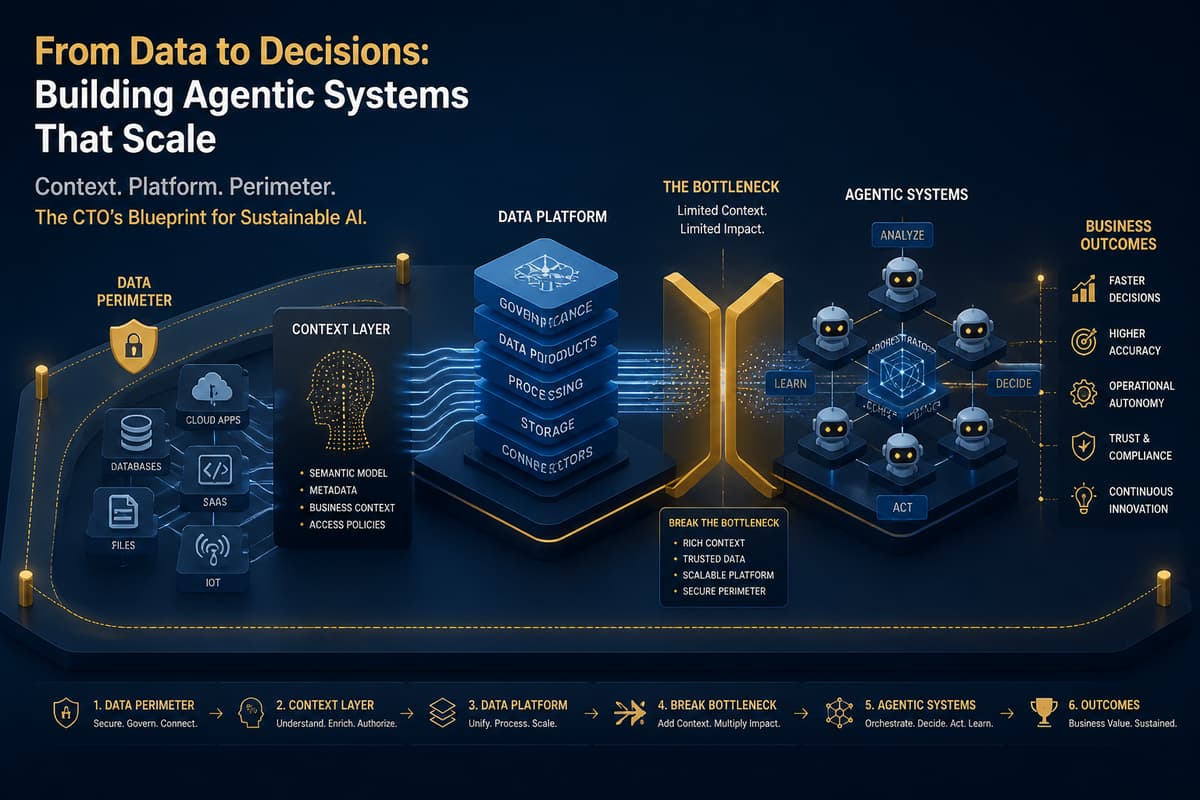
AI roadmaps are colliding with physics and budgets. Model quality still matters, but unit economics (tokens, I/O, GPU time) and governance constraints are now dictating what teams can safely deploy at scale. The practical bottleneck has shifted to context: how teams assemble it, compress it, secure it, and serve it to agents quickly.
Snowflake is making a direct bet that the data platform becomes the AI execution perimeter. The Snowflake announcement of Grok 4.6 on Snowflake Cortex AI emphasizes running “long-running agents and agentic pipelines” inside a governed boundary, close to enterprise data and controls (Snowflake, Grok 4.6 on Cortex). A separate Snowflake post argues that business context, not model choice, is the missing ingredient for AI growth strategies, pushing governed enterprise context as the differentiator (Snowflake, Context Advantage). The platform message is consistent: context and control planes become first-class product surfaces.
Engineering teams are attacking the same problem from the workload side: reduce waste. Shopify’s gisting compresses long system prompts into learned “gist tokens,” improving throughput and lowering inference cost, which effectively treats prompts as an optimizable artifact rather than static text (InfoQ, Shopify Gisting). Spotify’s Portal write-up adds an operational reality check: for coding agents, much of the spend is not “thinking,” it is I/O, and optimizing the interaction loop cut token usage by 90% in their reported case (Spotify Engineering, Portal). The shared implication is that agent systems need performance engineering discipline: caching, batching, retrieval shaping, and context compaction.
Infrastructure pressure makes that discipline non-optional. BBC reporting on Australia’s AI data center boom frames the external constraint set: energy, land, water, and local tradeoffs are becoming part of the AI scaling conversation (BBC, AI data centres in Australia). If power and capacity become contested, the winning architecture is the one that does less per request while meeting governance requirements.
CTOs can treat the shift as an architectural reframe: move from “model integration” to “context supply chain.” Practical moves follow. Establish a context layer with explicit budgets (token, latency, freshness), and make prompt/context artifacts versioned and testable. Prefer execution patterns that keep sensitive context inside governed perimeters (data platforms, VPC enclaves, or equivalent), and push vendors on auditability and policy enforcement at the agent-runtime level. Finally, fund efficiency work like a reliability program, because prompt compression, retrieval shaping, and I/O reduction can buy more capacity than the next model upgrade.
Actionable takeaways: (1) create a costed context contract per AI feature (what context, how fresh, how big, what it costs), (2) invest in context optimization techniques (compression, caching, distillation, retrieval tuning) alongside model evaluation, and (3) decide where the “AI perimeter” lives in your stack, then standardize agent execution there. The next competitive edge comes from shipping the right context cheaply and safely.
Sources
- https://www.snowflake.com/en/blog/announcing-grok-4-6-snowflake-cortex-ai/
- https://www.snowflake.com/en/blog/context-advantage-ai-growth-strategy/
- https://engineering.atspotify.com/2026/9/portal-by-spotify-cut-my-claude-code-token-usage-by-90
- https://www.infoq.com/news/2026/09/spotify-gisting-llm-performance/
- https://www.bbc.co.uk/news/articles/cgl3we7wdr3o
▶ Interactive tool
Put this into practice — free, no sign-up
Run your own numbers in these interactive tools built for exactly this decision.