Context-Aware Control Planes Are Becoming the New Security Perimeter (Data, Identity, Sessions)
Security and governance are moving up the stack into context-aware control planes that span data access, identity/session lifecycle, and multimodal assets, driven by scale, compliance pressure, and...
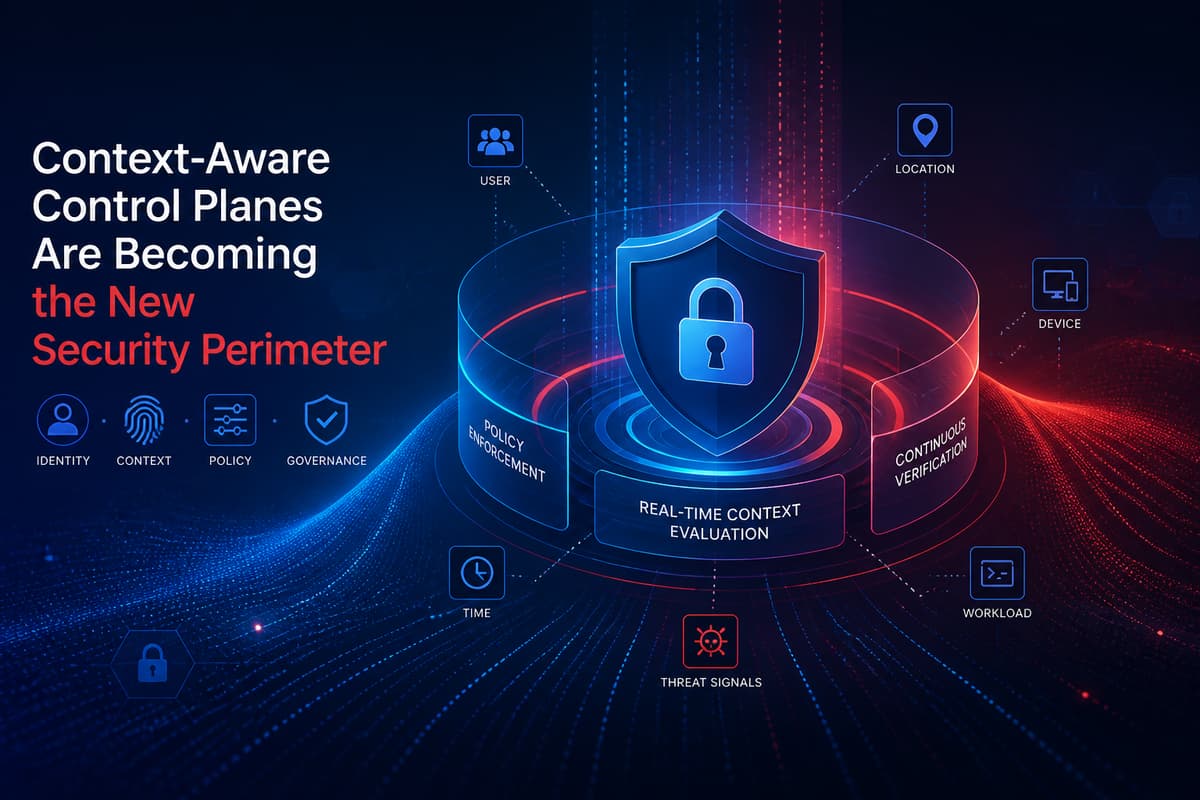
Platform scale and regulatory pressure keep turning “security” into an architectural property, not a product checkbox. Consumer platforms face rising external constraints (litigation, policy changes, monetization shifts), while internal systems must still support hundreds of millions of users and ever more sensitive data. CTOs are getting pushed toward a single direction: design for fine-grained control, continuous evaluation, and durable auditability.
Databricks is signaling a governance shift with “contextual policies” in Omnigent, focused on preventing risky combinations of otherwise-allowed actions (the “innocent until combined” problem) rather than only checking static permissions at the door. The same Databricks cycle also highlights the data-shape change: a native FILE column type for multimodal assets expands the governance surface from rows and columns to blobs, embeddings, and derived artifacts, with lineage and policy expectations attached to each step in the pipeline (Databricks Blog: contextual policies; Databricks Blog: FILE type).
Infrastructure teams are making parallel moves on the identity side. Canva’s session revocation redesign uses Amazon S3 as a durable revocation store to reduce hot-path database lookups while handling revocation across roughly 100M active sessions (InfoQ). The key architectural idea is not “S3 for auth,” it is a control plane separation: durable, cheaply scalable state for security decisions, plus distribution mechanisms that keep enforcement close to the request path. That pattern matches what contextual policy engines are doing for data access: decouple decision state from enforcement, then scale both independently.
External pressures amplify the need for provable controls. Google Play reopening to rival app stores after court-ordered changes increases distribution complexity and raises the stakes for supply-chain integrity, policy enforcement, and telemetry consistency across channels (TechCrunch on Aptoide). Social platforms also remain under heavy litigation around addictive design, keeping attention on governance, audit trails, and risk management, not only feature velocity (TechCrunch on addiction lawsuits). Control planes become a way to answer “who did what, under which policy, with what context” across heterogeneous surfaces.
CTOs should treat context-aware policy as a product platform, not a security add-on. Practical moves: (1) unify policy definitions across data, identity, and application actions (one vocabulary, multiple enforcement points), (2) separate durable decision state from low-latency enforcement so scale does not force weaker controls, (3) extend governance to multimodal and derived AI assets (files, embeddings, generated outputs), and (4) instrument for auditability by default because legal and partner ecosystems increasingly demand it.
Actionable next steps for the next quarter: pick one high-risk workflow (session revocation, privileged data export, model artifact access), implement continuous evaluation with explicit context signals, and measure the operational cost (latency, incident rate, on-call load). Security posture improves when the control plane becomes boring, cheap, and ubiquitous.
Sources
- https://www.databricks.com/blog/innocent-until-combined-blocking-lethal-trifecta-omnigent-contextual-policies
- https://www.databricks.com/blog/introducing-file-type-native-column-type-multimodal-data
- https://www.infoq.com/news/2026/08/canva-session-revocation-scale/
- https://techcrunch.com/2026/08/10/aptoide-becomes-the-first-rival-app-store-to-return-to-google-play-in-the-us/
- https://techcrunch.com/2026/08/10/social-media-platforms-still-facing-thousands-of-user-addiction-lawsuits-after-failed-appeals/