AI Agents Are Forcing a Security Reboot: From “Login Trust” to Continuous Authorization
Enterprises are shifting from session-based trust to continuous, identity- and policy-driven authorization to safely run AI agents across cloud, OS, and data platforms—treating agents as first-class...
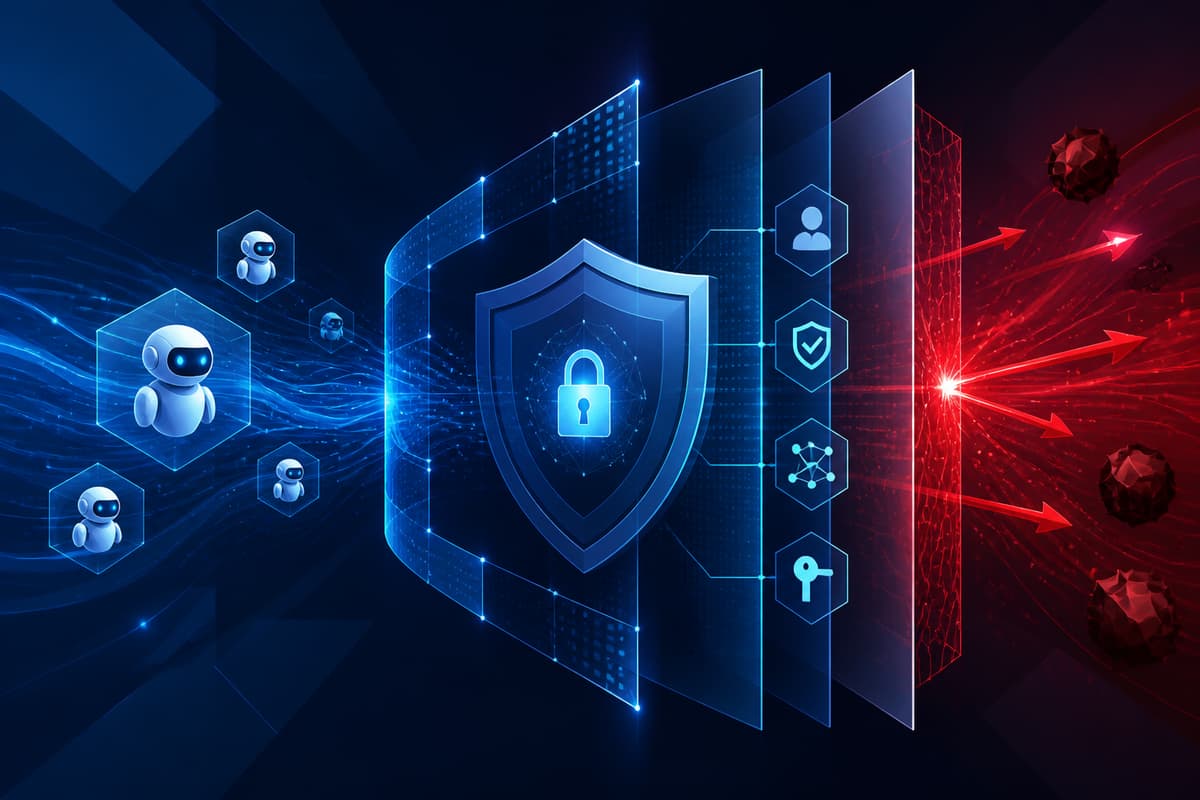
AI agents are quickly becoming a new execution layer in enterprise software: they don’t just answer questions, they take actions across tools, data, and infrastructure. That changes the security problem. The old model—authenticate once, then trust the session—breaks down when an autonomous actor can chain hundreds of tool calls, operate for long durations, and interact with sensitive systems. Over the last 48 hours, multiple platform vendors and architecture voices converged on the same conclusion: production-grade agentic systems require continuous authorization and auditable identity, not just better prompts.
InfoQ’s architecture piece on continuous authorization for sensitive cloud systems frames the core issue: most systems make a single authorization decision at login, leaving a large “trust gap” afterward where breaches occur—especially in regulated environments (InfoQ). In parallel, Microsoft is making the agent surface area explicit: it announced an Azure Functions serverless agents runtime (agents defined via .agent.md, triggers, MCP server access, and many connectors) and is positioning Windows as a “trustworthy OS for autonomous agents,” emphasizing platform security for agents (InfoQ, InfoQ). The subtext is important for CTOs: vendors are standardizing agent runtimes and agent connectivity, which expands the blast radius unless authorization becomes continuous and context-aware.
Data platforms are moving the same direction. Snowflake’s Data-Model-Agent framework explicitly focuses on prompt injection defense, “zero-copy governance,” and—most tellingly—auditable agent identity (Snowflake). This is a shift from “secure the model” to “secure the actor”: who/what is the agent, what data/tools can it access right now, and how do you prove what it did later? Meanwhile, AWS highlights network-level identity verification to reduce SMS OTP fraud, reinforcing the broader pattern that identity signals are moving deeper into infrastructure layers—not just app logic (AWS).
The emerging architectural pattern is a new trust boundary: treat agents as first-class principals (like users and services) with their own identities, scoped entitlements, and explicit policy evaluation on every meaningful action. In practice, “continuous authorization” for agents looks like: (1) short-lived credentials and step-up checks for high-risk actions, (2) policy decisions that incorporate real-time context (device posture, network signals, data sensitivity, tool risk), and (3) immutable audit trails that connect an agent’s intent, tool calls, and resulting data access. This also aligns with the governance question of decision rights—what humans delegate to AI and under what constraints—which MIT CISR highlights as a core management challenge (MIT CISR).
Actionable takeaways for CTOs:
- Design for “authorization at every hop,” not “auth at the door.” For agent tool use, require explicit policy checks per action category (read vs write, low-risk vs irreversible).
- Make agent identity auditable and separable from human identity. Avoid “agent runs as a user” anti-pattern; create distinct principals with minimal privileges and tight scopes.
- Instrument agent activity like production traffic. Adopt strong observability around tool calls, data access, and policy decisions (and retain logs for forensics/compliance).
- Push identity signals down the stack. Combine application auth with platform and network signals (device, OS trust, network verification) to reduce fraud and lateral movement.
The big shift: AI agents are turning security from a perimeter/session problem into a continuous control system. CTOs who update their architecture now—identity, policy engines, auditing, and runtime guardrails—will be able to adopt agent runtimes safely. Those who bolt security on after agents are already wired into dozens of connectors will find that “prompt safety” is the least of their problems.
Sources
- https://www.infoq.com/articles/continuous-authorization-cloud/
- https://www.infoq.com/news/2026/06/azure-functions-serverless-agent/
- https://www.infoq.com/news/2026/06/windows-security-agents/
- https://www.snowflake.com/en/blog/securing-the-agentic-enterprise/
- https://aws.amazon.com/blogs/architecture/reducing-sms-otp-fraud-with-vonage-network-powered-solutions-and-amazon-cognito/
- https://cisr.mit.edu/publication/AIDecisionMatrix_Framework