The New Enterprise AI Battleground: Context Planes, Interoperability, and Agent-Speed Guardrails
Enterprise AI is entering a “context plane” phase: organizations are investing in unified context layers (catalogs, semantics, permissions, and lineage) and interoperability standards, while...
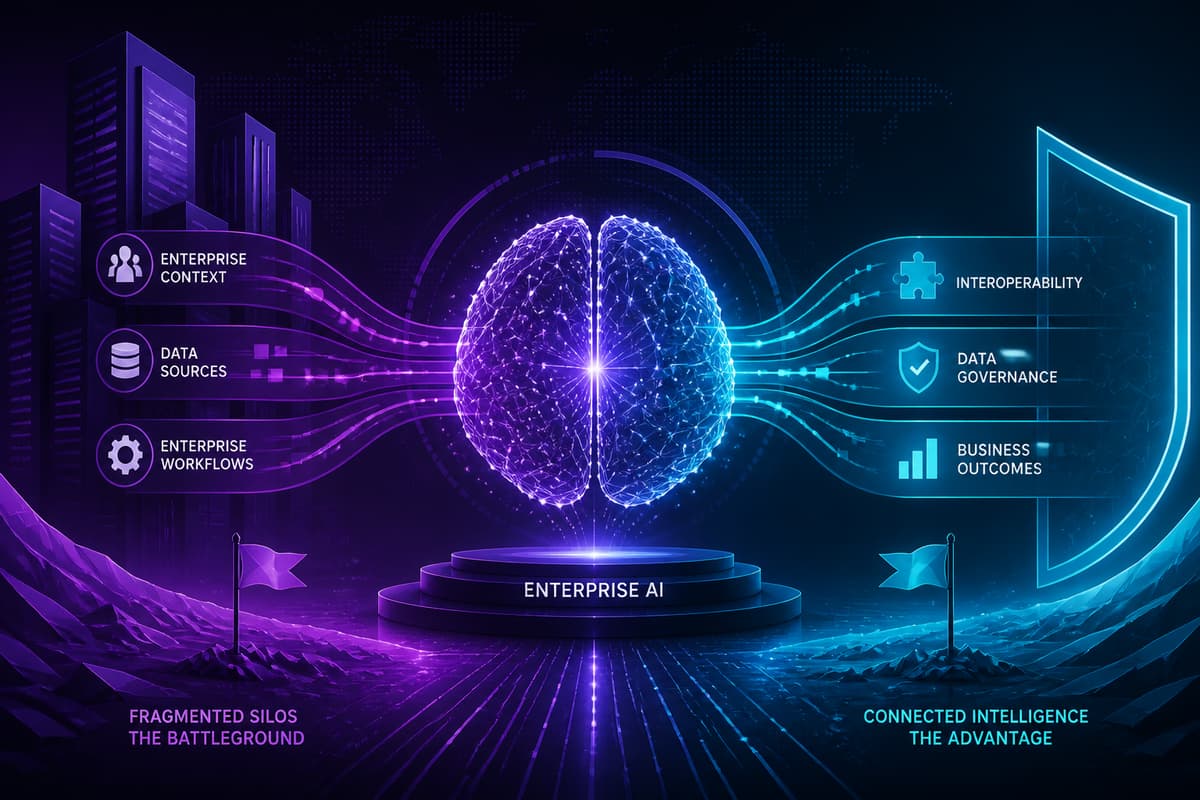
Enterprise AI programs are moving past demos and into daily workflows. The bottleneck is no longer “Which model?” The bottleneck is whether agents can access the right data, with the right meaning, under the right permissions, without blowing up spend.
Databricks is naming the core requirement directly: a unified context layer that sits underneath “AI coworkers” and connects data, semantics, governance, and operational signals across the organization (Databricks, “Unified context: The missing layer for enterprise AI coworkers”). Databricks is also signaling that context work is becoming a first-class engineering discipline by introducing a context engineer certification and agent trainings to address the skills gap in agentic AI (Databricks, “The skills gap behind agentic AI…”). That pairing matters. A new layer in the stack usually creates a new role, and organizations that treat context as an ad hoc prompt-engineering task will struggle to scale beyond pockets of success.
Snowflake’s latest interoperability push points to the same architectural destination, but from a vendor-boundary perspective. The Snowflake team argues that “data agency” requires bidirectional interoperability, calling out the Iceberg REST Catalog protocol as the mechanism that lets enterprises avoid one-way doors for metadata and governance (Snowflake, “The Open Interoperability Standard: Why Bidirectional Iceberg REST Matters”). The strategic read for CTOs is that the context plane is becoming a competitive surface area, and open protocols are becoming procurement leverage. Catalogs, policies, and lineage are no longer internal plumbing. Those capabilities determine how quickly teams can swap tools, add new agent frameworks, and keep governance consistent.
Agentic workflows also change the failure mode. InfoQ describes incidents where attackers or misconfigurations led to agent-accessible cloud credentials producing extreme spend in hours, outpacing billing controls designed for slower, human-driven mistakes (InfoQ, “AI Agents with Cloud Credentials Are Outrunning Billing Guardrails Built for Human-Speed Mistakes”). The core issue is not only key leakage. The issue is that agents can execute high-cardinality actions (API calls, tool invocations, job fan-out) at a rate that multiplies blast radius. Traditional guardrails like periodic budget alerts, coarse IAM roles, and post-hoc anomaly review become insufficient.
CTO takeaway: treat “context” as a platform product with explicit interfaces. Build a context plane roadmap that includes (1) a governed semantic layer (entities, metrics, definitions), (2) policy enforcement that travels with data and tools (attribute-based access, purpose-based controls where needed), (3) interoperable catalogs and metadata flows (Iceberg REST and equivalent standards where applicable), and (4) agent-speed safety systems (short-lived credentials, per-agent spend caps, tool-level allowlists, rate limits, and real-time anomaly shutdown). Then staff it accordingly, either by growing context engineers internally or by formalizing the skill set in hiring and training.
The next 12 months will reward organizations that can answer one question crisply: “What can an agent do, on whose behalf, against which data, for how much, and how fast?” The teams that can encode that answer into a reusable context plane will ship more agentic features with fewer surprises.
Sources
- https://www.databricks.com/blog/unified-context-missing-layer-enterprise-ai-coworkers
- https://www.databricks.com/blog/skills-gap-behind-agentic-ai-and-how-databricks-closing-it-new-context-engineer-certification
- https://www.snowflake.com/en/blog/bidirectional-interoperability-snowflake-horizon-databricks/
- https://www.infoq.com/news/2026/07/ai-agents-billing-guardrails/
▶ Interactive tool
Put this into practice — free, no sign-up
Run your own numbers in these interactive tools built for exactly this decision.