Enterprise architecture and software architecture as the core CTO model
Enterprise architecture and software architecture as the core CTO model
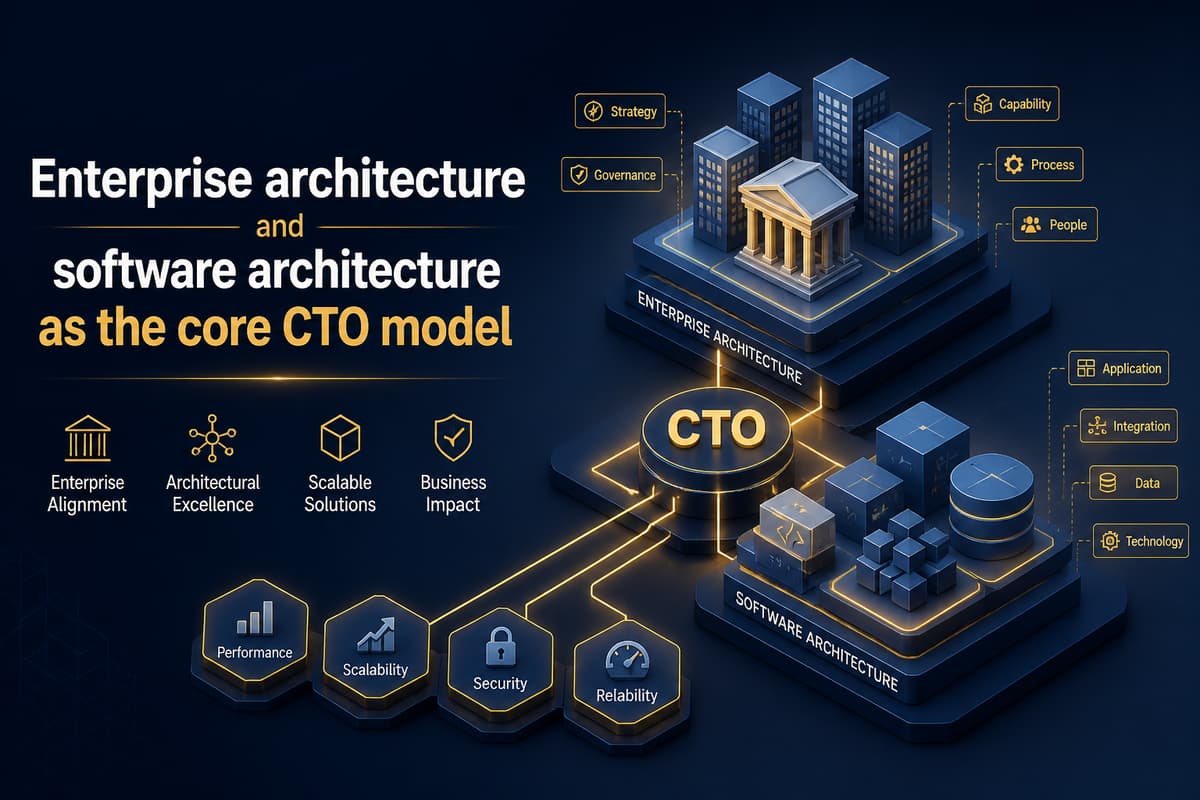
Table of Contents
Enterprise architecture and software architecture as the core CTO model
In 2025, Gartner published an enterprise architecture benchmark infographic based on 26 activities across six objectives, and positioned it as a way to compare EA maturity against peers (Gartner IT Score for EA). That framing matters for CTOs because architecture isn’t a slide deck. Architecture is the operating system for how your company changes.
Enterprise architecture (EA) and software architecture sit at the center of the “good CTO” model. EA draws the map of capabilities, data, and risk. Software architecture turns that map into systems that ship weekly and survive incidents.
Enterprise architecture for CTOs
We use enterprise architecture as a management system for change. EA connects business capabilities to applications, data, infrastructure, cost, and risk. EA also sets the rules for how teams make tech decisions without pulling the CTO into every meeting.
Software architecture lives closer to code. It covers service boundaries, data flows, runtime behavior, and failure modes. CTOs need both views at the same time. EA without software architecture turns into a catalog that nobody uses. Software architecture without EA turns into local wins and a global mess.
The Art of CTO definition: Enterprise architecture is the smallest set of shared models and rules that lets a company change safely at speed.
EA usually includes a capability map tied to revenue and regulated processes, a system and data inventory with owners and lifecycle state, a set of standards and guardrails like identity, logging, encryption, and APIs, and a target state with a roadmap that teams can execute.
LeanIX describes EA maturity as a continuous process that reinvents itself to support business transformation, with measurement and governance as core parts (LeanIX on EA maturity models). Product roadmaps shift, compliance scope expands, vendors change pricing, and suddenly your “temporary” workaround is running payroll.
EA also needs an operating model. Info-Tech frames an “Agile Enterprise Architecture Operating Model” around work like identifying strategy risks, aligning budgets, and prioritizing improvements, then planning execution (Info-Tech EA operating model). The template isn’t the point. The cadence is. The explicit link to risk and spend is what keeps EA from drifting into diagram theater.
Software architecture as the CTO’s execution engine
Software architecture is where strategy becomes constraints teams can actually code against. CTOs who treat architecture as optional end up paying for it anyway, just later, in slower delivery, brittle systems, and surprise costs. CTOs who treat architecture like a living product get compounding returns.
Netguru argues for “infrastructure as a product” and calls out metrics like time-to-deploy, cost per environment, and a DevEx score as ways to measure ROI (Netguru on modern architecture for CTOs). Those metrics sit right at the seam between architecture and leadership. Engineers feel the friction first. Finance sees the bill later.
I keep coming back to a simple split of responsibilities. EA decides what the company must be able to do. Software architecture decides how systems do it under load and failure. Platform engineering decides how fast teams can repeat it.
Red Hat’s overview of enterprise architecture trends points out the hybrid reality. AppDev teams still need systems that run across cloud and on-prem, and architects need to equip teams with tools like Kubernetes or OpenShift for container management (Red Hat EA trends). Hybrid isn’t an academic constraint. Hybrid changes how you design identity, networking, and data gravity. It also changes what “standard” even means.
The CTO architecture loop
CTOs need a repeatable loop that ties architecture to outcomes. I use a four-step loop that fits quarterly planning and weekly delivery.
- Decide: pick a small set of architecture bets.
- Design: set guardrails and reference patterns.
- Deliver: ship through teams and platforms.
- Defend: run it, measure it, and learn from incidents.
The “defend” step is where architecture either earns respect or becomes shelfware. If you want architecture to matter, you need operational feedback. Our piece on Agent Ops arriving with benchmarks and guardrails makes the same point in the AI domain. Production systems need acceptance tests beyond feature demos, and architecture needs the same kind of reality check.
A real scenario: the payments rewrite that never ends
A common failure mode is predictable. A company runs a monolith that processes payments, refunds, and chargebacks. The team starts a rewrite into microservices. Six months later, the rewrite has 12 services, three databases, and no clear owner for end-to-end correctness.
EA would have forced two questions early:
- Which business capabilities are in scope, and which are not?
- Which data is system of record, and who owns it?
Software architecture would have forced three more:
- What is the transaction boundary, and how do we handle partial failure?
- What is the idempotency strategy for retries?
- What is the rollback plan for schema changes?
Without those answers, teams ship code, but the business doesn’t get outcomes. The rewrite turns into a second system that still can’t be trusted.
AI changes the pace, not the need
Premium AI Guide claims AI lets architectures iterate faster with less manual effort, and with more assurance of best practices (Architectural agility and AI). Speed is real. The problem is that speed also raises the cost of bad defaults. You can ship a mistake into production faster than ever.
AI also pushes architecture deeper into identity and governance. Our article on governance moving from policy docs into architecture explains why runtime controls matter more than static rules. Architecture becomes the enforcement layer, not the suggestion box.
Enterprise architecture operating models and maturity
But maturity work only matters if it changes decisions and delivery. EA fails when it behaves like a central committee. EA also fails when it behaves like a documentation team. CTOs need EA to act like a product function, with a service level, a backlog, and outcomes you can point to.
Martin Fowler draws a useful boundary: application architecture focuses within an application boundary, while enterprise architecture looks across a large enterprise with many codebases and teams that developed in isolation, with independent funding and users (Fowler on enterprise architecture). That’s the maturity problem in one sentence. If you don’t create coordination mechanisms, you still get coordination, just via outages, escalations, and surprise integration work.
The Essential Project case studies describe EA work that ties models to cost and decision support. One Global NGO case study reports an ROI of over 800% in 12 months after a six-week “value drop” that improved perception and delivered savings (Essential case studies). Treat that number as a vendor case study claim, but don’t miss the pattern. EA wins when it ships value fast, not when it perfects the taxonomy.
A CIO Index case study collection highlights a lesson many CTOs learn the hard way. TOGAF can be a starting point, but real EA practices tailor the framework and drop the parts that don’t drive outcomes (CIO Index EA case studies). Framework purity doesn’t pay your cloud bill.
Pick an EA operating model that matches your business
The “4 enterprise architecture operating models” video uses examples like Marriott and McDonald’s to show different levels of process and system unification across a company (EA operating models video). The Marriott example works because loyalty, identity, and customer data have to travel across locations. No amount of local autonomy fixes a broken customer profile.
CTOs can turn that into a concrete choice:
- High unification: shared data, shared platforms, strict standards.
- Low unification: local autonomy, looser standards, more integration work.
High unification cuts duplicate systems but raises coordination cost. Low unification speeds local delivery but raises integration and security cost. Pick the pain you can afford, then design the operating model around it.
A link-worthy tool: the CTO Architecture Decision Matrix
Use this matrix in planning and in architecture reviews. The goal isn’t perfect scoring. The goal is to make trade-offs explicit, while the decision is still reversible.
| Decision | Speed to ship (0-5) | Run cost (0-5) | Risk and compliance (0-5) | Talent and DevEx (0-5) | Reversibility (0-5) | Notes |
|---|---|---|---|---|---|---|
| Build new service | ||||||
| Buy SaaS | ||||||
| Keep legacy | ||||||
| Modernize in place |
Rules that make the matrix work:
- Score “reversibility” as a first-class input. Lock-in is an architecture choice.
- Force a note on the system of record and data retention.
- Require an owner for the decision and the follow-up work.
If you want a more formal version, our Build vs Buy Matrix tool gives a weighted model you can reuse in procurement.
Why enterprise architecture matters for CTOs
EA and software architecture change four things boards and CEOs care about: speed, cost, risk, and talent. CTOs earn credibility when they can connect each one to a concrete scenario, not a diagram.
Speed shows up in time-to-deploy and time-to-recover. Netguru calls out time-to-deploy as a core metric for infrastructure-as-product work (Netguru on modern architecture for CTOs). CTOs can translate that into targets like “new service to production in under 60 minutes” or “new environment in under 15 minutes.” Targets like that force platform and architecture work that removes friction. Targets like that also expose where the real bottleneck lives (spoiler: it’s often approvals and unclear ownership).
Cost shows up in duplicate systems and unused capacity. EA inventories expose redundant tools, overlapping CRMs, and shadow data pipelines. The Essential Project describes license cost savings from better IT selection decisions in an international media company (Essential case studies). CTOs can copy the pattern by tying every major tool to a capability owner and a renewal date. Ownership plus renewal dates create pressure to clean up, because the bill is about to hit.
Risk shows up in regulated flows and incident blast radius. Red Hat points out hybrid deployments across cloud and on-prem, which expands the attack surface and complicates controls (Red Hat EA trends). EA makes risk visible by mapping data classes to systems and integrations. Software architecture then shrinks blast radius with isolation, least privilege, and sane defaults. Risk work gets easier when you can answer “where does PCI data go?” without opening five different spreadsheets.
Talent shows up in developer experience and retention. Netguru argues developer experience becomes a differentiator, and suggests tracking a DevEx score (Netguru on modern architecture for CTOs). CTOs can make DevEx real by measuring onboarding time, local build time, and deploy friction. A team that ships twice a week won’t tolerate a two-day environment setup. They’ll route around it, and that’s how you get snowflake environments and tribal knowledge.
AI raises the stakes across all four. Our piece on engineering work leaving the laptop explains why identity becomes the control plane as work shifts into cloud agents and shared runtimes. EA and software architecture decide how identity, policy, and audit work across that shift. If identity is messy, everything downstream is messy.
CTO actions: build the architecture practice
CTOs need actions that change behavior in 30 days, not a two-year “EA program.” The goal is a small practice that earns trust, then expands.
I break the work into three tracks: immediate actions, a policy framework, and architecture principles.
Immediate actions (next 30 days)
Start by making the current state visible and owned. LeanIX stresses the value of a real-time overview of the IT landscape and stakeholder-specific views (LeanIX on EA maturity models). You don’t need LeanIX to start. You need a list that’s correct enough to drive decisions, and a process that keeps it from rotting.
What should you inventory first? Start with what can hurt you fastest: customer data flows and money flows.
Actions:
- Build a “top 20 systems” list with owners, spend, and renewal dates.
- Map three end-to-end flows: signup, checkout, and support case.
- Tag each system with data class (PII, PCI, PHI, internal).
- Set a weekly 45-minute architecture review for high-risk changes.
If incident learning is weak, fix that early. Use our guide to incident postmortems to standardize action items and owners, then feed the results back into architecture guardrails. Incident reviews that don’t change guardrails are just storytelling.
Policy framework (next 90 days)
Policy needs to live in code and pipelines, not in PDFs. Softacom describes modernization programs that rely on CI/CD automation, feature flags, blue green, canary, and SRE practices like SLOs and incident reviews (Softacom legacy modernization trends). Those practices become your enforcement points. If a policy can’t be checked, it won’t be followed.
The policy model I use has three layers:
- Guardrails: non-negotiables like encryption, logging, and identity.
- Standards: preferred tools and patterns, with an exception path.
- Recommendations: good defaults that teams can ignore.
Actions:
- Write five guardrails and publish them in the repo template.
- Add CI checks for dependency scanning and secret detection.
- Require service owners to publish SLOs for tier 0 and tier 1 systems.
- Create an exception process with a 30-day expiry and named approver.
If you want to track this work as a portfolio, Command Center helps. Use Command Center to track risks, incidents, migrations, and team capacity in one place.
Architecture principles (next 6 to 12 months)
Principles keep architecture from turning into taste wars. Red Hat calls out hyperautomation and hybrid cloud as forces that shape enterprise architecture choices (Red Hat EA trends). AI adds another force: faster iteration and more automation in design and delivery (Architectural agility and AI). Principles help you absorb those forces without thrashing every quarter.
Pick a small set. Five is enough, and you’ll still argue about them.
Actions:
- Define system of record for every core domain (customer, billing, identity).
- Standardize identity and auth flows across services.
- Prefer asynchronous integration for cross-domain events.
- Design for failure with timeouts, retries, and idempotency.
- Treat platforms as products with owners and roadmaps.
Netguru describes platform roles like platform owners, component owners, and feature owners, and frames infrastructure product owners as “CEOs” for their products (Netguru on modern architecture for CTOs). That ownership model is the leadership half of architecture. Without owners, principles decay into “nice ideas” and teams do whatever the loudest person wants.
If you need to model dependencies, use our Microservices Dependency Mapper to make service coupling visible before the next reorg or migration.
Architecture as the CTO job
EA and software architecture sit at the center of building systems and leading people. Architecture sets the constraints that make teams fast. Architecture also sets boundaries that reduce conflict between teams, because it answers “who owns what?” before the incident hits.
Architecture is also how you respond to world events without panic. Regulatory pressure pushes compliance into pipelines. Supply chain risk pushes you to know what you run and who maintains it. AI pushes work into shared runtimes where identity and audit matter more than ever. None of those pressures are going away.
A good CTO model treats architecture like a product with users, metrics, and a roadmap. Pick your operating model, publish guardrails, and measure time-to-deploy, cost per environment, and SLO health. Then make one hard call: which two architecture bets will you fund this quarter, and which ones will you stop pretending you’ll do?
Sources
- Modern Architecture for CTOs: Treating Infrastructure as a Product
- An overview of 7 tech trends reshaping enterprise architecture
- Architectural Agility and the CTO's Imperative: Navigating Today's AI Tsunami
- Legacy Modernization Trends: What CTOs Must Know
- Enterprise Architecture Case Studies Collection
- Case Studies, The Essential Project
- The 4 Enterprise Architecture Operating Models Explained (YouTube)
- Agile Enterprise Architecture Operating Model, Info-Tech Research Group
- Infographic: Benchmark Data From the IT Score for Enterprise Architecture (2025), Gartner
- Enterprise Architecture Maturity Models For Long-Term Success, LeanIX
▶ Interactive tool
Put this into practice — free, no sign-up
Run your own numbers in these interactive tools built for exactly this decision.