From Agent Demos to Agent Platforms: Stateless Protocols, Context-Ready Data, and Telemetry Become the New Stack
AI systems are moving from prototype agents to production agent platforms, forcing architectural changes in three places at once: stateless integration protocols, context-ready data layers, and...
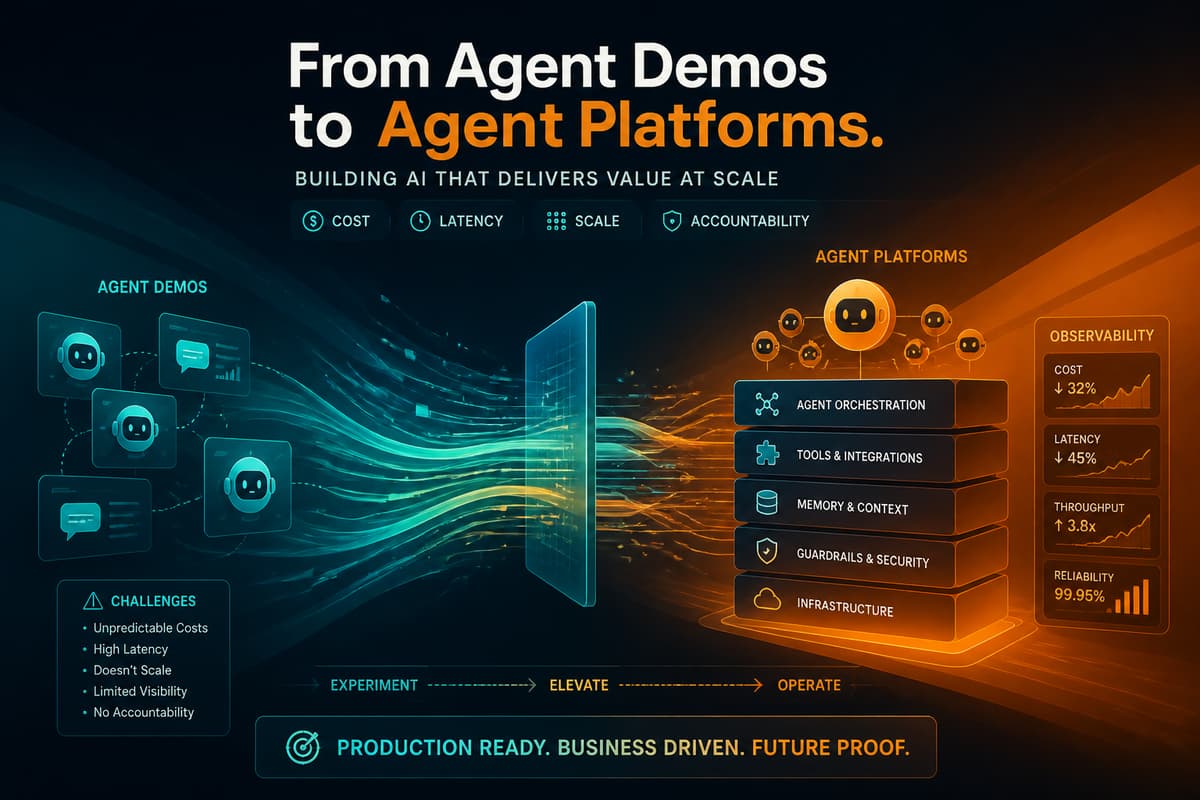
AI adoption is exiting the demo phase and colliding with production constraints: cost, latency, scale, and accountability. Recent coverage shows the stack changing in response, not at the model layer alone, but in the infrastructure, the data layer, and the operational tooling that keeps agent behavior predictable.
A first signal is infrastructure and scale economics. TechCrunch reports British AI “neocloud” Nscale raising $3.36B in convertible financing ahead of a US IPO to fund a massive AI data center buildout (TechCrunch, Sep 25, 2026). Capital at that level indicates demand for sustained, high-throughput inference and training, which tends to expose hidden architectural bottlenecks upstream: stateful services, chatty storage layers, and brittle integration patterns.
A second signal is protocol design shifting toward statelessness so agent tooling can scale like standard web services. InfoQ covers AWS’s update to the Model Context Protocol (MCP) specification that removes protocol-level sessions and sticky-session requirements for remote MCP servers (InfoQ, Sep 2026). Stateless MCP pushes responsibility for continuity into explicit inputs and externalized state, which makes horizontal scaling and failure recovery simpler. The tradeoff is sharper: context becomes an engineered artifact, not an implicit side effect of a long-lived session.
A third signal is the data layer being remodeled for agents, not dashboards. dbt argues “context engineering” is already possible in the warehouse, starting with semantic search and models designed for agent consumption rather than BI alone (dbt Blog, Sep 2026). In parallel, teams are also rebuilding core storage for performance and cost under AI workloads. InfoQ describes Perplexity replacing DynamoDB with an internal Rust key-value store (CobbleDB) to cut query latency by 5x and reduce cloud storage costs (InfoQ, Sep 2026). Agentic systems amplify read patterns and tail-latency sensitivity, so storage decisions become product decisions.
Observability is the fourth leg, because agent platforms fail in new ways. Grafana’s approach to converting Cypress test results into Prometheus metrics and persisting them in Grafana Cloud reframes tests as time-series signals (InfoQ, Sep 2026). That pattern maps cleanly onto agent platforms: treat evaluations, regressions, and tool-call outcomes as telemetry, then alert on drift. CTOs also face a governance parallel: Chief Executive highlights heightened oversight and the need for consistent, explainable decision narratives under scrutiny (Chief Executive, Sep 2026). Agent systems increase the surface area of “why did the system do that,” and the organization needs evidence, not anecdotes.
CTO takeaways:
- Design for stateless scaling early. Stateless protocols (like MCP’s direction) reduce operational fragility, but require deliberate external state, idempotency, and replayable inputs.
- Build a context supply chain. Warehouse models, semantic layers, and retrieval indexes need contracts, freshness guarantees, and cost budgets, because “context” becomes production data.
- Make evaluation and testing observable. Persist agent and test outcomes as metrics, then manage agent quality like SLOs, not like ad hoc QA.
- Revisit storage with AI read patterns in mind. Latency and cost pressures can justify specialized stores or new caching tiers, as shown by CobbleDB’s results.
- Prepare an explainability posture. Decision traceability, audit logs, and consistent narratives are becoming operational requirements, not compliance afterthoughts.
Sources
- https://techcrunch.com/2026/09/25/ahead-of-u-s-ipo-british-ai-neocloud-nscale-secures-3-36b-in-convertible-finacing/
- https://www.infoq.com/news/2026/09/aws-stateless-mcp/
- https://www.getdbt.com/blog/context-engineering-in-your-warehouse
- https://www.infoq.com/news/2026/09/cobbledb-perplexity/
- https://www.infoq.com/news/2026/09/grafana-cypress-observability/
- https://chiefexecutive.net/under-congressional-scrutiny-can-your-company-explain-its-decisions/