From AI Policy to Architectural Guarantees: Sovereignty and Resilience Become Platform Requirements
AI-era governance is shifting from policy documents to architecture: regulators and vendors increasingly expect technical guarantees for data sovereignty, access controls, and cyber...
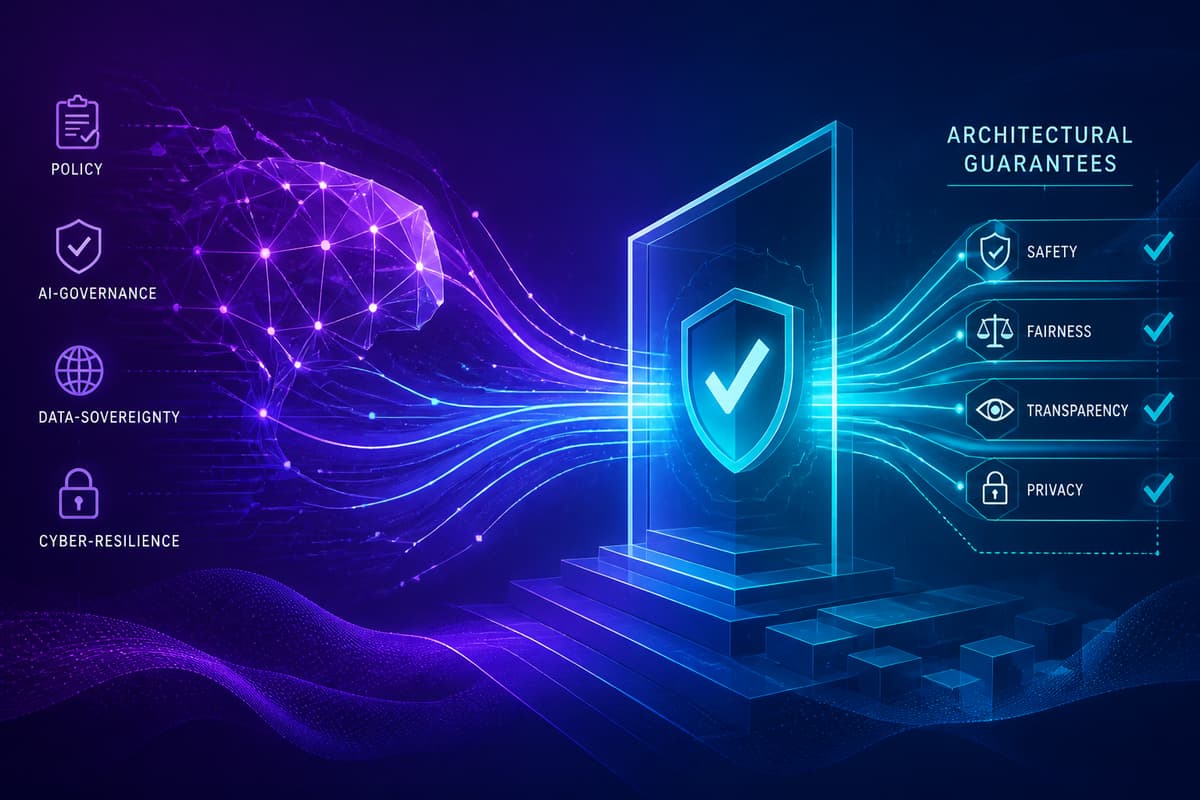
The center of gravity for “responsible AI” is moving: away from high-level principles and toward enforceable system properties. In the last 48 hours, we’ve seen regulators frame frontier AI as a resilience problem, vendors argue sovereignty must be built into data platforms, and fresh breach stories remind everyone that a single misconfiguration or weak access governance can erase trust overnight. For CTOs, this isn’t a compliance footnote—it’s an architectural constraint that will shape platform roadmaps and procurement.
First, the regulatory tone is hardening around operational risk. The Bank of England, FCA, and HM Treasury jointly positioned frontier AI models alongside cyber resilience concerns—implicitly treating AI capabilities as potential amplifiers of outages, security incidents, and systemic risk in critical sectors (Bank of England). In parallel, U.S. political leadership is publicly discussing “AI guardrails” at the geopolitical level, signaling that governance expectations will increasingly cross borders and supply chains (The Hill). Even if your company isn’t regulated like a bank, your customers, partners, and cloud vendors increasingly are—and their requirements will flow down to you.
Second, the vendor narrative is changing from “trust us” to “verify the architecture.” Confluent’s argument is explicit: digital sovereignty in real-time streaming requires architectural guarantees—e.g., BYOC patterns, schema controls, and open protocols—rather than policy promises (Confluent). Separately, Confluent’s case study on turning customer interaction data into real-time intelligence highlights the operational reality: AI-native products are being built on continuous, multi-stream ingestion and analysis, which increases both the blast radius of mistakes and the need for strong governance at the data-in-motion layer (Confluent). In other words: the more “real-time” and “AI-native” you become, the less viable it is to bolt governance on after the fact.
Third, the breach pattern is depressingly consistent—and it’s governance, not “hackers,” that often fails. TechCrunch reports a hotel check-in provider left cloud storage publicly accessible, exposing passports and driver’s licenses (TechCrunch). The BBC reports NHS staff accessed victims’ records inappropriately, and the impacted individuals weren’t told for nearly two years (BBC). One is a configuration failure; the other is an insider/access governance failure. Both point to the same lesson: “we have a policy” is not a control. CTOs should assume auditors, customers, and regulators will increasingly ask for proof: immutable logs, least-privilege enforcement, continuous posture checks, and time-bounded access.
What should CTOs do now? Treat sovereignty and resilience as platform features.
- Make governance measurable at the system boundary: enforce default-private storage, automated public-access detection, and continuous configuration scanning for cloud resources.
- Design for data residency/sovereignty explicitly: decide where data is allowed to live and be processed; prefer architectures that can prove locality and separation (e.g., BYOC/tenant isolation where appropriate).
- Elevate “data-in-motion” controls: apply schema governance, encryption, and authorization to streaming/event pipelines—not just databases.
- Operationalize access governance: implement just-in-time access, strong audit trails, and anomaly detection for sensitive record access; assume insider risk is part of the threat model.
The takeaway: AI is making systems more real-time, more interconnected, and more powerful—so trust will be granted to teams that can demonstrate constraints, not merely describe intentions. The winning CTO playbook in 2026 looks less like writing better policies and more like shipping architectures that make the safe path the default path.
Sources
- https://www.bankofengland.co.uk/news/2026/may/boe-fca-and-hm-treasury-joint-statement-on-frontier-ai-models-and-cyber-resilience
- https://www.confluent.io/blog/real-time-data-streaming-sovereignty/
- https://www.confluent.io/blog/infinitewatch-turning-customer-interaction-data-into-real-time-intelligence/
- https://techcrunch.com/2026/05/15/a-hotel-check-in-system-left-a-million-passports-and-drivers-licenses-open-for-anyone-to-see/
- https://www.bbc.com/news/articles/cgmpz1mxzd9o
- https://thehill.com/homenews/administration/5880013-donald-trump-xi-jinping-china-summit-ai-guardrails/
▶ Interactive tool
Put this into practice — free, no sign-up
Run your own numbers in these interactive tools built for exactly this decision.