From ChatOps to Skill-Based Agents: Why CTOs Now Need Guardrailed Action Architectures
Cloud platforms are moving from “AI assistants that answer questions” to “agents with skills that take actions” across operations, migrations, and troubleshooting.
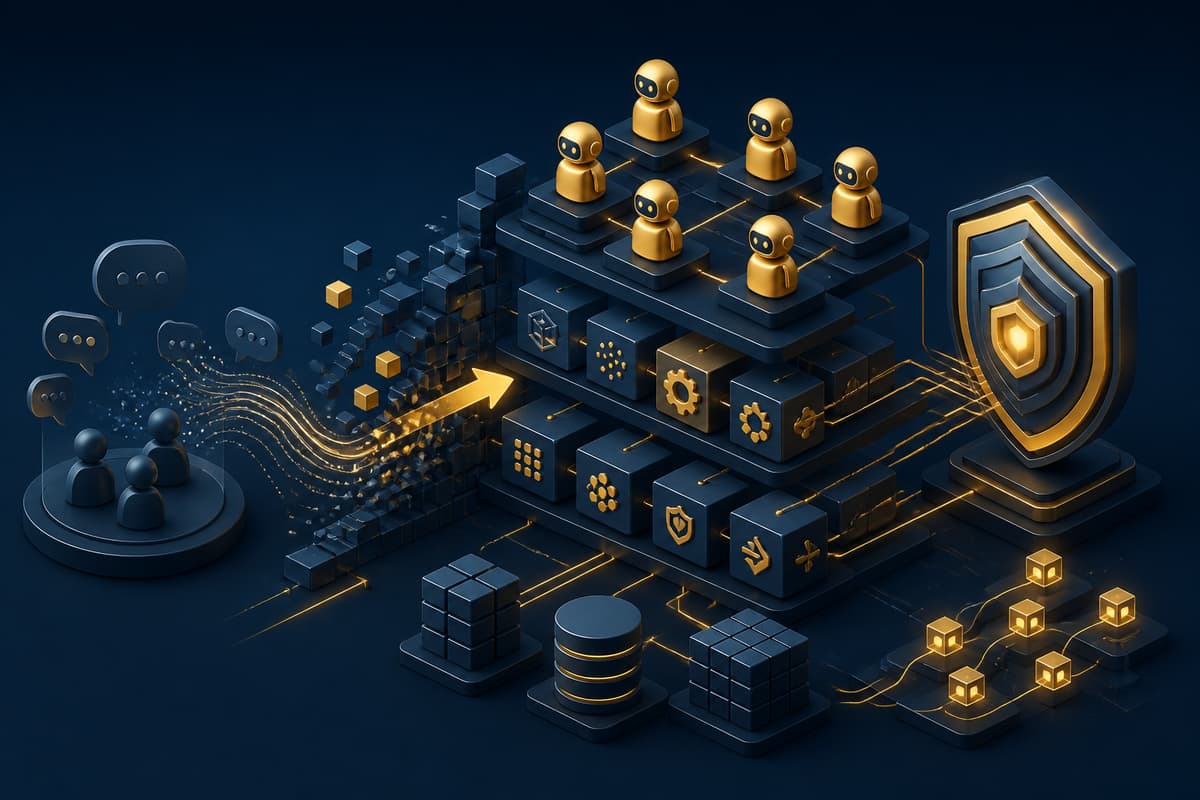
AI in engineering orgs is shifting from conversational help to operational execution. Vendor roadmaps in the last 48 hours show the same direction: agents are being packaged as repeatable “skills” that can run migrations, diagnose failures, and operate managed services. The CTO problem changes immediately, because action-taking systems require architecture for safety, not just usefulness.
Azure’s architecture guidance on choosing between a skill and a sub-agent frames the design question as an engineering tradeoff, not a product preference: use a skill when a bounded capability can be invoked predictably, use sub-agents when decomposition and specialization are needed for a broader workflow (InfoQ). AWS is landing on the same abstraction in operations-heavy domains. Amazon MSK “Agent Skills” package broker-aware operational and migration steps for Kafka clusters (AWS), and Amazon EMR on EKS now has a Spark troubleshooting agent that walks from failure signals to remediation workflows (AWS). The common pattern is a curated action surface: the agent does not do “anything,” it does a constrained set of things.
Execution creates a second-order requirement: permissions and policy have to become machine-evaluable. HubSpot’s redesign of Just-In-Time Access authorization using a rule engine architecture is a strong parallel signal (InfoQ). Rule graphs and independent evaluators create a structure that is easier to test, reason about, and audit than ad hoc authorization logic. Agent skills benefit from the same property. A skill that can roll brokers or change IAM policies needs a policy layer that can answer, deterministically, “allowed under what conditions,” and produce an explanation that survives an audit.
CTOs should treat “skills vs sub-agents” as an architectural boundary decision with operational blast radius. Skills map well to stable runbooks (migrations, standard troubleshooting, DR drills). Sub-agents make sense when a workflow must be decomposed across domains (data platform plus networking plus identity), but decomposition multiplies failure modes and makes observability mandatory. Short version: keep the action surface small.
Practical takeaways for the next quarter:
- Define an agent action contract. Inventory which actions are permissible (read-only diagnostics, safe writes, privileged writes), and ship skills only when inputs, outputs, and rollback are explicit.
- Put policy in a decision engine, not in prompts. A rule-based authorization layer (like HubSpot’s direction) gives testability and audit trails that prompt-only controls cannot.
- Instrument skills like production code. Every skill invocation should emit structured events (who/what/why), link to a change record, and support replay in a sandbox.
- Design for DR and failure, not demos. Operational agents will be asked to act during incidents. Tie agent-run changes to resilience goals, such as multi-Region recovery playbooks in data systems (AWS).
Agentic operations is becoming a platform primitive. The differentiator for engineering leaders will be governance and reliability architecture: which actions are allowed, how decisions are evaluated, and how the organization proves the system behaved safely when it mattered.
Sources
- https://www.infoq.com/news/2026/08/choosing-between-subagent-skills/
- https://aws.amazon.com/blogs/big-data/streamline-apache-kafka-cluster-operations-and-migrations-with-agent-skills-for-amazon-msk/
- https://aws.amazon.com/blogs/big-data/introducing-apache-spark-troubleshooting-agent-for-amazon-emr-on-eks/
- https://www.infoq.com/news/2026/08/hubspot-jita-rule-engine/
- https://aws.amazon.com/blogs/big-data/amazon-redshift-multi-region-disaster-recovery/
▶ Interactive tool
Put this into practice — free, no sign-up
Run your own numbers in this interactive tool built for exactly this decision.