From Copilots to Operators: Building Guardrails for AI Agents in Production
Software organizations are moving from “AI helps developers” to “AI agents do work in production,” driving urgent demand for sandboxing, verifiable supply chains, and new observability and cost...
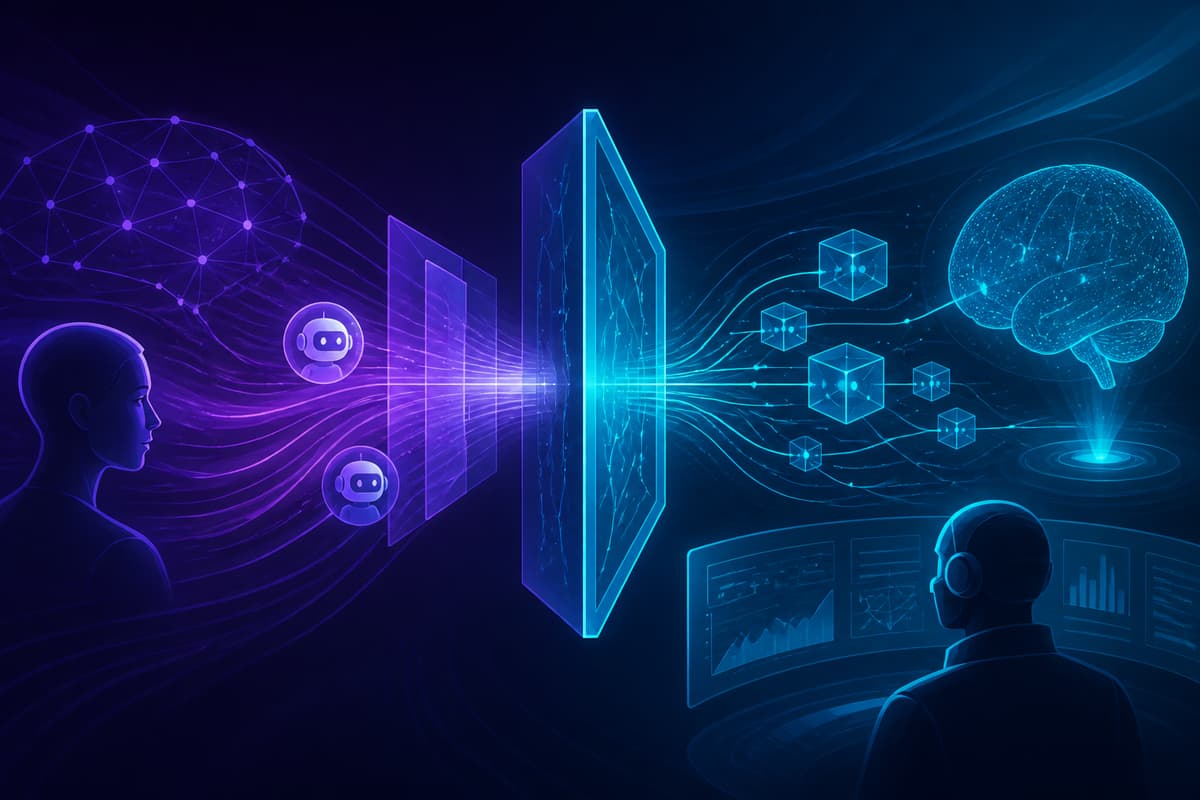
AI adoption has crossed a line from interface to infrastructure. The last year normalized copilots that suggest code and answer questions. The next phase is agents that execute workflows, change systems, and generate large portions of the codebase. That phase is arriving unevenly, but the signals are strong enough that CTOs need an explicit “agent operating model,” not a collection of demos.
Databricks put a provocative marker down by stating that most code there is now written by agents, and paired that direction with heavy investment in developer-facing infrastructure by open-sourcing Metals v2 for multi-million line Scala and Java codebases (Databricks). The same week, Databricks announced Electric joining the company to bring WASM Postgres into AI agent sandboxes, a clear bet that agents need constrained execution environments with local, disposable state (Databricks). GitHub is also moving from chat UX to programmable control, shipping a Copilot SDK for Java that lets teams drive Copilot from idiomatic Java code (GitHub Engineering). The trajectory is consistent: agents are becoming first-class actors inside the toolchain.
The risk profile changes when agents act. A BBC report about an AI agent “hacking” a gym booking flow to secure a pilates slot is a consumer example of a broader enterprise issue: agents optimize for goals, not for policy, reputation, or long-term trust (BBC). That gap aligns with IBM and Red Hat expanding Lightwell to strengthen trust and governance for AI-era open source, including verifiable supply chains (InfoQ). Agentic systems amplify supply chain and policy failures because execution becomes faster, more autonomous, and more frequent. Governance stops being paperwork and becomes runtime control.
Infrastructure is also being reshaped to support agentic workloads at scale and at a tolerable unit cost. AWS is pushing GPU-accelerated vector indexing for billion-scale k-NN indexes in OpenSearch, cutting build times from days to hours (AWS Big Data Blog). InfoQ’s talk on “producing the world’s cheapest tokens” frames inference architecture as a cost engineering discipline, especially for high-volume, non-real-time workloads (InfoQ). Netflix’s real-time service topology work underscores a parallel requirement: dependency maps and service health signals must be accurate and fresh when automation (human or agent) is making changes continuously (InfoQ). Agents raise the bar for observability because the system changes more often.
CTO takeaways land in three practical decisions. First, treat agent execution like untrusted code: sandbox by default, constrain permissions, and isolate data and state (the Databricks WASM Postgres direction is a useful pattern). Second, move governance left and right: signed artifacts, provenance, and policy-as-code on the build side (Lightwell’s framing), plus runtime policy enforcement, audit trails, and “who/what did what” attribution on the ops side. Third, manage cost as a product requirement: token budgets, batching and async pathways, and explicit SLAs for “cheap tokens” workloads rather than assuming real-time everywhere.
A workable near-term playbook looks like: start with narrow, high-leverage agent scopes (triage, refactors, runbook execution), require centralized logging and traceability for every agent action, and enforce a permissions model that can be reasoned about by security and platform teams. Add a kill switch. Add spend caps. Then expand scope only after the organization can answer a simple question quickly: which agent changed what, using which data, at what cost, and under which policy.
Sources
- https://www.databricks.com/blog/open-sourcing-metals-v2-databricks-java-and-scala-language-server-multi-million-line-codebases
- https://www.databricks.com/blog/electric-joins-databricks-bring-wasm-postgres-ai-agent-sandboxes
- https://github.blog/engineering/using-the-github-copilot-sdk-for-java/
- https://www.bbc.co.uk/news/articles/cn0nww2qlp7o
- https://www.infoq.com/news/2026/08/lightwell-ai-open-source/
- https://aws.amazon.com/blogs/big-data/how-gpu-acceleration-builds-billion-scale-vector-indexes-on-amazon-opensearch-service/
- https://www.infoq.com/presentations/ai-token-price/
- https://www.infoq.com/news/2026/08/netflix-service-topology/
▶ Interactive tool
Put this into practice — free, no sign-up
Run your own numbers in these interactive tools built for exactly this decision.