From LLM Demos to Governed Agents: Why Data Portability and Tool Access Just Became Platform Work
AI systems are shifting from “LLM demos” to governed, tool-using agents and real-time ML operating on interoperable data layers.
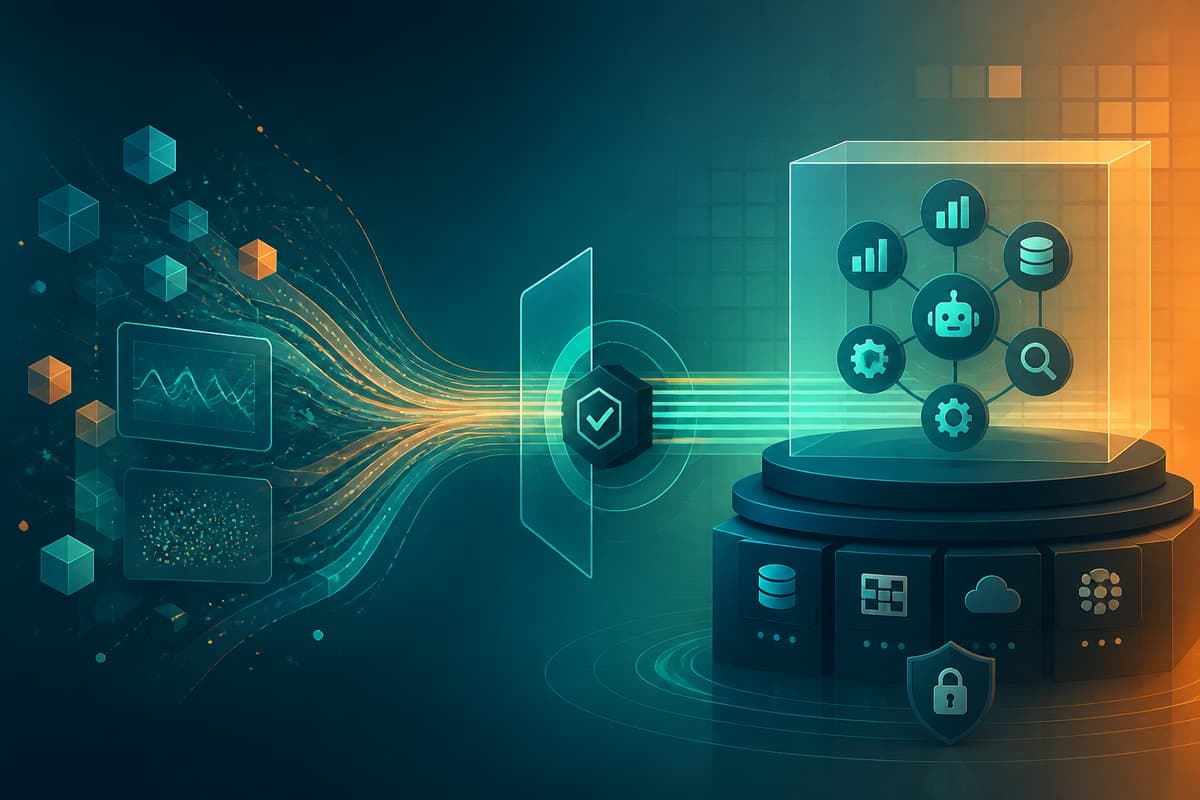
The last year was about proving LLM value; the next phase is about operationalizing AI safely and repeatably. In the last 48 hours of coverage, three threads show up repeatedly: (1) agents are being treated as production software that needs governance, (2) data layers are being rebuilt for interoperability, and (3) real-time signals are becoming the differentiator for ML-driven experiences. For CTOs, this marks a shift: AI is no longer “a model choice”—it’s platform architecture.
First, agent adoption is forcing a new security and control plane. AWS making its managed Model Context Protocol (MCP) server GA emphasizes that the hard problem isn’t just connecting an LLM to tools—it’s doing so with enterprise-grade governance (e.g., IAM-based access to APIs and operational workflows) so agents can act without becoming an unbounded risk surface (InfoQ). In parallel, ByteByteGo’s “RAGs vs Agents” framing is effectively an architectural decision record: use RAG to ground answers in your data; use agents when you need multi-step actions and tool use. The key: the more you move from RAG to agents, the more you need explicit permissions, auditability, and failure-mode design—because the system is no longer just “retrieving,” it is executing (ByteByteGo).
Second, the data foundation is being reshaped around portability. Google Cloud’s push for cross-engine Apache Iceberg support in BigQuery—including a serverless Iceberg REST catalog preview—signals that organizations want to avoid AI/analytics lock-in and standardize on open table formats as the “source of truth” across engines (InfoQ). This matters for AI because agentic and RAG systems amplify the cost of fragmented data: embeddings, retrieval indexes, and evaluation pipelines become brittle when data definitions diverge across warehouses/lakes.
Third, production ML is leaning harder into near real-time. Uber’s description of improving Uber Eats recommendations using near real-time sequence features and transformer-based approaches highlights a broader pattern: competitive advantage is shifting from “better offline model” to “better online system”—fresh signals, fast feature computation, and ranking architectures that can absorb rapid context changes (InfoQ). This is the same operational pressure agentic systems create: if an agent is going to act, it must act on current state (inventory, incidents, permissions, customer context), not yesterday’s batch.
What to do about it as a CTO:
- Treat agent tool access as a platform capability, not per-team glue code. Standardize on a tool protocol (MCP or equivalent), require scoped permissions (least privilege), and build audit trails for every tool invocation.
- Decide where RAG ends and agents begin. Many orgs should start with RAG for answer quality and compliance, then introduce agents only for well-bounded workflows (e.g., ticket triage, runbook execution) with explicit guardrails.
- Invest in an interoperable data layer (Iceberg-like formats, shared catalogs, consistent semantics). This reduces duplicated pipelines for embeddings/retrieval and keeps evaluation reproducible across tools.
- Build for freshness: online features, event-driven pipelines, and latency budgets become core architecture constraints for both recommenders and agents.
The meta-trend: AI is becoming a systems engineering problem again—interfaces, governance, data contracts, and runtime guarantees. CTOs who respond by building an “AI control plane” (permissions + observability + data portability) will move faster and safer than those who keep shipping one-off copilots tied to a single model or warehouse.
Sources
▶ Interactive tool
Put this into practice — free, no sign-up
Run your own numbers in this interactive tool built for exactly this decision.