From LLM Experiments to Operated Agent Stacks: Context Layers, In-House Serving, and OTEL-Native AI
Teams are moving from API-based LLM usage to a full “agent stack” that they operate: in-house serving, a structured enterprise context layer for agents, and production-grade observability that treats...
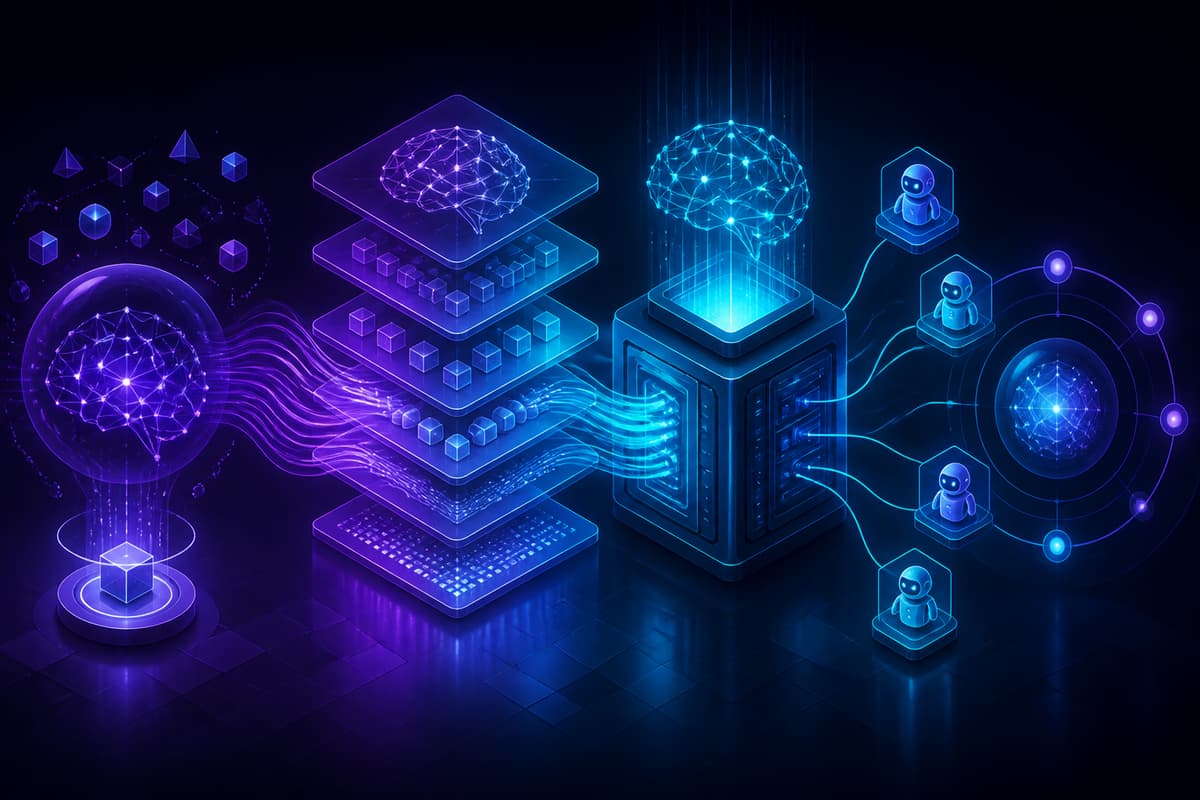
LLM adoption has moved past the phase where a single hosted API key and a few prompts feel like progress. Competitive pressure is rising fast, and model choice is no longer stable for long. CTOs are responding by treating AI as a platform surface: owned serving where it matters, a first-class context layer, and telemetry that makes model behavior debuggable in production.
Netflix provides the clearest signal of the “operate it yourself” direction. The Netflix Tech Blog describes in-house LLM serving across the stack, from deployment through inference, rather than relying solely on hosted APIs (Netflix Tech Blog). The subtext for engineering leaders is cost, control, and reliability, plus the ability to tune runtime and scheduling to workload patterns. Owning the serving layer also reduces vendor coupling when model performance, pricing, or policy shifts.
At the same time, “context engineering” is hardening into a product category. Pinecone’s Nexus positions a knowledge engine that compiles enterprise data into a structured layer that agents can query directly, shifting the problem from raw retrieval to curated, governed business context (InfoQ). That framing matters because many agent failures are not model failures, they are context failures: missing data, stale permissions, ambiguous entities, or untracked provenance. A structured context layer becomes the control plane for accuracy, access, and auditability.
Operational discipline is catching up, and observability is the hinge. An InfoQ presentation describes instrumenting AI agents natively with OpenTelemetry and distilling frontier-model behavior into smaller, task-specific models using production telemetry (InfoQ). Production traces and spans are no longer only for microservices. Agent runs need the same treatment: tool calls, retrieval steps, policy checks, latency budgets, and failure modes. Short version: if the team cannot trace it, the team cannot ship it.
Model competition and geopolitics raise the stakes for optionality. TechCrunch and the BBC both highlight Moonshot AI’s new Kimi release and claims that Kimi K3 can rival leading US models (TechCrunch, BBC). A rapidly shifting frontier increases the value of an internal abstraction layer that allows model swaps without rewriting product logic. Vendor diversity also becomes a resilience strategy when availability, regulation, or procurement rules change.
Action for CTOs: treat the “agent stack” as a platform roadmap. Start by separating concerns: (1) model serving (hosted vs self-hosted, with clear SLOs), (2) a governed context layer (identity, provenance, freshness, entity resolution), and (3) OTEL-native instrumentation for every agent run. Decide where differentiation lives. If differentiation depends on latency, privacy, unique workloads, or tight integration, in-house serving like Netflix’s approach becomes more compelling. If differentiation depends on business context, invest in the structured layer and the data contracts behind it. Then require traces for every agent capability before broad rollout. No trace, no launch.
Sources
- https://netflixtechblog.com/in-house-llm-serving-at-netflix-a5a8e799ea2c?gi=f3ee771b665d&source=rss----2615bd06b42e---4
- https://www.infoq.com/news/2026/07/pinecon-nexus-knowledge-engine/
- https://www.infoq.com/presentations/otel-slm-ai/
- https://techcrunch.com/2026/07/18/kimi-threat-or-menace/
- https://www.bbc.co.uk/news/articles/cy9w4q8pgp0o