Model-Driven Ops Is Becoming the Only Way to Survive the Agentic Change Rate
Engineering orgs are adopting model-driven automation (graphs, state machines, continuous behavioral analysis) to keep reliability and security intact as AI-assisted and agentic development...
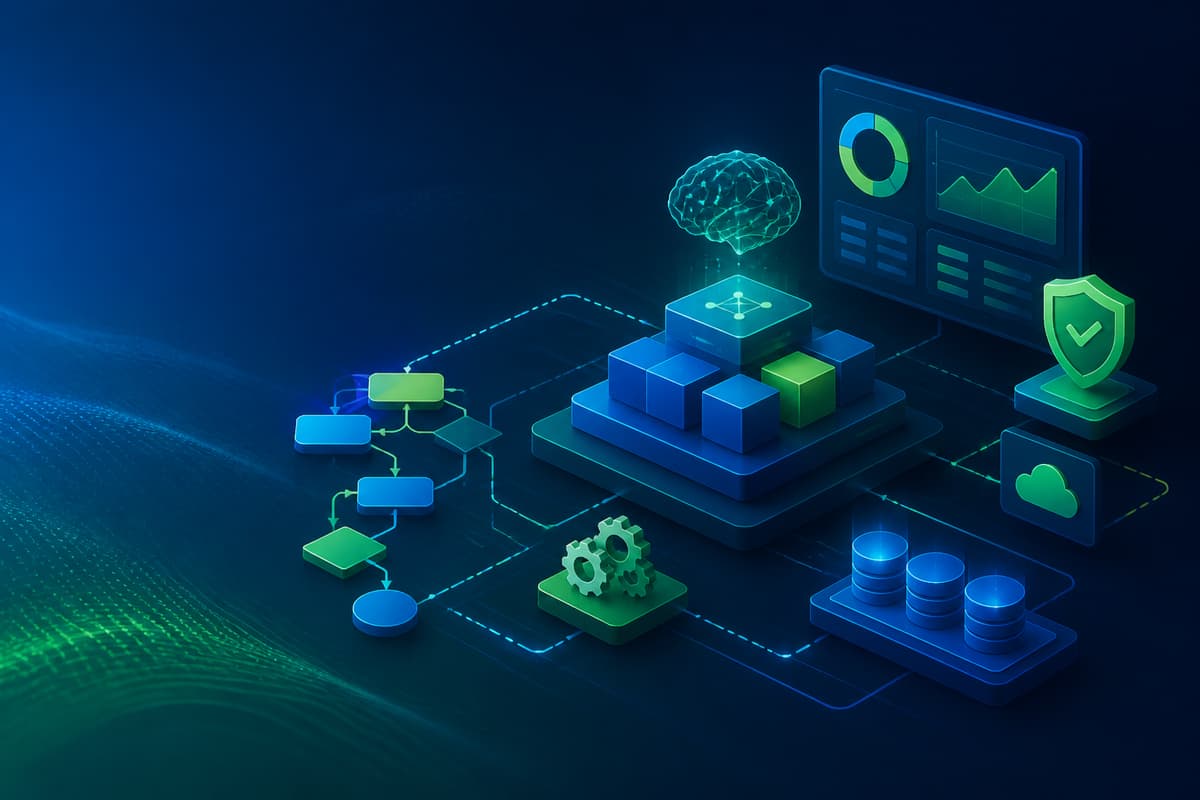
AI-assisted engineering has shifted the bottleneck from writing code to operating change. Release volume is rising, blast radius is harder to reason about, and the cost of “mostly fine” deployments shows up later as latency, incident load, and security exposure. CTOs are starting to see the same requirement across reliability and security: operational decisions need to be automated from explicit models of how the system behaves.
Stripe’s database remediation work is a strong example of the new posture. The team modeled global infrastructure relationships as a graph, then used graph search plus state machines to automate incident recovery steps that previously required expert humans to reason through dependencies and safe actions (InfoQ: “Stripe Uses Graph Search and State Machines to Automate Database Remediation”). The key shift is not “better runbooks.” The key shift is executable system knowledge, expressed as a graph of dependencies and a state machine of allowed transitions.
OpenAI’s performance engineering narrative describes the other side of the same coin: agentic workflows increase code change volume dramatically, and the systemic cost shows up beyond GPUs. The talk frames performance as an end-to-end property affected by deployment velocity, hidden coupling, and the operational overhead of rapid shipping (InfoQ: “Keeping ChatGPT Fast as AI Development Accelerates”). When change volume rises, human review and manual performance triage stop scaling. Engineering leaders need mechanisms that continuously validate, gate, and remediate without waiting for a human to connect the dots.
Security is converging on the same model-driven approach. Cloudflare’s Precursor uses continuous behavioral analysis (mouse movement, keyboard timing, session interaction patterns) to detect bots and AI agents that look increasingly human at the HTTP layer (InfoQ: “Cloudflare's Precursor Detects Bots and AI Agents Through Continuous Behavioral Analysis”). The perimeter is no longer a static set of signatures or rules. The perimeter becomes a continuously evaluated model of “normal” interaction, updated as automation gets better at mimicry.
Practical takeaways for CTOs:
- Invest in system modeling as a first-class artifact, dependency graphs, service maps, state machines, and invariants that can drive automation. Treat model drift as production risk.
- Turn incident response into software. Automate diagnosis and remediation for the repeatable 60%, and require every major incident to produce new executable logic, not just a document.
- Make performance and security continuous, not episodic. Add automated checks that run on every change, and couple them to progressive delivery so rollback and mitigation are fast.
- Align org design to the new constraint. Reliability engineering, security engineering, and platform teams need shared ownership of the models and the automation pipelines that act on them.
Teams that keep relying on humans to interpret dashboards and run playbooks will fall behind the change rate. The near-term advantage will go to orgs that can encode operational knowledge into models and let automation execute safely at machine speed.
Sources
▶ Interactive tool
Put this into practice — free, no sign-up
Run your own numbers in this interactive tool built for exactly this decision.