AI Agents Are Becoming Production Software: Governance, Data Modeling, and Cost Controls Are the New Differentiators
AI is entering its “production era”: agents are being treated like governed software services, not experiments—driven by new runtimes and guardrails, better data modeling foundations, and hard...
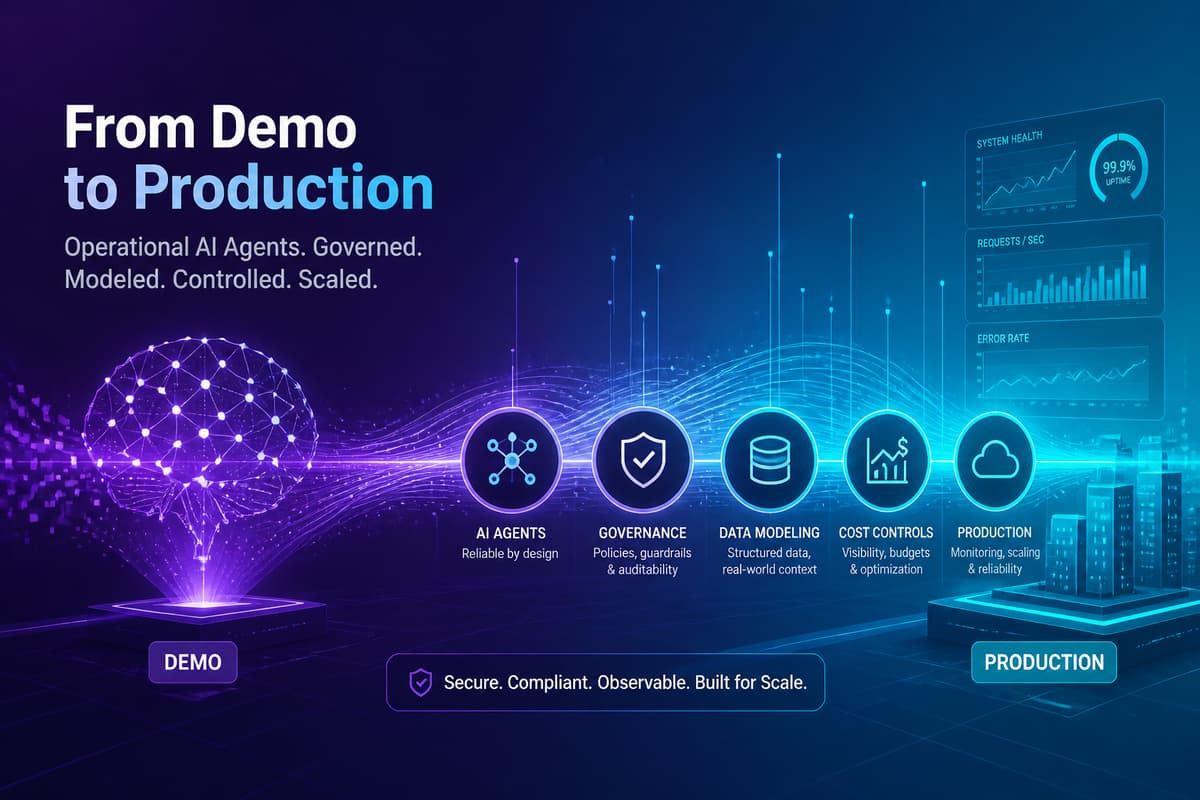
The last year rewarded teams that could demo AI. The next 12 months will reward teams that can operate it. In the past 48 hours of writing from vendors, practitioners, and regulators, a clear pattern is emerging: AI agents are being pulled into the same gravity well as any other production system—governance, repeatability, cost controls, and data correctness are now the constraints that matter.
First, the stack is hardening around “agent ops.” Microsoft is explicitly positioning Foundry as the place where agents move “from experiments to production systems,” adding runtime, tooling, and governance rather than just model access (InfoQ). In parallel, Salesforce’s learnings from 20,000 enterprise agent deployments read less like prompt advice and more like a field guide to operational reality—agents that deliver value have clear scopes, reliable integrations, and measurable outcomes; the rest stall after the demo (ByteByteGo). The meta-signal: enterprises are standardizing the “how” of agents (execution environment, permissions, evaluation, rollback) because ad-hoc agent implementations don’t scale.
Second, data architecture is reasserting itself as the limiting factor for AI reliability. dbt’s blunt framing—“Your AI isn’t broken. Your data model is.”—matches what many teams are experiencing: PoCs succeed on curated datasets, but production fails when definitions drift, lineage is unclear, and entities aren’t modeled consistently (dbt). Airbnb’s write-up on evolving data architecture for a multi-product world reinforces the same foundational need: consistent, flexible modeling patterns that survive organizational and product expansion (Airbnb Engineering). For CTOs, the synthesis is important: “agent quality” is increasingly a downstream property of your semantic layer, not your model choice.
Third, production pressure exposes second-order constraints: cost, security, and interoperability. Token spend is becoming a first-class architectural concern—routing, caching, and model selection are now part of system design, not procurement (ByteByteGo). Secrets and identity hygiene are also moving up the priority stack as agents touch more systems; automated credential rotation and LDAP secrets management (e.g., Vault Enterprise updates) signal renewed focus on operational security fundamentals (InfoQ). And outside the datacenter, regulation is shaping product boundaries: the EU pushing Meta to open WhatsApp to rival AI chatbots is an interoperability forcing function that will ripple into API strategy, platform risk, and vendor dependency calculations (BBC).
What should CTOs do now? Treat agents as a software platform problem, not an app feature. Concretely: (1) establish an “agent runtime” standard (execution, permissions, audit logs, evals, rollbacks) before teams proliferate bespoke frameworks; (2) invest in semantic consistency—define canonical entities/metrics and enforce lineage, because this is where production reliability is won; (3) implement cost controls as architecture (smart routing, budgets, caching, graceful degradation), not as after-the-fact finance reporting; and (4) assume interoperability and governance requirements will tighten—design integrations and data access with portability and auditability from day one.
The organizations that win won’t be the ones with the most agents. They’ll be the ones that can ship and operate agents safely: governed like production services, grounded in a durable data model, and constrained by explicit cost/security guardrails.
Sources
- https://www.infoq.com/news/2026/06/microsoft-foundry-agents/
- https://blog.bytebytego.com/p/what-salesforce-learned-from-20000
- https://www.getdbt.com/blog/your-ai-isn-t-broken-your-data-model-is
- https://medium.com/airbnb-engineering/scaling-beyond-one-how-airbnb-evolved-its-data-architecture-for-a-multi-product-world-6125645d470c
- https://blog.bytebytego.com/p/token-spend-out-of-control-the-case
- https://www.infoq.com/news/2026/06/ibm-hashicorp-vault-ldap-secrets/
- https://www.bbc.com/news/articles/cn8qj8wjgxwo
▶ Interactive tool
Put this into practice — free, no sign-up
Run your own numbers in these interactive tools built for exactly this decision.