AI Is Becoming an Operational Budget Line, Not a Feature: The Rise of FinOps-for-AI and Local-First Execution
CTOs are entering an “AI operations” phase where model usage, data infrastructure, and observability are being redesigned around cost governance, predictable performance, and developer-controlled...
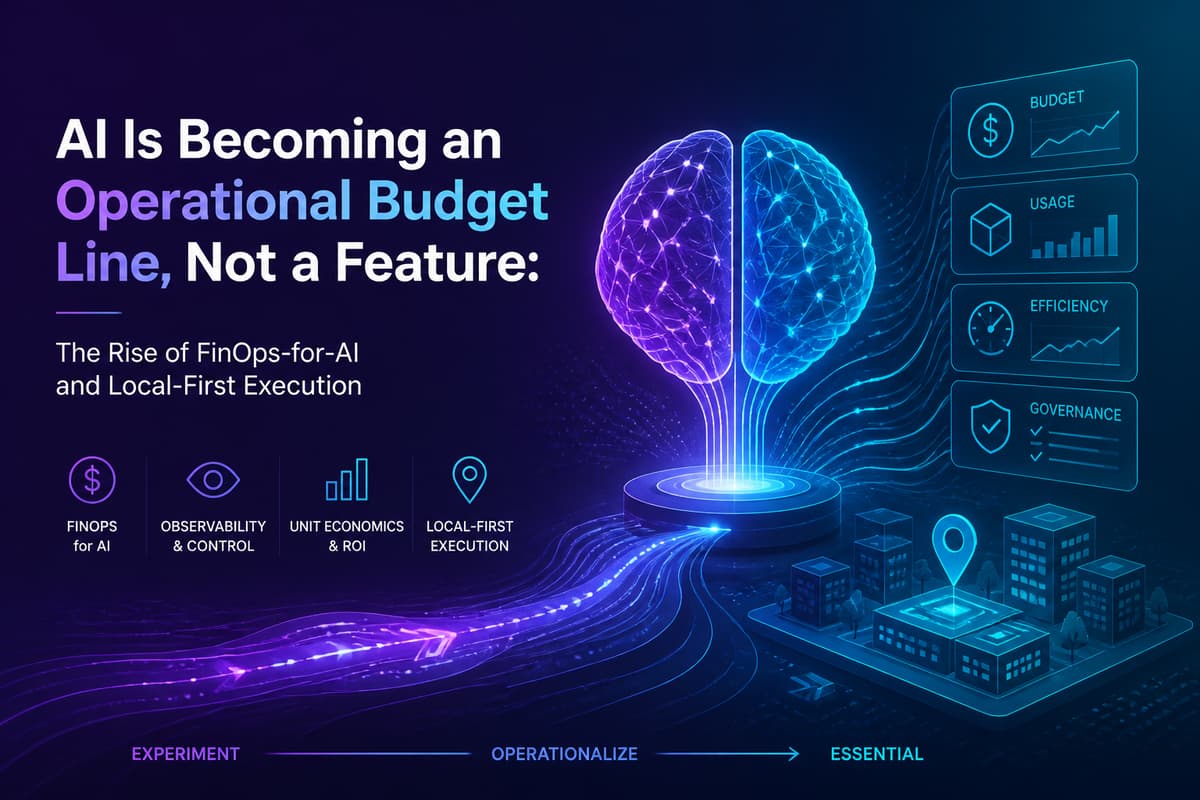
AI adoption has moved past experimentation, and the new bottleneck is operational: controlling spend, keeping systems debuggable, and making performance predictable. Recent coverage shows vendors and teams treating AI workloads like any other production platform concern, with quotas, retention tiers, and repeatable tooling. CTOs who keep framing AI as a “model choice” problem are going to miss where the real leverage is showing up.
Local-first execution is accelerating, and the signal is hard to ignore. TechCrunch reports Ollama raising $65M while growing to nearly 9M users, a reminder that many developers want models running on their own machines, with tight feedback loops and fewer centralized dependencies (https://techcrunch.com/2026/07/09/popular-open-source-ai-developer-tool-ollama-raises-65m-grows-to-nearly-9m-users/). Local execution changes the control plane: procurement and GPU allocation matter, but so do policy, model distribution, and how developers graduate prototypes into governed production endpoints.
At the same time, AI spend is getting formalized. Snowflake is explicitly pitching “FinOps for AI” with budgets, per-user quotas, and granular usage views, which is the language of operational governance rather than innovation theater (https://www.snowflake.com/en/blog/ai-finops-cost-management-governance-snowflake/). AWS is making similar cost-and-operations moves in adjacent layers, for example OpenSearch “writable warm storage” positioned to cut costs while keeping historical data mutable (https://aws.amazon.com/blogs/big-data/cut-costs-and-simplify-operations-with-writable-warm-storage-in-amazon-opensearch-service/). The combined pattern: AI programs are being forced into the same accountability structures as cloud spend, with sharper internal chargeback and clearer guardrails.
Observability and data infrastructure are being pulled into the AI cost conversation as first-class drivers. Charity Majors argues ClickHouse-style columnar storage is “winning the observability wars,” largely because cost and scale characteristics are better aligned with modern telemetry volumes (https://charity.wtf/p/have-you-heard-clickhouse-is-winning). dbt is making a parallel pitch that data infrastructure modernization yields measurable capacity returns even when budgets stay flat (https://www.getdbt.com/blog/data-infrastructure-productivity-gains). AI workloads amplify both pressures: more events, more pipelines, more experimentation, more retention, and more demand for fast root-cause analysis when agents or model-backed features misbehave.
CTO-level implications land in architecture and operating model, not model selection. Teams will need an explicit “AI control plane” that covers (1) identity and quota enforcement for model usage, (2) cost attribution down to user, team, and feature, (3) standardized telemetry for prompts, tool calls, and model responses, and (4) data retention tiers that keep debugging viable without bankrupting the business. InfoQ’s story about OpenAI debugging a long-standing libunwind issue by treating failures like epidemiology illustrates the direction: reliability work becomes a data problem, and the organization needs the instrumentation and discipline to isolate interacting faults across hardware, OS, and application layers (https://www.infoq.com/news/2026/07/openai-libunwind-core-dumps/).
Actionable moves for the next quarter: define AI usage budgets and quotas before usage explodes, decide where local-first tools (like Ollama) fit in the dev-to-prod path, and update observability/data retention architecture to match AI-driven telemetry growth. Then pick one internal metric that finance and engineering both accept (cost per successful task, cost per 1k tool calls, or cost per resolved incident) and operationalize it. AI roadmaps that cannot be priced and debugged will stall, regardless of model quality.
Sources
- https://techcrunch.com/2026/07/09/popular-open-source-ai-developer-tool-ollama-raises-65m-grows-to-nearly-9m-users/
- https://www.snowflake.com/en/blog/ai-finops-cost-management-governance-snowflake/
- https://aws.amazon.com/blogs/big-data/cut-costs-and-simplify-operations-with-writable-warm-storage-in-amazon-opensearch-service/
- https://charity.wtf/p/have-you-heard-clickhouse-is-winning
- https://www.getdbt.com/blog/data-infrastructure-productivity-gains
- https://www.infoq.com/news/2026/07/openai-libunwind-core-dumps/
▶ Interactive tool
Put this into practice — free, no sign-up
Run your own numbers in this interactive tool built for exactly this decision.