From AI Tools to an AI Operating Model: Outcomes, Guardrails, and Workflow Automation
AI adoption is shifting from ad-hoc tooling to an outcome-driven operating model: teams are standardizing AI in the dev workflow (PRs, automation), defining success metrics and guardrails, and...
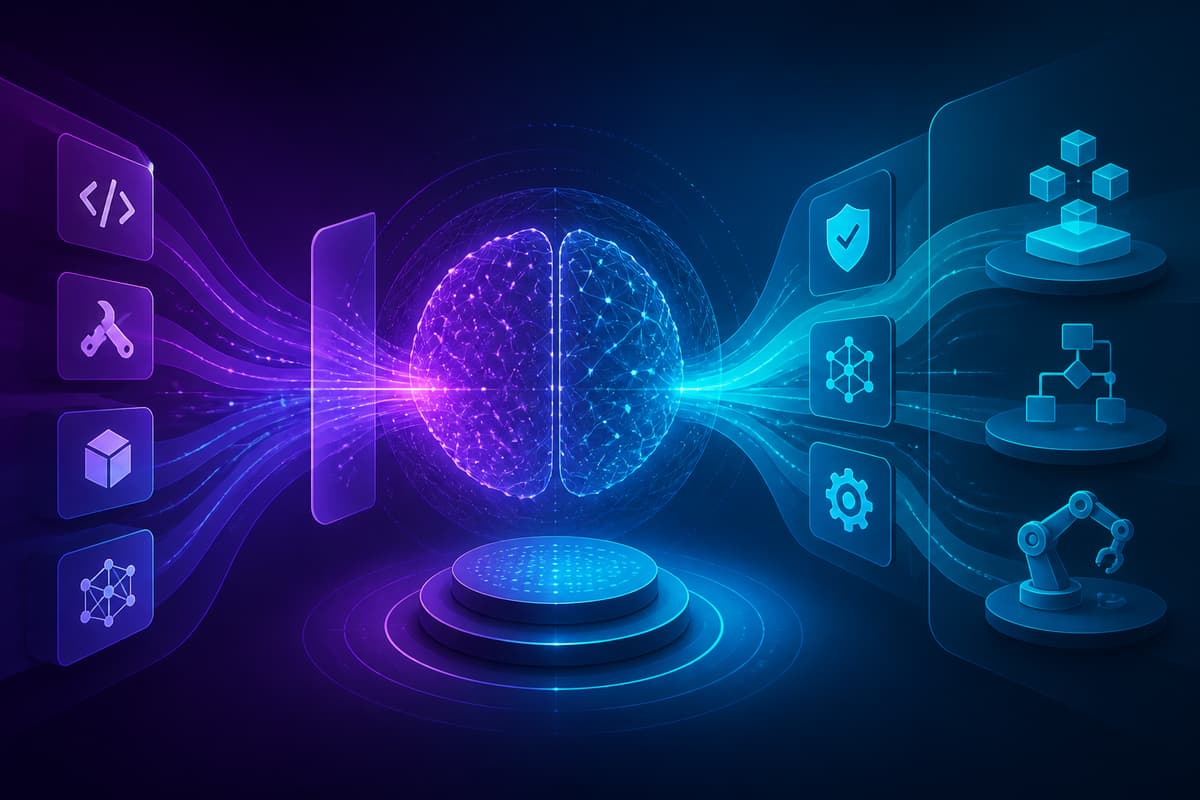
AI conversations are getting less speculative and more operational. Over the last 48 hours, several signals point to the same shift: engineering orgs are moving from “let teams try some copilots” to building an AI operating model—clear outcomes, standardized workflow integration, and explicit capability-building to keep up with AI-native competitors.
One driver is the normalization of AI directly inside the development workflow. InfoQ’s coverage of Pullfrog AI, an open-source, model-agnostic CodeRabbit-style alternative running via GitHub Actions, highlights a pattern CTOs should notice: AI isn’t only a chat interface anymore—it’s becoming CI/CD-adjacent automation (review comments, checks, policy-like gates) that can be swapped across model providers as costs, latency, or compliance needs change (InfoQ: Pullfrog AI). In parallel, platform tooling continues to evolve toward “productized” internal developer experiences—e.g., formae adding Kubernetes/Helm integration—making it easier to standardize how such automation is deployed and governed across teams (InfoQ: formae update).
A second driver is leadership teams getting explicit about what success means. Medium Engineering published a concrete articulation of “outcomes we want to see from AI,” which is the missing layer in many rollouts: not which model you picked, but which measurable changes you expect (cycle time, quality signals, support load, knowledge retrieval, editorial/ops throughput) and which failure modes you’re actively designing against (Medium Engineering). This aligns with what early-stage CTOs are reporting in the field—leaders are trading novelty for repeatability: shared practices, constraints, and “how we work” changes rather than isolated hero experiments (Refactoring: AI Club).
The competitive pressure is rising at the same time. HBR’s piece on competing against agentic startups frames the strategic reality: AI-native companies are organizing around agents and automation from day one, compressing time-to-market and redefining customer expectations (HBR). This is why the “AI operating model” matters: if incumbents treat AI as a tool choice, they’ll optimize locally; if they treat it as an operating model, they can rewire throughput, decision-making, and cost structure.
What CTOs should do now is less about picking a winner model and more about institutionalizing leverage:
- Define AI outcomes and anti-outcomes (what improves; what must not regress—security, IP leakage, correctness, brand risk). Use these to prioritize use cases.
- Standardize AI in the workflow where it compounds: PR review, test generation, migration assistance, runbook drafting, incident summarization—implemented as auditable automation (e.g., GitHub Actions bots) rather than informal chat usage.
- Design for model portability (model-agnostic interfaces, policy layers, evaluation harnesses) because cost/performance/regulatory constraints will change.
- Build organizational capability deliberately—training, peer cohorts, and shared patterns. InfoQ’s expansion into AI engineering cohorts is a signal that “production AI practice” is becoming a distinct senior skillset, not an add-on (InfoQ cohorts).
The takeaway: treat AI like a platform and an operating model, not a plugin. The teams that win won’t be the ones with the most AI tools—they’ll be the ones who can reliably turn AI into shorter feedback loops, safer automation, and defensible execution speed.
Sources
- https://medium.engineering/outcomes-we-want-to-see-from-ai-at-medium-engineering-10891d52a19f?source=rss----2817475205d3---4
- https://www.infoq.com/news/2026/05/pullfrog-ai-github/
- https://hbr.org/2026/05/how-to-compete-against-agentic-startups
- https://refactoring.fm/p/insights-from-our-first-ai-club
- https://www.infoq.com/news/2026/05/formae-k8s-helm-integration/
- https://www.infoq.com/news/2026/05/online-cohort-certification-prog/
▶ Interactive tool
Put this into practice — free, no sign-up
Run your own numbers in these interactive tools built for exactly this decision.