From Copilots to Governed Agents: Why Metadata and Service Topology Just Became AI Infrastructure
AI is shifting from code generation copilots to agentic systems that execute scoped tasks, while data platforms and infra teams are building the governance and “system maps” (metadata, service...
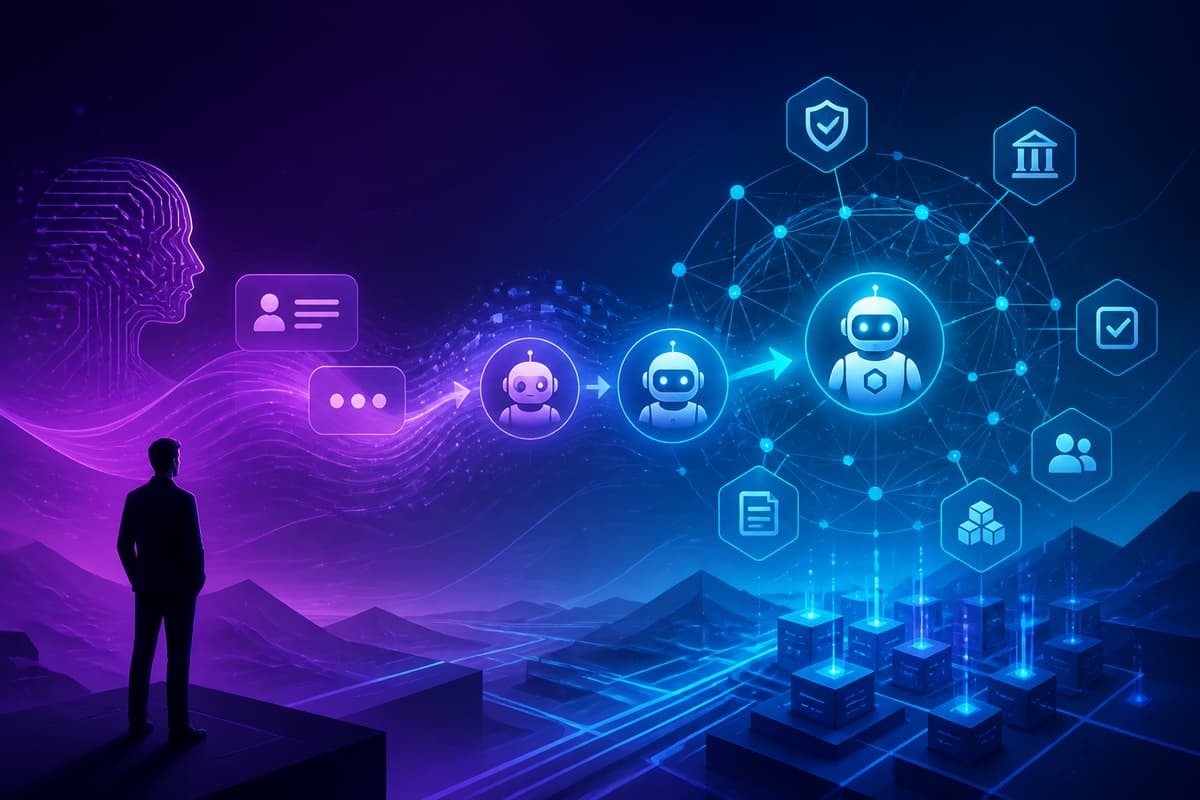
Engineering leaders are watching AI move past autocomplete and into execution. The last year was about copilots; the next phase is about agents that can take a ticket, make changes, run tests, and open a PR—or migrate infrastructure—inside clearly defined guardrails. The CTO implication is immediate: agentic capability isn’t just a model choice, it’s an operating model and a platform architecture problem.
Two signals stand out. First, Dropbox describes a deliberate shift “beyond code generation” toward agentic systems that execute scoped tasks, and the need to build internal platforms that support those workflows (tooling, permissions, evaluation, and safe execution) Dropbox Tech. Second, InfoQ highlights an AI-assisted migration that moved dozens of Kubernetes ingress resources in minutes—an early example of agents doing real operational work, not just suggesting snippets InfoQ. These are not isolated “cool demos”; they’re precursors to a new default expectation: routine engineering changes should be automatable.
But execution requires context and controls—this is where the parallel trend matters. Snowflake is explicitly positioning the data platform as the governed surface area for agentic AI (e.g., Claude Opus 4.8 on Cortex AI) and pushing “metadata hub” concepts to unify governance across the data estate without moving data Snowflake, Snowflake. In the infrastructure layer, Netflix describes building a real-time service map to understand dependencies and speed troubleshooting—effectively a living topology graph of the system Netflix Tech Blog. Put these together and you get the missing ingredient for reliable agents: a continuously updated model of “what exists, who owns it, what depends on it, and what policies apply.”
The cautionary counter-signal is reliability and vendor risk. InfoQ reports Google Cloud’s automated systems suspended Railway’s production account without notice, causing an eight-hour outage affecting millions InfoQ. As you introduce agents that can change production systems faster than humans, you also amplify the consequences of opaque automation—whether it’s a cloud provider’s control plane or your own internal agent pipeline. The lesson for CTOs: agentic velocity without explicit blast-radius design and transparent governance is just outage acceleration.
Actionable takeaways for CTOs:
- Treat metadata + topology as first-class AI infrastructure. Invest in a “system map” (service catalog, ownership, dependencies, runtime signals) and a “data map” (catalog, lineage, policy) so agents have authoritative context and your org can audit actions.
- Design agent guardrails like production controls. Require scoped permissions, change windows for high-risk actions, policy-as-code checks, and mandatory human approval thresholds based on impact (not on who initiated the change—human or agent).
- Measure productivity at the workflow level, not the tool level. Track lead time, rework rate, incident rate, and review load for agent-produced changes; don’t over-index on “lines of code written by AI.”
- Plan for control-plane failure modes. Build runbooks and architectural mitigations for external automation surprises (account suspensions, API throttling, policy changes), and ensure you can degrade gracefully when a provider or internal agent platform is unavailable.
The emerging pattern is that “agentic engineering” is becoming a platform capability, not a collection of developer tools. The winners will be organizations that pair execution (agents) with understanding (service topology) and control (metadata-driven governance)—so speed increases while risk stays bounded.
Sources
- https://dropbox.tech/culture/beyond-code-generation-rethinking-engineering-productivity-in-the-age-of-ai-agents
- https://www.infoq.com/news/2026/05/ai-nginx-higress/
- https://www.snowflake.com/en/blog/claude-opus-4-8-snowflake-cortex-ai/
- https://www.snowflake.com/en/blog/snowflake-horizon-metadata-hub/
- https://netflixtechblog.com/from-silos-to-service-topology-why-netflix-built-a-real-time-service-map-0165ba13a7bc
- https://www.infoq.com/news/2026/05/railway-gcp-account-outage/
▶ Interactive tool
Put this into practice — free, no sign-up
Run your own numbers in this interactive tool built for exactly this decision.