Agentic AI Is Becoming a Stateful Platform Problem: Memory, Security, and Cost
Agentic AI is entering a production phase where memory, interaction protocols, and security controls matter more than raw model capability.
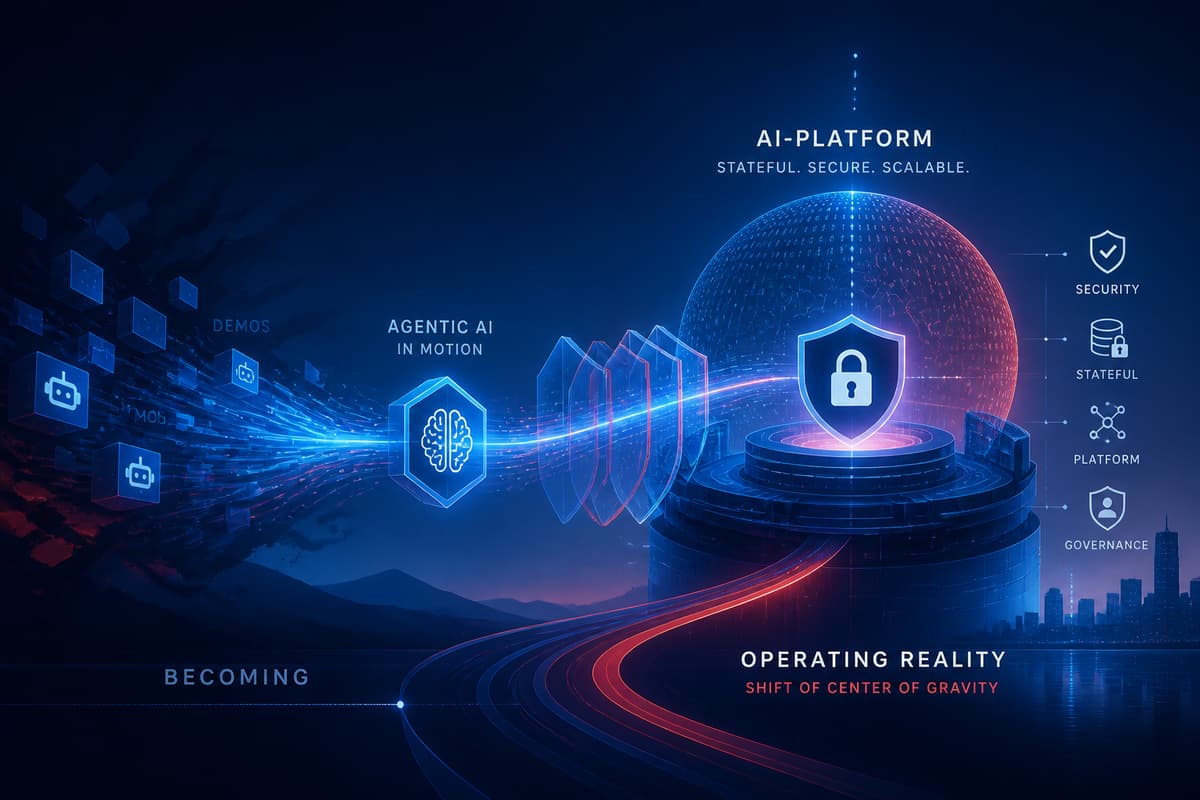
Agentic AI is moving from demos into operating reality, and the center of gravity is shifting. Model choice still matters, but production outcomes are being decided by the surrounding system: memory, tool orchestration, security boundaries, and unit economics. Engineering leaders are now being asked to run agents like services with state and lifecycle, not like a prompt-and-response feature.
Cost pressure is accelerating adoption. TechCrunch reports Anthropic launching Claude Sonnet 5 positioned as a cheaper way to run agents, explicitly framing agentic capability as something teams will execute at high volume, not occasionally (TechCrunch). Lower inference cost increases the number of agent calls per workflow, which increases the blast radius of mistakes, and it turns observability, rate limits, and rollback paths into first-order concerns.
Meanwhile, the agent stack is solidifying around “state.” ByteByteGo’s deep dives on interaction models and agent memory highlight the practical constraint: agents forget, drift, and repeat work without an explicit memory architecture (ByteByteGo, ByteByteGo). InfoQ adds a concrete implementation signal: Elastic open-sourced Atlas Agent Memory, with separate memory categories, per-user isolation, and integration via MCP (InfoQ). The pattern looks increasingly like a platform layer: a standardized interface for tools plus a governed state store that can be inspected, segmented, and expired.
Security and quality are the forcing functions. InfoQ’s presentation on “Trustworthy Productivity” describes vulnerabilities hidden inside agent loops (for example, ReAct-style patterns) across context and tool calls, which is where prompt injection and data exfiltration tend to land in real systems (InfoQ). BBC’s report on Ford rehiring human engineers after AI failed to match quality checks underscores the organizational implication: agent systems that cannot explain decisions, handle edge cases, or demonstrate consistent accuracy will be rolled back, regardless of the hype cycle (BBC). Production trust is earned through controls and measurement, not aspiration.
CTOs should treat agentic AI as a stateful platform program with clear contracts. Start by separating concerns: the model provider, the orchestration layer, the memory layer, and the policy layer (authz, redaction, audit). Require per-user and per-tenant memory isolation, explicit retention windows, and a reviewable “agent transcript” that includes tool inputs and outputs, not only chat text. Enforce allowlisted tools, scoped credentials, and deterministic fallbacks when confidence is low or when tool output violates schema.
Action items for the next quarter: (1) define an “agent SLO” that includes cost per successful task, tool error rate, and human escalation rate, (2) implement an agent security gate for context ingestion and tool execution (input sanitization, output validation, least-privilege), and (3) decide where memory lives and who owns it (platform, data, or product engineering). Agentic AI is becoming a software supply chain with state, and the teams that build the guardrails early will ship faster with fewer reversals.
Sources
- https://techcrunch.com/2026/06/30/anthropic-launches-claude-sonnet-5-as-a-cheaper-way-to-run-agents/
- https://www.infoq.com/presentations/ai-development/
- https://www.infoq.com/news/2026/06/elastic-atlas-agent-memory/
- https://blog.bytebytego.com/p/how-ai-agents-manage-memory-and-avoid
- https://blog.bytebytego.com/p/inside-thinking-machines-interaction
- https://www.bbc.co.uk/news/articles/cgrkd41n2v9o
▶ Interactive tool
Put this into practice — free, no sign-up
Run your own numbers in these interactive tools built for exactly this decision.