Mid Week Summary: AI Governance, FinOps, and the Agent Control Plane (Plus Data Platform Decisions)
The pattern this week: “AI features” are turning into operational risk
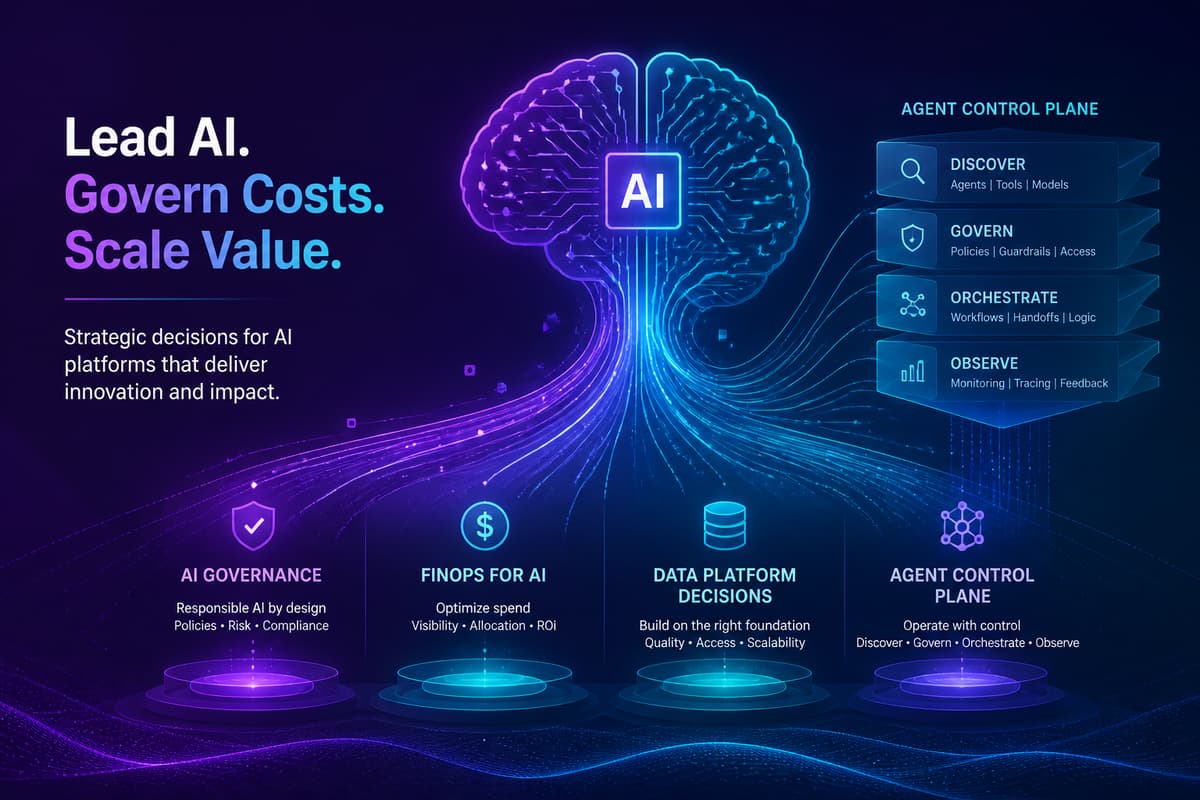
Table of Contents
The pattern this week: “AI features” are turning into operational risk
The loudest signal across the last seven days was a shift in what teams are optimizing for. The conversation moved away from model novelty and toward operating discipline: policy, spend controls, provenance, and reliability. You can feel it in the news cycle too, where AI wins are getting measured in reduced inference cost, fewer moderation mistakes, and fewer compliance surprises, not prettier demos.
What we published: governance becomes architecture, not paperwork
We published a cluster of pieces that all land on the same point: enterprise AI is entering an ops-and-governance phase. Start with Enterprise AI Is Moving From Prototypes to Governed Operations, then pair it with The AI Ops-First Era: Pipelines, Security Engineering, and Proof-of-Human. Both posts treat security, abuse resistance, and data pipeline discipline as the gating items for shipping AI into real products, not “nice-to-haves” for later.
The strongest “new stack” idea this week was the control-plane framing. The Agent Control Plane Is Arriving: Auth, Metadata, and Payments Move Into Core Infrastructure connects identity, authorization, audit context, and quota or payment rails into one coherent layer so agents can safely take actions. That ties directly into From Chatbots to Governed Agents: The New Enterprise AI Stack CTOs Are Building Right Now and AI Platforms Are Becoming Production Infrastructure: SLOs, Lineage, and Guardrails, where the differentiator becomes SLOs, lineage, and guardrails, not prompt cleverness.
The “boring” decisions that matter: data, delivery, and sovereignty
A second thread in our publishing was pragmatic CTO decision-making, the stuff that quietly determines whether the AI program survives contact with production. The database and delivery guides are worth skimming when you need to standardize quickly: ClickHouse vs Cassandra, DynamoDB vs PlanetScale, DynamoDB vs Oracle, plus the CI/CD and GitOps clarity pieces ArgoCD vs CircleCI, CircleCI vs Argo CD, and Argo CD vs Azure DevOps for Kubernetes Delivery on Azure.
Meanwhile, sovereignty constraints moved from “legal asks” into platform design. Sovereignty-by-Design Moves Up the Stack lines up with the week’s Daily Sync notes on cloud availability gaps and hardened residency choices, especially Daily Sync: July 6, 2026 and Daily Sync: July 8, 2026. The practical takeaway is uncomfortable but useful: control plane placement, telemetry locality, and AI feature availability are now coupled decisions.
What the wider market said: cost control, reliability, and trust are the new battlegrounds
External coverage reinforced the same themes from different angles. On cost and compute, TechCrunch covered both new “make inference cheaper” tooling and fresh capital flowing into silicon: ZML releasing ZML/LLMD to speed inference across heterogeneous chips (TechCrunch, July 8, 2026: https://techcrunch.com/2026/07/08/hot-french-startup-zml-releases-free-product-to-speed-inference-across-lots-of-ai-chips/) and SambaNova raising $1B at an $11B valuation (TechCrunch, July 8, 2026: https://techcrunch.com/2026/07/08/sambanova-draws-1b-at-11b-valuation-in-series-f-first-close/). The “AI margins” point we kept hitting in Daily Sync: July 7, 2026 showed up again when TechCrunch reported Microsoft relying more on its own models to cut AI costs (TechCrunch, July 7, 2026: https://techcrunch.com/2026/07/07/microsoft-joins-ai-cost-cutting-trend-by-relying-more-on-its-own-models/).
On reliability and governance in practice, InfoQ highlighted AWS expanding its DevOps Agent with AI-powered release management checks (InfoQ, July 7, 2026: https://www.infoq.com/news/2026/07/aws-devops-ai-agent/?utm_term=global), which maps neatly to our “agent control plane” and “ops-first” framing. Snowflake’s post on FinOps for AI (Snowflake Blog, July 7, 2026: https://www.snowflake.com/content/snowflake-site/global/en/blog/ai-finops-cost-management-governance-snowflake) echoed our repeated theme that quotas, budgets, and usage attribution are becoming first-class product requirements for internal AI platforms. And the “trust gap” got a real-world reminder: TechCrunch reported Discord’s AI moderation bug that wrongfully banned users (TechCrunch, July 7, 2026: https://techcrunch.com/2026/07/07/discord-admits-ai-moderation-bug-wrongfully-banned-users-over-harmless-images/), while Cambridge Judge research argued healthcare’s AI bottleneck is trust, not capability (Cambridge Judge Business School, July 7, 2026: https://www.jbs.cam.ac.uk/2026/healthcares-ai-problem-isnt-technology-its-trust/).
What to take back to your team
The week’s connective tissue is simple: every serious AI roadmap is becoming an infrastructure roadmap. Our internal pieces argue for SLOs, lineage, and policy controls as the foundation, and the external news shows the same pressures playing out as cost-cutting, reliability automation, and public trust failures. If you only do one concrete thing after reading, make the control plane real: define agent identity and authorization, require auditable context and metadata, put quotas and spend attribution in the request path, and treat governance like production engineering. The rest of the stack choices get easier once that layer is non-negotiable.
If you want the fast scan version of the week’s signals, the Daily Syncs are the best entry point: July 8, July 7, July 6, July 5, July 4, July 3, July 2, and July 1. For sector-specific context, the Industry Outlook set from July 6 is also worth a pass: SaaS, Banking, Healthcare, Insurance, Telecoms, Hardware & Semiconductors, Ecommerce, and Media & Gaming.
▶ Interactive tool
Put this into practice — free, no sign-up
Run your own numbers in these interactive tools built for exactly this decision.