The New Agentic Stack: Cost, Reliability, and Governance Are Becoming the Differentiators
AI agents are rapidly becoming a production workload, forcing a new CTO playbook: optimize token/tool spend, build internal agent platforms, and pair scale with governance, reliability, and...
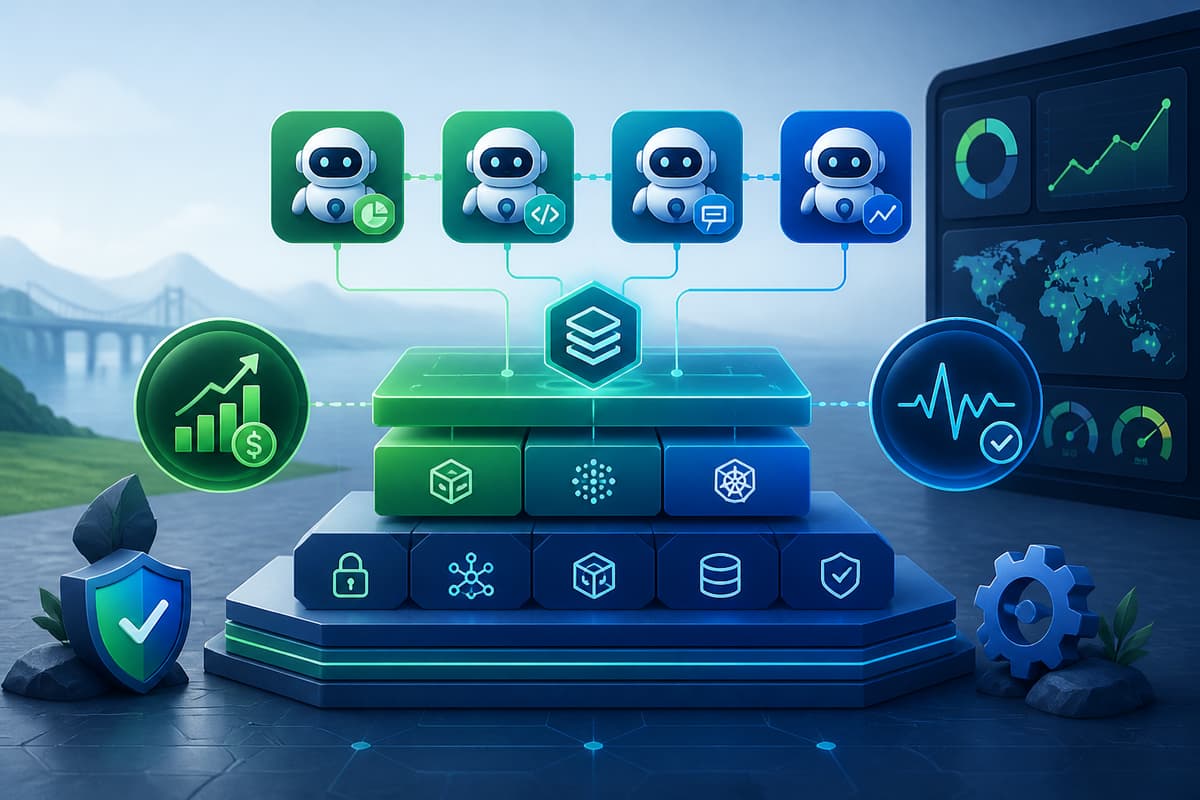
Agentic AI is having its “productionization moment.” Over the last 48 hours, multiple teams described the same shift: the hard part is no longer getting an agent to do something impressive—it’s making agentic workflows economical, reliable, and governable enough to run every day inside real engineering and business processes.
On the cost front, GitHub’s report of cutting token spend up to 62% is a telling signal of where waste hides in early agent deployments: tool sprawl and unnecessary calls. Their approach—pruning unused MCP tools, swapping some calls for simpler CLI operations, and running daily “auditor”/“optimizer” agents—looks like the beginning of FinOps, but for agent behavior and toolchains rather than cloud resources alone (InfoQ: “GitHub Slashes Agent Workflow Token Spend…”). The meta-lesson for CTOs: agent cost isn’t just “model choice”; it’s workflow design, tool selection, and continuous optimization loops.
At the same time, teams are building the internal platforms required to make agents safe and repeatable. Dropbox explicitly frames the move “beyond code generation” toward agentic systems that execute scoped tasks—and notes they’re building platforms to support those workflows (Dropbox Tech: “Beyond code generation…”). Databricks complements this with the infrastructure view: if agents are going to be embedded across products and operations, inference must behave like a tier-1 service with reliability patterns, capacity planning, and predictable performance (Databricks: “Reliable LLM Inference at Scale”). Together, these point to an architectural shift: agents are becoming a first-class workload that needs a platform team mindset (observability, guardrails, evaluation, rollout controls), not a collection of ad-hoc integrations.
Governance is the third leg of the stool—and it’s increasingly coupled to data platforms. Snowflake’s announcement of Claude Opus 4.8 on Cortex AI positions “secure governed AI” as the adoption wedge, while Databricks’ push around Iceberg v3 GA, open sharing, and unified governance underscores that the catalog and policy layer is becoming the control plane for AI-enabled enterprises (Snowflake: “Claude Opus 4.8 on Snowflake Cortex AI”; Databricks: “Advancing Apache Iceberg…”). Outside the vendor stack, the pressure is rising: InfoQ highlights EU regulation themes around accountability and transparency (InfoQ: “Accountability is the Goal for AI…”), while LSE maps how governments are formalizing AI governance models, which will cascade into procurement, compliance expectations, and cross-border operations (LSE: “How countries write their AI strategies…”).
What should CTOs do now? First, treat agent programs as a product with unit economics: define token budgets, instrument cost per task, and implement “agent hygiene” (tool pruning, caching, prompt/tool routing) as a continuous practice—not a one-time optimization. Second, invest in an “agent platform” capability: standardized execution environments, permissioning, audit logs, evaluation harnesses, and rollback controls. Third, align governance early: connect agents to your data catalog/policy layer, and ensure accountability requirements (traceability, human oversight, risk classification) are designed into workflows—especially for customer-impacting or regulated domains.
The takeaway: in 2024–2025, the differentiator was access to better models. In 2026, the differentiator is operational excellence—cost control, reliability engineering, and governance-by-design. CTOs who build these capabilities now will be able to scale agents broadly; those who don’t will either cap usage due to risk/cost, or ship brittle systems that can’t survive real-world load and scrutiny.
Sources
- https://www.infoq.com/news/2026/05/github-agentic-token-savings/
- https://dropbox.tech/culture/beyond-code-generation-rethinking-engineering-productivity-in-the-age-of-ai-agents
- https://www.databricks.com/blog/reliable-llm-inference-scale
- https://www.snowflake.com/en/blog/claude-opus-4-8-snowflake-cortex-ai/
- https://www.databricks.com/blog/unity-catalog-and-next-era-apache-icebergtm
- https://www.infoq.com/news/2026/05/accountability-AI-EU-regulations/
- https://blogs.lse.ac.uk/businessreview/2026/05/28/how-countries-write-their-ai-strategies-mapping-the-many-models-of-governance/
▶ Interactive tool
Put this into practice — free, no sign-up
Run your own numbers in these interactive tools built for exactly this decision.